
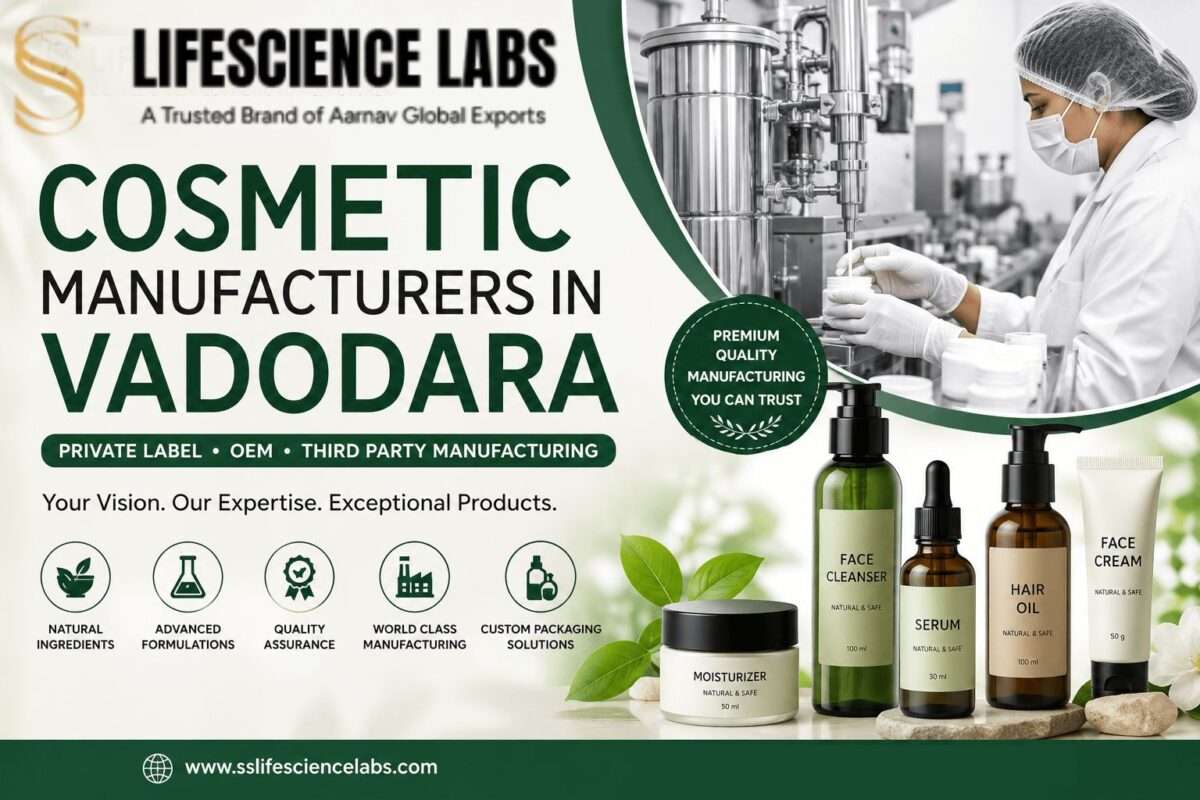
Cosmetic Manufacturers in Vadodara: Complete Private Label & OEM Guide 2026
India’s beauty and personal care industry is entering a phase where launching a cosmetic brand is easier than before, but building a brand consumers repeatedly choose is considerably harder. Customers now compare ingredients, product experience, packaging, positioning and value before making a purchase. Behind all of these visible elements sits one decision that can influence almost everything that follows: choosing the right manufacturing partner.
For a startup planning its first skincare range or an established company expanding into new categories, researching cosmetic manufacturers in Vadodara should therefore involve much more than collecting quotations. A suitable manufacturer needs to align with the brand’s product category, quality expectations, manufacturing model, quantity requirements, packaging plans and future growth.
Vadodara is part of Gujarat’s significant industrial landscape, making it a relevant location for companies researching manufacturing opportunities. However, a beauty business does not have to restrict its supplier search to one city. Comparing local options with a broader Cosmetic Products Manufacturer in India can help decision-makers understand differences in capabilities, product categories and manufacturing support before making a commitment.
This 2026 guide explains how private label, OEM, custom and third-party cosmetic manufacturing work, what businesses should compare, which questions matter before production, and how to select a manufacturing partner without allowing price alone to determine the decision.
What Do Cosmetic Manufacturers in Vadodara Actually Do?
A cosmetic manufacturer transforms a product concept or defined requirement into a commercially manufacturable product. Depending on the company’s capabilities, this may include formulation selection, customization, raw-material sourcing, batch manufacturing, filling, packaging coordination and quality-related processes.
Consider a skincare startup that wants to launch a facial cleanser, serum and moisturizer. The founders may understand their audience and desired market positioning but lack an in-house production facility. Instead of investing heavily in machinery, manufacturing infrastructure and a dedicated production team, they can evaluate an external manufacturing partner.
The arrangement can vary considerably. Some businesses require relatively ready-to-market private label products, while others want greater control over formulation and specifications. Established companies may simply want to outsource production.
This is where models such as private label, OEM and third-party manufacturing become important.
A company researching a manufacturer should therefore begin with one question:
“What exactly do we need the manufacturer to do for our brand?”
Until that question is answered, comparing suppliers accurately is difficult.
Why Is Vadodara Relevant for Cosmetic Manufacturing?
Vadodara has an established industrial environment and sits within Gujarat, one of India’s major manufacturing states. For beauty businesses, however, geographical location should be treated as one selection factor rather than the primary indicator of manufacturing quality.
A manufacturer located close to the brand may offer logistical advantages, but a company located elsewhere may provide stronger capabilities for a specific product category. This is why brands should compare manufacturers based on what they can actually deliver.
The same principle applies when researching different cities. A company evaluating Vadodara manufacturers may also learn from the criteria discussed while researching Cosmetic Manufacturers in Delhi, because MOQ, customization, packaging, quality processes and scalability remain important regardless of manufacturing location.
The best manufacturing decision is therefore usually based on a combination of capability + quality + commercial suitability + communication + scalability, rather than city alone.
Private Label, OEM or Third-Party Manufacturing: What Should You Choose?
One of the first decisions a beauty business needs to make is which manufacturing model fits its strategy. These terms are sometimes used interchangeably in marketing, but their practical application can differ.
| Manufacturing Model | Suitable For | Customization Level | Main Benefit |
|---|---|---|---|
| Private Label | Startups & growing brands | Low–Moderate | Faster market entry |
| OEM | Brands with defined requirements | Moderate–High | Greater product control |
| Third-Party Manufacturing | Businesses outsourcing production | Varies | Reduced manufacturing burden |
| Custom Manufacturing | Differentiated/premium brands | High | Greater product differentiation |
Private Label Cosmetic Manufacturing
Private label can be particularly attractive to businesses that want to establish their own cosmetic brand without building a production facility from scratch. Depending on the manufacturer, the brand may choose from existing product options and customize selected elements such as packaging, fragrance, presentation or other available specifications.
For businesses evaluating this route, working with an experienced Private Label Cosmetics Supplier can simplify the journey from product selection to commercial production, particularly when the manufacturer supports multiple beauty and personal care categories.
Private label should not, however, be treated as a shortcut that eliminates brand strategy. Even if the formulation is based on an existing option, the business still needs clear positioning, attractive packaging, a defined audience and a strong reason for customers to choose the product.
What Is OEM Cosmetic Manufacturing?
OEM, or Original Equipment Manufacturing, is generally relevant when a brand has more specific product or manufacturing requirements.
A company may have requirements related to texture, fragrance, ingredients, packaging, product performance or positioning. The precise degree of customization depends on the manufacturer and project.
For example, two brands could both sell facial serums while targeting completely different audiences. One may position itself around lightweight everyday skincare, while another targets a premium segment with specialized product characteristics.
The manufacturing partner must understand these differences.
When evaluating an OEM cosmetic manufacturer Vadodara, ask exactly which elements can be customized rather than relying only on the “OEM” label.
What Is Third-Party Cosmetic Manufacturing?
Third-party manufacturing allows a brand or company to outsource production to another manufacturer instead of operating its own manufacturing infrastructure.
This can be useful for startups, marketing-led beauty brands, distributors and established businesses looking to expand production.
The commercial benefit is straightforward: instead of allocating significant resources to running a manufacturing facility, the company can concentrate on areas such as:
- Brand development
- Distribution
- Sales
- Digital marketing
- Retail expansion
- Customer acquisition
- Product portfolio strategy
Third-party manufacturing does not remove the brand’s responsibility for selecting the right partner. The manufacturer still needs to meet the company’s product, quality, quantity and operational requirements.
Cosmetic Products Brands Can Consider Manufacturing
A manufacturer’s product range matters because not every supplier will have the same experience across skincare, haircare, body care, cosmetics and oils.
| Category | Examples | Important Considerations |
|---|---|---|
| Skincare | Cleansers, serums, creams, toners | Texture, positioning, ingredients |
| Haircare | Shampoo, conditioner, serum, oils | Hair concern, fragrance, usage |
| Body Care | Lotion, wash, scrub, cream | Texture, packaging, audience |
| Personal Care | Daily-use care products | Functionality and consistency |
| Oils | Essential, carrier and massage oils | Sourcing, packaging, storage |
| Beauty Products | Category-specific cosmetics | Product positioning and market |
Brands planning skincare products should specifically evaluate whether the supplier has relevant experience rather than selecting a general manufacturer only because it offers a large catalogue.
The same applies to businesses researching Cosmetic Manufacturing Companies in Delhi or another major manufacturing location. A long product list is less important than proven relevance to the products your business actually intends to sell.
Aromatherapy and Essential Oils as a Portfolio Opportunity
Beauty, personal care and wellness increasingly overlap from a branding perspective. For companies building a broader portfolio, oils can complement skincare and body-care categories when they fit the brand’s audience.
Essential oils, carrier oils and aromatherapy-focused products can have different sourcing, packaging and product-handling considerations from conventional creams or cleansers. Businesses planning this category should therefore evaluate a specialized Aromatherapy Oils Manufacturer in India rather than assuming every general cosmetic manufacturer provides the same capabilities.
This does not mean every beauty company should add oils to its range. Portfolio expansion works best when each new category supports the brand’s existing positioning and customer requirements.
How to Choose the Right Cosmetic Manufacturer in Vadodara
Selecting a manufacturing partner should follow a structured process rather than depending on one sales conversation.
Start With a Clear Product Brief
Before asking for quotations, prepare a basic product requirement document.
It should contain:
| Requirement | Example |
|---|---|
| Product | Facial Serum |
| Target Audience | Adults seeking daily skincare |
| Positioning | Premium / Mass / Professional |
| Quantity | Expected initial order |
| Manufacturing Model | Private Label / OEM |
| Packaging | Bottle / Pump / Jar / Tube |
| Customization | Required or minimal |
| Launch Timeline | Target month |
| Future Plan | Expected additional SKUs |
A clear brief improves the quality of conversations with potential manufacturers and allows different suppliers to quote against similar requirements.
Product Quality Should Come Before the Cheapest Quotation
One of the most common mistakes new beauty businesses make is comparing manufacturers primarily on price.
Suppose Manufacturer A offers a noticeably lower unit cost, while Manufacturer B provides stronger packaging coordination, better communication, suitable MOQ and more relevant product-category capabilities.
Choosing Manufacturer A solely because it is cheaper could become more expensive later if the business experiences inconsistent products, packaging problems, delays or difficulty scaling.
A more useful comparison is:
Total Manufacturing Value = Product Quality + Commercial Cost + MOQ + Support + Reliability + Scalability
This approach is also important when comparing Best Cosmetics Manufacturers in Delhi, because “best” should describe suitability for the brand’s requirements rather than simply the lowest quotation.
MOQ: A Critical Factor for Startups
MOQ means Minimum Order Quantity—the minimum production or purchase quantity required for a particular product or arrangement.
This matters enormously for startups.
Imagine a brand planning five products with three variants each. Even if the MOQ for one variant appears manageable, multiplying that requirement across the full catalogue could create a substantial initial inventory commitment.
Ask whether MOQ applies:
- Per SKU
- Per formulation
- Per fragrance
- Per shade
- Per variant
- Per packaging configuration
A focused launch with fewer hero products can often be commercially easier to manage than starting with a very large range.
Private Label vs Custom Manufacturing Comparison
| Factor | Private Label | Custom/OEM |
|---|---|---|
| Launch Speed | Usually faster | Usually requires more development |
| Initial Complexity | Lower | Higher |
| Differentiation | Moderate | Potentially higher |
| Development Requirement | Lower | Higher |
| Best For | New/growing brands | Defined/premium concepts |
| Product Control | Moderate | Greater |
| Scalability | Depends on partner | Depends on partner |
Neither option is universally superior.
A new business seeking faster market entry may find private label more practical. A brand competing through distinctive product characteristics may require greater customization.
The manufacturing model should match the business strategy, not simply industry terminology.
How Does Cosmetic Manufacturing Usually Work?
Although the exact process varies by product and supplier, the journey can broadly be understood in seven stages.
1. Requirement Discussion
The brand explains what it wants to manufacture, the intended audience, quantity, positioning and desired timeline.
2. Manufacturing Route Selection
The parties determine whether private label, OEM, third-party or a more customized approach is appropriate.
3. Product Evaluation
Where applicable, available formulations or samples are evaluated and feedback is discussed.
4. Packaging Planning
Suitable bottles, jars, pumps, tubes, labels or cartons are considered.
5. Commercial Finalization
MOQ, price, responsibilities, timelines and specifications are confirmed.
6. Production
Manufacturing takes place according to the finalized project requirements and applicable processes.
7. Filling, Packing and Dispatch
The final product is filled, packed and prepared for dispatch according to the agreed scope.
Brands should obtain project-specific details directly from the selected manufacturer because timelines and processes vary.
Packaging Can Influence the Success of the Product
Cosmetic packaging is not simply decoration. It affects functionality, customer perception, positioning and cost.
A premium skincare serum may require a very different presentation from a mass-market body lotion. Likewise, an oil-based product can have packaging requirements different from those of a cleanser or cream.
Brands should evaluate:
Container → Closure → Label → Outer Packaging → Functionality → Visual Positioning → Cost
Packaging should therefore be discussed relatively early in the manufacturing process.
What Should You Compare Between Cosmetic Manufacturers?
Instead of relying on memory after several supplier conversations, create a structured comparison.
| Selection Factor | Manufacturer A | Manufacturer B | Manufacturer C |
|---|---|---|---|
| Relevant Product Capability | /10 | /10 | /10 |
| Product Quality | /10 | /10 | /10 |
| MOQ Suitability | /10 | /10 | /10 |
| Customization | /10 | /10 | /10 |
| Packaging Support | /10 | /10 | /10 |
| Communication | /10 | /10 | /10 |
| Commercial Suitability | /10 | /10 | /10 |
| Scalability | /10 | /10 | /10 |
| Overall Score | /80 | /80 | /80 |
This type of scorecard is particularly useful when a business is comparing suppliers across multiple locations.
For instance, your research does not necessarily have to stop with Vadodara. Comparing the criteria with Top Cosmetics Manufacturers in Delhi can provide a broader benchmark before the final supplier is selected.
Should You Choose a Manufacturer Only in Your City?
Not necessarily.
A brand based in one city can work with a manufacturing company located elsewhere if logistics, quality, communication, commercial terms and production requirements are suitable.
This has become especially relevant as beauty companies expand nationally and increasingly coordinate suppliers remotely.
Yesterday’s detailed guide to Cosmetic Manufacturers in Surat also illustrates the same principle: the correct manufacturing partner should be selected according to capability and business fit, not simply the shortest geographical distance.
For some businesses, a nearby manufacturer may still provide logistical advantages. For others, a manufacturer in another region may be better aligned with the intended product range.
How Startups Should Approach Cosmetic Manufacturing in 2026
A startup should resist the temptation to launch every possible product immediately.
A more practical sequence is:
Identify Market → Define Audience → Select Category → Choose Hero Products → Compare Manufacturers → Evaluate Product → Finalize Packaging → Launch → Measure Demand → Expand
Suppose a skincare company wants to target consumers looking for a simple daily routine. Instead of launching 15 products, it might begin with three clearly connected products: cleanser, serum and moisturizer.
Marketing becomes easier because the brand has a focused story. Inventory planning is simpler, and consumer feedback can guide the second phase of expansion.
Once the initial range gains traction, additional skincare, haircare, body care or wellness products can be considered.
How Established Brands Should Evaluate Manufacturing Partners
Established companies usually have different priorities from startups.
MOQ may become less restrictive, while production capacity, repeat-order reliability, multi-category capability and operational consistency become more important.
Growing brands should ask:
- Can production quantities increase?
- Can additional categories be introduced?
- Can packaging requirements evolve?
- How are repeat orders coordinated?
- What happens when demand rises quickly?
- Is communication structured enough for larger projects?
Manufacturing decisions should account for where the business intends to be in the next few years, not only its immediate order.
Common Mistakes While Selecting a Cosmetic Manufacturer
Choosing Based Only on Price
The lowest manufacturing cost does not necessarily produce the strongest overall business outcome.
Starting With Too Many SKUs
Large catalogues increase inventory, packaging and marketing complexity.
Ignoring MOQ
MOQ should be discussed early, particularly for multiple variants.
Treating Packaging as an Afterthought
Packaging availability and suitability can influence both cost and production planning.
Not Comparing Like-for-Like Quotations
Two quotations cannot be fairly compared if they are based on different specifications.
Ignoring Future Capacity
A supplier suitable for a first launch may not necessarily be suitable when production requirements increase.
Weak Brand Positioning
Manufacturing can create the product, but the business still needs to explain why customers should buy it.
What Questions Should You Ask a Cosmetic Manufacturer?
Before finalizing a supplier, ask direct questions.
| Question | Purpose |
|---|---|
| Which categories do you specialize in? | Capability |
| What manufacturing models do you offer? | Service fit |
| What is your MOQ? | Budget planning |
| Are samples available? | Product evaluation |
| What can be customized? | Differentiation |
| What packaging support is available? | Launch planning |
| What is the expected timeline? | Scheduling |
| How do repeat orders work? | Future planning |
| Can production scale? | Growth |
| What documentation/specifications are required? | Process clarity |
Brands can use the same framework regardless of manufacturing location.
How to Evaluate a Manufacturer Beyond Marketing Claims
Manufacturing websites frequently use terms such as premium, innovative, best, advanced and trusted. These words alone should not determine supplier selection.
Look for specific information.
If a company says it provides customization, ask what exactly can be customized?
If it promotes quality, ask which processes are relevant to your product?
If it claims scalable manufacturing, ask what happens when your order quantity increases?
If it advertises private label services, ask what is included in that service?
Specific answers are more useful than broad promotional claims.
This approach can also help businesses reading How to Choose the Best Cosmetic Company in Delhi, because supplier evaluation principles remain broadly applicable across cities.
Why Manufacturing and SEO/Marketing Need to Work Together
A cosmetic product can be manufactured perfectly and still struggle commercially if customers do not understand why they should buy it.
Before production, brands should be able to answer:
Who is the product for?
What problem or need does it address?
What makes its positioning different?
Where will customers discover it?
Why should they trust the brand?
Manufacturing decisions can then support those answers.
For example, packaging, product range and formulation direction should align with whether the brand intends to compete as affordable, premium, professional, natural-positioned or another clearly defined category.
When Should a Brand Consider Changing Manufacturers?
A manufacturer relationship can evolve as the business grows.
A brand may consider evaluating additional manufacturing options when its current partner can no longer support required quantities, new categories, customization, packaging changes or operational expectations.
Other signals can include repeated communication difficulties, challenges with scaling or a mismatch between the manufacturer’s capabilities and the brand’s future portfolio.
Changing a manufacturing partner should nevertheless be planned carefully because product consistency and supply continuity matter.
Cosmetic Manufacturing Decision Framework for 2026
Before signing a manufacturing agreement or placing a significant order, evaluate four areas.
Product Fit
Can the manufacturer produce the category and specifications you need?
Commercial Fit
Are MOQ, pricing and packaging compatible with your business model?
Operational Fit
Can the supplier communicate clearly and support realistic production planning?
Growth Fit
Can the relationship support additional products or larger quantities if the brand succeeds?
If a manufacturer performs strongly across all four areas, it deserves deeper consideration.
Frequently Asked Questions
What services do cosmetic manufacturers in Vadodara provide?
Services vary by manufacturer and can include private label manufacturing, OEM production, third-party manufacturing, product development, filling and packaging support. Always confirm the exact scope with the individual supplier.
Is Vadodara suitable for private label cosmetic manufacturing?
Businesses can explore private label options in Vadodara, but the final manufacturer should be selected according to product capability, quality expectations, MOQ, customization, commercial terms and scalability rather than location alone.
What is the difference between private label and OEM cosmetics?
Private label generally offers a more streamlined route using manufacturer-supported product options, while OEM can involve more defined brand-specific requirements. Exact services vary between manufacturers.
What is third-party cosmetic manufacturing?
It is an arrangement in which a business outsources agreed manufacturing activities to an external manufacturer rather than operating its own production facility.
How do I select a cosmetic manufacturer?
Prepare a product brief and compare manufacturers on relevant product capabilities, quality, MOQ, samples, customization, packaging, communication, commercial terms and scalability.
What is MOQ?
MOQ stands for Minimum Order Quantity—the minimum quantity required by the manufacturer for a particular product or manufacturing arrangement.
Should startups use private label manufacturing?
It can be a practical option for startups seeking to launch their own brand without establishing manufacturing infrastructure. Suitability depends on the individual business model.
Can I work with a cosmetic manufacturer outside my city?
Yes. Location is only one consideration. Product capabilities, quality, logistics, communication, cost and scalability should also influence the decision.
Should I request samples before a large order?
Where sampling is available and relevant, evaluating samples can help the brand assess product characteristics before making a larger production commitment.
What should growing cosmetic brands prioritize in 2026?
Product consistency, differentiation, customer relevance, reliable manufacturing, commercially sensible inventory and scalability should all be considered.
Final Thoughts: Finding the Right Cosmetic Manufacturers in Vadodara
Finding the right cosmetic manufacturers in Vadodara is not about identifying the company with the longest product list or lowest quotation. It is about finding a manufacturing arrangement that fits the brand’s current requirements and future direction.
Start by defining exactly what you want to manufacture. Decide whether private label, OEM, third-party or custom manufacturing is appropriate. Compare suppliers using the same product brief, evaluate quality and commercial considerations together, discuss MOQ early and ensure packaging is included in planning.
For startups, simplicity can be an advantage. A focused portfolio of well-positioned products may be easier to manufacture, market and scale than a large collection launched without clear customer demand. For established companies, capacity, consistency and future category expansion become increasingly important.
Most importantly, treat your manufacturer as part of the business supply chain rather than simply a vendor providing the cheapest unit price. When product strategy, manufacturing, packaging and marketing work together, a beauty brand is in a much stronger position to build sustainable growth.