Categories
Blog

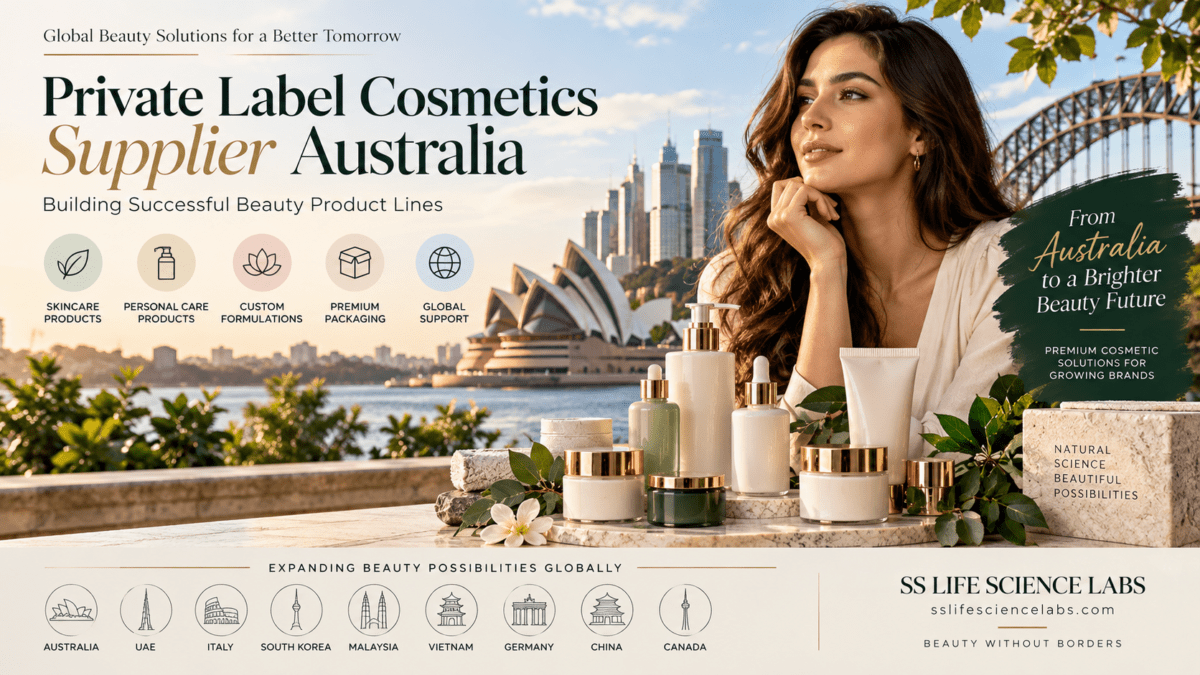
Private Label Cosmetics Supplier Australia: Building Successful Beauty Product Lines

Private Label Cosmetics Supplier Australia: Building Successful Beauty Product Lines

Australia has a diverse beauty and personal care market, creating opportunities for businesses that want to build skincare, cosmetics, body care, hair care, wellness, and other beauty product lines. For a new brand, retailer, distributor, or established beauty business, developing the right products is only one part of the process. Finding a manufacturing partner that can support product development, private labeling, packaging, production, and future expansion is equally important.

Choosing a Private Label Cosmetics Supplier Australia can help a beauty business develop products under its own brand identity instead of relying entirely on products from established brands. Private label manufacturing can provide businesses with an opportunity to build a distinct product portfolio while focusing their resources on branding, marketing, distribution, and customer relationships.

However, supplier selection should involve more than comparing prices. Product quality, formulation options, samples, minimum order quantities, packaging, manufacturing capabilities, communication, production capacity, and future scalability should all be considered before making a decision.

For businesses operating internationally, the manufacturing partner does not necessarily have to be located in Australia. An India-based cosmetic manufacturer can also work with international brands when the products, documentation, labeling, shipping, import requirements, and other applicable market considerations are properly addressed.

SS Life Science Labs is an India-based cosmetic manufacturer offering private label and customized cosmetic product solutions across categories such as skincare, personal care, body care, and aromatherapy-related products. Brands looking to understand its broader capabilities can explore the SS Life Science Labs website.

What Is a Private Label Cosmetics Supplier Australia?

A Private Label Cosmetics Supplier Australia can help businesses develop or source cosmetic and personal care products that are sold under the business’s own brand identity.

The exact services offered by a supplier can vary. Some suppliers may provide ready formulations, while others may offer customization, packaging support, product development, sampling, and manufacturing services.

For a growing beauty brand, this model can make it possible to build a branded product range without investing in its own manufacturing facility.

A business can focus on deciding what type of products it wants to offer, who those products are designed for, and how the brand should be positioned.

The manufacturing partner can then become part of the product development and supply process.

This relationship can be particularly useful when a brand plans to start with a focused range and gradually introduce more products.

Why Private Label Can Help Growing Beauty Brands

Private label can give a business more control over its product identity.

Instead of selling products only under another company’s branding, the business can develop a portfolio that represents its own brand.

This can include skincare products, body care, personal care, hair care, wellness products, or other categories depending on the manufacturer’s capabilities.

A startup may begin with one hero product, while a larger company may develop an entire product collection.

The important point is that private label does not mean launching everything at once.

A brand can build its product range step by step.

For businesses researching private label manufacturing, the Private Label Cosmetics Supplier page provides more information about private label and customized cosmetic solutions.

Building a Successful Beauty Product Line

A successful product line begins with a clear understanding of the customer.

Before contacting a manufacturer, a brand should define its target audience, product category, positioning, preferred product formats, packaging direction, and expected launch scale.

For example, a skincare startup may want to create a simple daily routine rather than launch twenty products immediately.

It could begin with a cleanser, serum, and moisturizer.

Once the brand understands customer response, it can consider expanding into masks, creams, body care, hair care, or other complementary categories.

This approach can make inventory management easier and provide a clearer identity for the brand.

A manufacturer should therefore be selected based on both today’s requirements and the brand’s future product plans.

Understanding Your Target Customer

The same cosmetic product will not necessarily appeal to every customer.

A premium skincare brand may focus on a different audience from a mass-market personal care company.

Similarly, a wellness brand may have different packaging, product formats, and messaging from a cosmetics-focused business.

Before developing products, ask:

Who is the customer?

What problem or need is the product designed around?

What product category does the customer already understand?

What price positioning does the brand want?

What type of packaging fits the brand?

Which products should be launched first?

These questions help the manufacturer understand the business direction and can make product discussions more productive.

Choosing the Right Product Categories

Beauty brands have many categories to choose from.

Depending on the manufacturing partner, a business may explore skincare, personal care, body care, hair care, wellness, aromatherapy, men’s grooming, baby care, lip care, hand and foot care, or other beauty-related categories.

However, a broad catalogue is not automatically better.

A brand should select products that fit its customer and positioning.

For example, a skincare-focused company may develop a coordinated skincare range before moving into body care.

A wellness brand may combine skincare with aromatherapy products.

A retailer may choose several categories to create a broader private label collection.

The product strategy should be driven by the business rather than by the number of products a supplier happens to offer.

Skincare as a Core Product Category

Skincare is often a natural starting point for businesses building a beauty portfolio.

A brand can create products around everyday routines, targeted skincare needs, or specific product formats.

Depending on the manufacturer’s capabilities, a range may include cleansers, serums, moisturizers, creams, masks, oils, and other skincare products.

The most important factor is consistency.

If customers purchase a product repeatedly, they expect a similar experience from one purchase to the next.

Brands should therefore evaluate samples and understand the manufacturer’s approach to product development and quality control before committing to larger production.

Businesses interested in skincare products can explore the Skin Care Product Manufacturer category from SS Life Science Labs.

Product Quality and Consistency

Product quality is one of the most important considerations when selecting a manufacturing partner.

A product may look attractive in marketing material, but the brand ultimately depends on the customer’s actual experience.

Before choosing a supplier, businesses should understand the product development process and evaluate samples where appropriate.

A sample can help the business review texture, appearance, fragrance, application, packaging compatibility, and overall product experience.

This stage also gives the brand an opportunity to identify changes before larger production.

For a new company, careful sampling can help reduce unnecessary inventory risk.

MOQ and Production Planning

MOQ means Minimum Order Quantity.

It is an important factor because the required quantity can affect the initial investment, inventory, storage, and cash flow of a new beauty business.

A startup may prefer a manageable initial order while an established brand may require larger production volumes.

There is no single MOQ that is appropriate for every business.

The right quantity depends on expected demand, product category, budget, sales channels, storage capacity, and launch strategy.

Brands should clarify MOQ requirements before finalizing their product range.

What to Check Before Choosing a Supplier

A supplier should be evaluated as a long-term business partner rather than simply as a source of low-cost products.

Important factors include manufacturing experience, product range, customization, samples, packaging, MOQ, communication, production capacity, and scalability.

Private Label Supplier Evaluation Checklist

🔍 Area to Evaluate 💎 What the Brand Should Check
Product Range Whether the supplier supports the categories required for the brand
Quality Product consistency and overall manufacturing standards
Customization Available formulation, fragrance, product and packaging options
MOQ Whether the minimum quantity suits the planned launch
Samples Whether samples can be evaluated before larger production
Packaging Packaging options that fit the brand identity
Production Ability to manage current and future production requirements
Communication Clear and responsive communication throughout development
Scalability Ability to support additional products and larger future orders

Packaging and Brand Identity

Packaging is an important part of a beauty brand’s identity.

Customers often see the package before they experience the product itself.

A strong packaging strategy should therefore support the brand’s positioning and make the product easy to recognize.

For a private label business, packaging can also help create consistency across the product portfolio.

For example, a brand with a skincare collection can use related colors, typography, bottle styles, and visual elements across different products.

At the same time, packaging should remain practical.

Businesses should consider product protection, labeling space, transportation, storage, usability, and the overall customer experience.

Australia as Part of an International Beauty Strategy

A business targeting Australia may eventually want to expand into other international markets.

This makes it useful to think about the product portfolio from an international perspective from the beginning.

A manufacturer that can support additional products can potentially make future expansion more manageable.

A brand may begin with Australia and later research markets such as the UAE, Italy, South Korea, Malaysia, Vietnam, Germany, China, Canada, or other regions.

Each market can have different business, labeling, regulatory, import, distribution, and customer considerations.

The product strategy should therefore remain flexible.

Private Label Cosmetics Supplier UAE

The UAE can be considered by beauty businesses planning broader international expansion from Australia or other markets.

A brand researching the UAE may evaluate private label manufacturing options, product categories, packaging, production capabilities, and supply-chain requirements.

Businesses should not assume that the exact same launch strategy will work in every country.

Customer segments, positioning, distribution channels, pricing, and applicable market requirements can vary.

For businesses researching this market, the Private Label Cosmetics Supplier UAE resource provides another reference point for international supplier research.

Private Label Cosmetics Supplier Italy

Italy is another market that businesses may research when planning international beauty expansion.

Brands interested in the Italian market should consider their customer segment and product positioning before developing a market-specific strategy.

A private label manufacturer can support the development of a branded product portfolio, while the business can focus on its chosen sales channels and customer communication.

For international expansion, it is useful to maintain a clear distinction between manufacturing requirements and the requirements of the market where products will ultimately be sold.

Private Label Cosmetics Supplier South Korea

South Korea is widely associated with skincare and beauty product innovation, making it a market that some international beauty businesses may research when planning a wider product strategy.

A company considering this market should first define whether it wants to compete through skincare, personal care, wellness, or another beauty category.

The same supplier-selection principles still apply: product quality, customization, samples, packaging, MOQ, production capacity, and scalability should all be considered.

Private Label Cosmetics Supplier Malaysia

Malaysia can also be included in an international beauty expansion plan.

For a business exploring Malaysia, understanding the target customer and preferred product category should come before selecting a manufacturing partner.

A focused product range can make it easier to manage inventory and build brand recognition while the business evaluates market response.

If the brand later expands into additional categories, its manufacturing partner should ideally be able to support that growth.

Private Label Cosmetics Supplier Vietnam

Vietnam is another market that can be researched by beauty companies developing an international strategy.

A brand planning to enter Vietnam should evaluate its product category, target customer, distribution model, packaging, and applicable market requirements.

From a manufacturing perspective, the same core supplier evaluation remains relevant.

The goal should be to select a partner that can support the business’s actual product requirements rather than simply selecting a supplier based on location.

Private Label Cosmetics Supplier Germany

Germany can also be relevant for businesses researching European beauty opportunities.

Brands considering Germany should build their product strategy around their intended customer and positioning.

A supplier should be assessed according to the products it can manufacture, customization options, quality processes, packaging support, MOQ, and production capabilities.

International brands should also ensure that their products and documentation are appropriate for the market in which they intend to sell.

Private Label Cosmetics Supplier China

China is another major market that businesses may research as part of a global beauty strategy.

A company looking at China should distinguish between market-entry considerations and manufacturing decisions.

The right supplier depends on the products required, production volumes, customization, quality expectations, packaging, and long-term business plans.

A brand should also consider how its product portfolio can remain consistent as it expands across multiple markets.

Private Label Cosmetics Supplier Canada

Canada can be another destination for businesses planning to expand an international beauty brand.

A company entering the Canadian market may consider skincare, personal care, body care, hair care, wellness, or other categories depending on its customer.

As with Australia and other international markets, the manufacturing partner should be selected according to the brand’s product requirements.

The business should also evaluate the applicable product, labeling, import, and distribution requirements for the Canadian market before launch.

Why an India-Based Manufacturer Can Support International Brands

An international beauty business does not always need its manufacturer to be located in the same country where its customers live.

India-based manufacturing can provide another sourcing option for businesses developing private label and customized cosmetic products.

For an international brand, the important considerations include product capabilities, quality, customization, communication, production capacity, packaging, and supply-chain requirements.

SS Life Science Labs operates from India and supports businesses looking for private label and customized cosmetic product solutions.

Its product categories include skincare, personal care, body care, and aromatherapy-related products.

The manufacturer location and target market can therefore be different, provided the business properly handles the requirements associated with its intended market.

Developing Products for Different Markets

International expansion does not necessarily mean creating completely different products for every country.

A brand may have a core product portfolio and adapt certain elements depending on the market.

For example, the core product identity can remain consistent while packaging, product information, positioning, distribution, or marketing strategy is adjusted where required.

This can help the business maintain a recognizable brand identity while remaining flexible across different markets.

The manufacturing partner should be informed about the brand’s international plans so that future product development can be considered from the beginning.

Building a Product Line Around a Hero Product

A hero product can give a new beauty brand a clear starting point.

Instead of launching a large catalogue, the business can focus its initial marketing around one product and then introduce complementary products.

For example:

Hero Serum → Cleanser → Moisturizer → Face Mask → Body Care

This progression can create a logical product journey.

It also allows the business to understand which products receive customer interest before expanding further.

The strategy will differ depending on the brand, but the principle remains useful: start with a clear purpose and expand based on the business’s requirements.

Expanding Into Wellness and Aromatherapy

Beauty and wellness can complement one another when they fit naturally with a brand’s identity.

A skincare company may eventually introduce aromatherapy or wellness-related products to create a broader self-care range.

A business interested in this category can explore the Aromatherapy Oils Supplier category from SS Life Science Labs.

Adding a new category should still be based on customer demand and brand positioning.

A product should have a clear reason for being part of the portfolio rather than being added simply to increase the number of products.

Private Label vs OEM vs ODM

Businesses researching cosmetic manufacturing will often encounter the terms private label, OEM, and ODM.

Although exact services can vary between manufacturers, these models generally represent different approaches to product development and customization.

Comparing Private Label, OEM and ODM

🏷️ Model ⚙️ General Approach 🎯 Suitable For
Private Label Products are offered under the brand’s own identity with available customization options Startups and growing beauty brands
OEM Products are developed according to specific brand requirements Businesses seeking greater customization
ODM Supplier-supported development using established product concepts Brands looking for development support

The most suitable approach depends on the brand’s product requirements, budget, customization expectations, and desired level of involvement in product development.

Why Sampling Should Be Part of the Process

Sampling should be treated as an important product-development stage rather than a formality.

A sample allows a business to evaluate the product before committing to larger production.

The brand can review the physical product and determine whether changes are required.

For skincare and personal care products, this may include evaluating texture, fragrance, appearance, application, packaging, and overall user experience.

Once the product meets the brand’s expectations, the business can move toward production with greater clarity.

Planning for Repeat Orders

The first production order is only one stage of the relationship between a brand and its manufacturer.

If the product performs well, the business may need repeat production.

This means the supplier should be evaluated for its ability to maintain consistency over time.

A brand should understand how repeat orders are handled and whether the manufacturer can support increasing quantities as the business grows.

This becomes particularly important when the brand begins expanding from Australia into other international markets.

Common Mistakes Beauty Brands Should Avoid

Choosing Only on Price

Price is an important commercial consideration, but it should not be the only factor.

Product quality, MOQ, customization, packaging, communication, and scalability can also affect the total value of a supplier relationship.

Launching Too Many Products

A large product range can increase inventory requirements and make it difficult for a new brand to communicate its core identity.

Skipping Product Samples

Moving directly into large-scale production without properly evaluating samples can create unnecessary product risk.

Ignoring Packaging

Packaging should support both the practical requirements of the product and the brand’s visual identity.

Not Planning Future Products

A supplier may satisfy the requirements of one product but may not be able to support future categories.

Brands should consider their longer-term product roadmap.

Ignoring Market Requirements

A product intended for Australia, Germany, Canada, China, Malaysia, or another market may have specific requirements.

Businesses should investigate and address the relevant market requirements before commercial launch.

How to Build a Scalable Beauty Brand

A scalable beauty brand needs a product strategy that can grow gradually.

The business can begin with a focused range, evaluate customer response, improve the product offering, and then introduce complementary products.

A possible progression is:

Research → Product Selection → Sampling → Branding → Packaging → Production → Launch → Customer Feedback → Product Expansion

This process can help the brand remain focused while creating opportunities for future growth.

The manufacturer can become an important part of this process by supporting product development and repeat production.

How SS Life Science Labs Can Fit Into an International Product Strategy

SS Life Science Labs is an India-based cosmetic manufacturer offering private label and customized cosmetic product solutions.

Its product categories include skincare, personal care, body care, and aromatherapy-related products.

For an Australian beauty business, the manufacturer can be evaluated according to its specific product requirements rather than simply its geographic location.

The same principle applies to brands researching UAE, Italy, South Korea, Malaysia, Vietnam, Germany, China, Canada, or other international markets.

Businesses should evaluate the supplier’s capabilities, product requirements, samples, packaging, production needs, and applicable market considerations before making a commercial decision.

Frequently Asked Questions

What should I look for in a Private Label Cosmetics Supplier Australia?

Look at product quality, customization, MOQ, samples, packaging, manufacturing capabilities, communication, production capacity, and scalability. These factors can have a direct impact on product development and long-term supply planning.

Can an Australian beauty brand work with an India-based manufacturer?

Yes. An Australian business can work with an India-based manufacturer when the supplier can support its product requirements and the business properly addresses the applicable Australian product, labeling, import, shipping, and other market requirements.

What is a private label cosmetic manufacturer?

A private label cosmetic manufacturer produces or supplies cosmetic products that a business can sell under its own brand identity. Depending on the manufacturer, private label services may include product selection, customization, packaging, sampling, and production.

Is private label suitable for beauty startups?

Private label can be a practical model for startups because it allows them to develop branded products without establishing their own manufacturing facility. A focused product launch can also make inventory and marketing easier to manage.

What products can I develop with a private label supplier?

Depending on the manufacturer’s capabilities, businesses can explore skincare, personal care, body care, hair care, wellness, aromatherapy, lip care, men’s grooming, and other beauty-related products.

How many products should a new beauty brand launch?

There is no fixed number. Many businesses can benefit from starting with a focused collection that matches their target customer and brand positioning before expanding into additional categories.

Why are samples important before production?

Samples allow the business to evaluate the product before committing to larger quantities. Brands can review characteristics such as texture, fragrance, appearance, application, packaging, and overall product experience.

What does MOQ mean in cosmetic manufacturing?

MOQ means Minimum Order Quantity. It refers to the minimum quantity a supplier requires for a particular product or production order. The appropriate MOQ depends on the brand’s budget, demand, storage, and launch strategy.

Can I sell private label cosmetics in Australia if the manufacturer is in India?

The manufacturer can be located in India while the products are sold in Australia. However, the business should properly investigate and comply with the applicable Australian product, labeling, import, documentation, and other market requirements.

Can one manufacturer support multiple beauty categories?

Some manufacturers support several categories, while others specialize in particular product types. Brands should confirm the manufacturer’s actual capabilities before planning a multi-category product portfolio.

Can an Australian beauty brand expand into other countries?

Yes. A business can develop an international expansion strategy covering markets such as the UAE, Italy, South Korea, Malaysia, Vietnam, Germany, China, and Canada. Each market should be evaluated separately for its customer, commercial, regulatory, labeling, import, and distribution requirements.

What is the difference between private label, OEM and ODM?

Private label generally focuses on selling products under the brand’s identity, while OEM can involve products developed according to specific requirements and ODM can involve supplier-supported product development. The exact services vary between manufacturers.

How important is packaging for a private label brand?

Packaging is important because it protects the product and contributes to the brand’s visual identity. Consistent packaging can also help customers recognize products as part of the same product line.

Can SS Life Science Labs support international beauty brands?

SS Life Science Labs is an India-based cosmetic manufacturer offering private label and customized cosmetic solutions across categories including skincare, personal care, body care, and aromatherapy-related products. International businesses can evaluate its capabilities according to their specific product and target-market requirements.

Conclusion

Building a successful beauty product line requires more than selecting attractive products. A brand needs a clear customer strategy, suitable product categories, reliable samples, appropriate packaging, manageable production quantities, and a manufacturing partner capable of supporting future growth.

For businesses researching a Private Label Cosmetics Supplier Australia, the supplier-selection process should include product quality, customization, MOQ, packaging, manufacturing capabilities, communication, production capacity, and scalability.

An Australia-focused brand can also consider international manufacturing options. An India-based manufacturer may support businesses targeting Australia and other international markets when the required product and supply-chain requirements are properly addressed.

As the brand grows, its product strategy can expand beyond Australia into markets such as the UAE, Italy, South Korea, Malaysia, Vietnam, Germany, China, and Canada. Each market should be researched according to its individual requirements rather than assuming that one approach will work everywhere.

SS Life Science Labs provides private label and customized cosmetic product solutions across skincare, personal care, body care, and aromatherapy-related categories. For brands looking to build a focused product range and gradually expand their portfolio, evaluating the right manufacturing partner can be an important step in creating a sustainable beauty business.

Related Reading

For brands researching international private label opportunities, explore the Private Label Cosmetics Supplier USA guide for additional information on building a beauty product strategy for the US market.

Businesses planning UK expansion can also read the Private Label Cosmetics Supplier UK guide to understand additional considerations when developing an international beauty portfolio.

For European market research, the Private Label Cosmetics Supplier Europe guide provides another resource for businesses evaluating international supplier options.

Brands exploring Middle Eastern opportunities can read the  Private Label Cosmetics Supplier Middle East guide before developing a wider regional strategy.

Businesses specifically researching Saudi Arabia can also explore the Beauty Products Supplier Saudi Arabia guide for additional information about beauty product sourcing and market planning.
Categories
Blog

Beauty Products Supplier Saudi Arabia: Guide for Brands Entering the Market

Beauty Products Supplier Saudi Arabia: Guide for Brands Entering the Market

Saudi Arabia has become an important market for beauty, skincare, personal care, wellness, and cosmetic businesses. As consumer interest in beauty and self-care continues to develop, brands are looking for reliable ways to build product ranges that match their customers, brand positioning, and long-term business goals.

For a new or growing beauty business, choosing the right Beauty Products Supplier Saudi Arabia can be one of the most important decisions during product development. A supplier is not simply a source of products. The right manufacturing partner can influence product consistency, packaging, customization, minimum order quantities, production planning, and the ability to expand the product range in the future.

For international brands targeting Saudi Arabia, the supplier does not necessarily have to be physically located in Saudi Arabia. An experienced India-based manufacturer can also support international beauty businesses, provided the products, documentation, packaging, shipping, import, labeling, and other applicable market requirements are properly addressed.

SS Life Science Labs is an India-based cosmetic manufacturing company providing private label and customized cosmetic product solutions for businesses looking to develop and expand beauty product ranges. Its product categories include skincare, personal care, body care, and aromatherapy-related products.

Businesses interested in understanding the company’s broader manufacturing capabilities can explore the SS Life Science Labs website.

Understanding the Saudi Arabian Beauty Market

Before choosing a supplier, a beauty business should first understand what it wants to achieve in the Saudi market.

Some businesses may want to launch a specialized skincare brand, while others may be interested in cosmetics, personal care, body care, hair care, wellness, or a broader beauty portfolio.

The right product strategy depends on the intended customer and the brand’s positioning.

For example, a skincare startup may begin with a small collection of complementary products instead of launching dozens of products at once. A brand could start with a cleanser, serum, and moisturizer and then expand its portfolio after understanding customer response.

This approach can make product management easier while allowing the business to build a recognizable identity.

A supplier should therefore be selected according to the brand’s current requirements as well as its potential future plans.

What Is a Beauty Products Supplier Saudi Arabia?

A Beauty Products Supplier Saudi Arabia can support businesses that want to source, develop, manufacture, or sell beauty-related products for the Saudi market.

Depending on the supplier’s capabilities, services may include product development, private label manufacturing, customized formulations, packaging support, sampling, production, and repeat manufacturing.

For a business building its own brand, private label manufacturing can be particularly useful. Instead of establishing a complete manufacturing facility, the brand can work with a manufacturing partner and develop products under its own identity.

The exact services available will differ between manufacturers, which is why businesses should discuss their requirements before making a commercial decision.

Why Private Label Is Attractive for Beauty Brands

Private label allows a business to sell products under its own brand identity.

This can give a company greater control over how its products are presented to customers, including product positioning, packaging, branding, and portfolio development.

A new beauty company may use private label to launch its first products, while an established retailer may use it to develop an exclusive range.

The model can also support gradual expansion.

A brand might begin with one hero product, introduce complementary products, and eventually expand into other categories.

For businesses looking for a private label manufacturing partner, the Private Label Cosmetics Supplier page provides additional information about private label and customized cosmetic product solutions.

Choosing the Right Beauty Products Supplier Saudi Arabia

Choosing a supplier should not be based only on the lowest quotation.

A supplier may offer an attractive price but have limitations around customization, MOQ, packaging, production capacity, communication, or future scalability.

A more useful approach is to evaluate the complete supplier relationship.

Important areas include product range, quality, samples, MOQ, customization, packaging, manufacturing capacity, communication, and future product development.

A business should also understand exactly what the supplier can provide before finalizing the product strategy.

Supplier Selection Checklist

🔎 Evaluation Area 💎 What Beauty Brands Should Check
Product Range Skincare, personal care, body care, hair care, wellness, and other required categories
Product Quality Consistency, formulation quality, and manufacturing standards
MOQ Whether the minimum order quantity fits the planned launch
Customization Product, formulation, fragrance and packaging options
Samples Availability of samples before larger production
Packaging Packaging options that match the brand’s positioning
Production Capacity Ability to manage current and future order volumes
Scalability Support for additional products and increasing demand
Communication Clear, responsive and consistent communication

Product Quality Should Come First

Beauty products are directly connected to the customer’s experience with a brand.

If the product quality is inconsistent, customers may lose confidence in the brand even if the packaging and marketing are strong.

For this reason, businesses should understand how a prospective manufacturer approaches product development and quality control.

Brands should also evaluate samples before committing to larger quantities.

A sample can provide an opportunity to assess the product’s appearance, texture, fragrance, application, packaging, and overall experience.

Product evaluation is especially important for new businesses because an early product launch can influence the customer’s perception of the entire brand.

Understanding MOQ Before Placing an Order

MOQ stands for Minimum Order Quantity.

It refers to the minimum quantity a supplier requires for a particular product or production order.

MOQ can have a significant effect on a new beauty brand’s initial investment.

A business that is still testing its market may not want to purchase an unnecessarily large quantity. On the other hand, a growing brand may need larger production volumes to maintain inventory.

The right MOQ therefore depends on expected demand, budget, storage capacity, sales channels, and launch strategy.

Before placing an order, brands should clearly understand the supplier’s MOQ and whether different products have different requirements.

Why Samples Matter

Sampling is one of the most useful stages of product development.

A business can use samples to determine whether the product meets its expectations before moving forward with larger production.

Depending on the product, a brand may evaluate:

  • Texture
  • Appearance
  • Fragrance
  • Application
  • Packaging compatibility
  • Overall product experience

Sampling can also help identify changes that should be made before production.

For startups, this can reduce the risk of committing a large amount of inventory before the product has been properly evaluated.

Cosmetic Products Supplier Saudi Arabia: What Should You Check?

Businesses searching for a Cosmetic Products Supplier Saudi Arabia should first define exactly what they want from the supplier.

A company looking for skincare products may have different requirements from a retailer seeking a broad beauty catalogue.

Similarly, a startup may prioritize smaller MOQs and flexibility, while an established company may prioritize production capacity and repeat-order consistency.

The supplier should therefore be evaluated according to the business model rather than simply comparing prices.

The following questions can help:

  • What product categories does the supplier support?
  • Can the products be customized?
  • Are samples available?
  • What is the MOQ?
  • What packaging options are available?
  • Can the supplier support repeat production?
  • Can the product portfolio expand in the future?
  • How does the supplier communicate with international clients?
  • Can the supplier support the business as order volumes increase?

Skincare Opportunities for Saudi Beauty Brands

Skincare can be an important category for beauty businesses entering the Saudi market.

Rather than creating an unnecessarily large catalogue, brands can consider developing a focused product range around specific customer needs.

A basic range might include a cleanser, serum, moisturizer, cream, or other complementary products.

Once the brand understands customer response, it can consider adding additional products.

This gradual approach can help businesses manage inventory while building a stronger product identity.

For businesses looking for skincare manufacturing options, the Skin Care Product Manufacturer category from SS Life Science Labs can be explored.

Building a Product Portfolio Step by Step

A beauty brand does not have to launch every possible product at the beginning.

A more structured approach can be:

Hero Product → Complementary Products → New Category → Wider Market Expansion

For example, a skincare company may begin with one serum.

After establishing its first product, the brand could introduce a cleanser and moisturizer.

Later, it may expand into body care, personal care, hair care, or wellness.

This approach gives the business time to understand customer preferences and determine which products deserve further investment.

Packaging and Brand Presentation

Packaging is an important part of the overall beauty product experience.

Customers often see the packaging before using the product itself, making it an important element of brand presentation.

Packaging should therefore match the product’s positioning.

A premium skincare brand may prefer a sophisticated and minimal presentation, while a wellness-focused brand may choose a different visual direction.

Consistency is also important when developing multiple products.

When products share recognizable design elements, customers can more easily identify them as part of the same brand.

Packaging should also be considered from a practical perspective, including product protection, labeling space, storage, transportation, and customer usability.

Working With an India-Based Cosmetic Manufacturer

A Saudi beauty business does not necessarily need to work with a manufacturer located within Saudi Arabia.

International sourcing can allow businesses to compare manufacturers based on their product capabilities, customization, production capacity, communication, and commercial requirements.

India has an established cosmetic and personal care manufacturing ecosystem, making it a potential sourcing destination for international beauty businesses.

SS Life Science Labs is an India-based manufacturer supporting private label and customized cosmetic product requirements across skincare, personal care, body care, and aromatherapy-related categories.

For an international brand, the key question should be whether the manufacturing partner can support the product and supply requirements of the intended market.

The manufacturer’s location and the brand’s target market can therefore be different.

Private Label Cosmetics Supplier Middle East

Saudi Arabia can also be considered as part of a broader Middle Eastern beauty strategy.

A company may initially target Saudi Arabia and later expand into other regional markets.

This makes scalability important when selecting a manufacturing partner.

A supplier that can support additional products and increasing production requirements can potentially make regional expansion easier to manage.

Businesses researching the wider region can read the Private Label Cosmetics Supplier Middle East guide for additional information.

Private Label Cosmetics Supplier UAE and Saudi Arabia

Saudi Arabia and the UAE are both important markets for businesses exploring the Middle Eastern beauty sector.

However, brands should not automatically assume that one product strategy will work identically in every market.

Customer preferences, pricing, positioning, distribution channels, and business requirements can vary.

A business planning regional expansion should therefore create a flexible product strategy.

For businesses also researching UAE opportunities, the Private Label Cosmetics Supplier UAE resource can be used for further supplier research.

Expanding From Saudi Arabia to International Markets

A beauty brand may begin by targeting Saudi Arabia and later explore additional markets such as the UAE, UK, Europe, USA, Australia, or other regions.

This is another reason why supplier selection should be viewed as a long-term decision.

The manufacturing partner should ideally be able to support the brand as its product portfolio develops.

For brands researching the United States, the Private Label Cosmetics Supplier USA guide provides additional information about supplier considerations.

Businesses researching the UK market can explore the Private Label Cosmetics Supplier UK guide.

For European market research, the Private Label Cosmetics Supplier Europe guide can also be useful.

These resources can help businesses compare supplier considerations across different international markets.

Private Label, OEM and ODM: What’s the Difference?

Businesses entering cosmetic manufacturing often encounter terms such as private label, OEM, and ODM.

Although the exact definition can vary between manufacturers, these models generally represent different approaches to product development and customization.

Private Label vs OEM vs ODM

🏷️ Manufacturing Model ⚙️ General Approach 🎯 Best Suited For
Private Label Products are offered under the brand’s own identity with suitable customization options Startups and growing beauty brands
OEM Products are developed according to specific brand requirements Brands seeking greater customization
ODM Supplier-supported product development using established product concepts Brands looking for development support

The appropriate model depends on the brand’s budget, product requirements, desired customization, and level of development involvement.

Wellness and Aromatherapy Opportunities

Beauty businesses can also explore the connection between beauty and wellness.

A skincare brand may eventually introduce wellness or aromatherapy products as complementary categories.

This can help create a broader lifestyle-oriented product portfolio when it fits the brand’s positioning.

Aromatherapy-related products may be considered by businesses interested in wellness, self-care, and lifestyle categories.

Brands researching this product category can explore the Aromatherapy Oils Supplier page from SS Life Science Labs.

As with any new category, businesses should first consider customer demand and whether the products fit naturally within the existing brand.

Common Mistakes When Choosing a Beauty Products Supplier

Choosing Only on Price

The lowest price does not necessarily represent the best overall value.

Quality, MOQ, customization, communication, production capacity, and scalability should also be evaluated.

Launching Too Many Products

A large catalogue can create unnecessary inventory and make it difficult for a new brand to establish a clear identity.

Ignoring MOQ

Businesses should understand the minimum quantity before finalizing a product plan.

Skipping Samples

Moving directly to bulk production without properly evaluating samples can create unnecessary product risk.

Ignoring Packaging

Packaging is part of the customer’s first impression and should support the overall brand identity.

Not Planning for Future Growth

A supplier may meet today’s requirements but struggle to support larger orders or additional categories later.

Brands should consider both current and future needs when evaluating a manufacturing partner.

How to Build a Strong Launch Strategy

A structured launch can make the process easier for a new beauty business.

Start by identifying the target customer.

Next, choose the primary product category.

Then determine which products are most relevant to the customer’s needs.

After that, shortlist suitable suppliers and compare their capabilities.

Request samples where appropriate and evaluate the products carefully.

Once the product direction is finalized, develop the packaging and branding strategy.

Finally, plan production, inventory, distribution, and marketing around the expected launch requirements.

The objective should be to build a sustainable product range rather than simply launch as many products as possible.

Why Supplier Communication Matters

Communication is sometimes overlooked when businesses compare manufacturers.

However, international product development involves multiple stages, and clear communication can make the process easier to manage.

Brands may need to discuss product requirements, samples, packaging, quantities, production schedules, documentation, and future orders.

A supplier that communicates clearly can help the business understand what is possible and what information is required at each stage.

This becomes even more important when the brand plans to develop multiple products.

How Can a Supplier Support Long-Term Brand Growth?

A manufacturing partner can become an important part of a brand’s supply chain.

At the beginning, the business may only require one or two products.

As the brand grows, it may need additional products, higher production quantities, new packaging options, or entry into additional markets.

A supplier that can support this progression can make the transition easier.

This is why businesses should not evaluate a supplier only according to the first order.

They should also consider whether the supplier can potentially support the next stage of the brand’s development.

Frequently Asked Questions

What should I look for in a Beauty Products Supplier Saudi Arabia?

Look at product quality, MOQ, customization, samples, packaging, manufacturing capabilities, communication, and scalability. Price is important, but it should not be the only factor used to select a supplier.

Can a Saudi beauty brand work with an India-based cosmetic manufacturer?

Yes. A Saudi beauty business can work with an India-based manufacturer when the supplier can provide the required products and the business properly addresses applicable product, labeling, import, shipping, and market requirements.

What is the difference between a cosmetic supplier and a private label supplier?

A cosmetic supplier may provide existing products or sourcing solutions, while a private label supplier can help a business develop products that are sold under its own brand identity. The level of formulation and packaging customization depends on the supplier.

What products can I develop for the Saudi beauty market?

Depending on the manufacturer’s capabilities, businesses can explore skincare, personal care, body care, hair care, wellness, and aromatherapy-related products. The final product range should be based on the target customer’s needs and the brand’s positioning.

Is private label suitable for a new beauty brand?

Private label can be a practical option for startups because it allows them to develop branded products without establishing their own manufacturing facility. Starting with a focused product range can also make inventory management easier.

What MOQ should a new beauty brand choose?

There is no universal MOQ that works for every business. The appropriate quantity depends on the brand’s budget, expected demand, storage capacity, sales strategy, and launch plans. New businesses should avoid committing to quantities that create unnecessary inventory pressure.

Should I order samples before placing a bulk order?

Yes. Samples allow the business to evaluate the product before committing to larger production. Depending on the category, brands can review texture, fragrance, appearance, application, packaging, and overall product experience.

Can one supplier provide skincare and other beauty products?

Some manufacturers support multiple categories, while others specialize in specific product types. Businesses planning a broader portfolio should confirm whether the supplier can support categories such as skincare, personal care, body care, wellness, and aromatherapy.

Can I start in Saudi Arabia and later expand into the UAE?

Yes. A brand can build a product strategy with regional expansion in mind. However, requirements can differ between markets, so businesses should evaluate applicable regulatory, labeling, import, shipping, and distribution requirements before entering each market.

Why is packaging important for a Saudi beauty brand?

Packaging protects the product while also communicating the brand’s identity and positioning. Consistent and professional packaging can help create a recognizable product range and a stronger customer experience.

How do I choose between Private Label, OEM and ODM?

The right model depends on the level of customization and development support required. Private label can suit brands looking for branded products, OEM can suit businesses requiring more specific customization, and ODM can be useful when a brand wants supplier-supported product development.

Can a beauty brand start with only one product?

Yes. A focused launch can be a practical strategy for a new business. Starting with a hero product allows the brand to test its positioning and customer response before expanding into complementary products.

Can SS Life Science Labs support international beauty brands?

SS Life Science Labs is an India-based cosmetic manufacturer providing private label and customized cosmetic product solutions across categories such as skincare, personal care, body care, and aromatherapy-related products. International businesses can evaluate its capabilities according to their specific product and target-market requirements.

Conclusion

Saudi Arabia presents opportunities for businesses looking to develop beauty, skincare, personal care, body care, wellness, and cosmetic brands. Choosing the right Beauty Products Supplier Saudi Arabia can help a business build a reliable product portfolio while creating a foundation for future growth.

The supplier-selection process should go beyond price. Product quality, MOQ, customization, samples, packaging, production capacity, communication, and scalability all deserve careful consideration.

For international beauty businesses, an India-based manufacturing partner can also be considered when its capabilities and supply process match the requirements of the intended market.

SS Life Science Labs provides private label and customized cosmetic product solutions across skincare, personal care, body care, and aromatherapy-related categories.

Whether a business is launching its first beauty product in Saudi Arabia or planning expansion across the Middle East and international markets, a focused product strategy and carefully selected manufacturing partner can provide a stronger foundation for sustainable brand growth.

Related Reading

For businesses researching international private label opportunities:

Private Label Cosmetics Supplier USA

Private Label Cosmetics Supplier UK

Private Label Cosmetics Supplier Europe

Private Label Cosmetics Supplier Middle East

Private Label Cosmetics Supplier UAE

For product and manufacturing information:

Private Label Cosmetics Supplier

Skin Care Product Manufacturer

Aromatherapy Oils Supplier

Categories
Blog

Private Label Cosmetics Supplier Middle East: Opportunities for Beauty Businesses

Private Label Cosmetics Supplier Middle East: Opportunities for Beauty Businesses

The Middle East beauty market continues to create opportunities for startups, retailers, eCommerce businesses, salons, beauty entrepreneurs, and established brands looking to develop their own cosmetic product ranges. With growing interest in skincare, personal care, body care, hair care, wellness, and premium beauty products, businesses are looking for flexible ways to build products under their own brand identity.

For a growing beauty business, selecting the right Private Label Cosmetics Supplier Middle East can be an important part of the product development and sourcing strategy. The right partner can help businesses develop a focused product range while supporting areas such as product selection, customization, packaging, production, and future portfolio expansion.

However, choosing a supplier should involve more than comparing prices. Beauty businesses should consider product quality, customization capabilities, minimum order quantities, packaging options, communication, production capacity, product categories, and the supplier’s ability to support long-term growth.

SS Life Science Labs is an India-based cosmetic manufacturing company that supports businesses with private label and customized cosmetic product solutions for international markets. Its product categories include skincare, personal care, body care, and aromatherapy-related products. Businesses can explore the SS Life Science Labs website for a broader overview of its cosmetic product and manufacturing capabilities.

Why Private Label Cosmetics Are Growing in the Middle East

Private label cosmetics can provide businesses with an opportunity to create products under their own brand instead of developing their own manufacturing infrastructure.

This can be useful for startups and established businesses that want to enter or expand within the beauty industry while focusing their resources on branding, marketing, distribution, and customer relationships.

A private label project may involve product selection, sample evaluation, customization, packaging, labeling, manufacturing, and production planning. The exact level of support depends on the supplier and the requirements of the brand.

For businesses targeting Middle Eastern customers, the first step should be understanding the intended customer segment and deciding what type of beauty products the brand wants to offer.

A company may begin with a focused skincare range and later expand into body care, hair care, personal care, or wellness products.

This gradual approach can make it easier to manage inventory, marketing, and product development while allowing the business to understand customer demand.

What to Look for in a Private Label Cosmetics Supplier Middle East

Choosing a suitable supplier can influence the quality and consistency of a beauty brand’s products. Before making a decision, businesses should evaluate several areas.

Manufacturing Experience

Start by checking whether the supplier has experience with the product category you want to launch.

For example, a skincare brand should look for a partner with relevant skincare capabilities, while a company planning a broader personal care portfolio should evaluate whether the supplier can support multiple categories.

A large catalogue does not automatically mean that a supplier is the right fit. The important factor is whether its capabilities match the brand’s requirements.

Product Customization

Private label products can vary in their level of customization.

Some projects may involve selecting existing product concepts and applying the brand’s identity, while other projects may require additional customization around product specifications, packaging, fragrance, texture, or product format.

Before moving forward, brands should ask what can be customized and what limitations may apply.

Minimum Order Quantity

MOQ is another important factor for beauty startups.

A supplier offering a low per-unit price may not necessarily be the best option if the required minimum order is too large for the business.

Brands should compare MOQ with their expected sales, available investment, storage capacity, and launch strategy.

Starting with a smaller, focused range can sometimes be more practical than launching too many products at once.

Private Label Cosmetics Supplier UAE: A Growing Opportunity

The UAE is an important destination for businesses operating within the Middle Eastern beauty market. Dubai and other commercial hubs attract beauty retailers, entrepreneurs, eCommerce businesses, salons, distributors, and international brands.

Businesses searching for a Private Label Cosmetics Supplier UAE should evaluate suppliers based on their complete product development and sourcing requirements rather than focusing only on location.

A UAE-focused beauty business may want to develop skincare, body care, personal care, hair care, or wellness products under its own brand.

The supplier selection process should therefore consider:

  • Product categories
  • Product quality
  • Customization
  • MOQ
  • Packaging
  • Samples
  • Production capacity
  • Communication
  • Repeat-order capabilities
  • Future product expansion

A well-planned supplier relationship can help a business create a more consistent product portfolio as it grows.

Cosmetic Products Supplier Middle East: Planning Your Product Range

Businesses searching for a Cosmetic Products Supplier Middle East should first determine which products are most relevant to their customers.

Instead of launching a large catalogue immediately, a focused product range can provide a clearer starting point.

For example, a skincare-focused brand could begin with:

Cleanser → Serum → Moisturizer

Once the brand establishes customer demand, it can gradually introduce complementary products.

A body care brand could follow a similar approach with:

Body Wash → Body Lotion → Body Scrub

The objective is not simply to have more products. The objective is to create products that work together and make sense for the target customer.

Skincare Opportunities for Middle Eastern Beauty Brands

Skincare remains an important category for businesses looking to develop private label products.

Brands may consider products such as cleansers, serums, creams, moisturizers, face oils, masks, and other skincare formats depending on their positioning and customer requirements.

A skincare brand should define its product concept before approaching a supplier.

Questions to consider include:

Who is the target customer?

What type of skincare routine does the brand want to support?

What price segment will the products target?

What packaging style fits the brand?

Which products should be launched first?

Businesses interested in skincare product development can explore the Skin Care Product Manufacturer category from SS Life Science Labs.

Building a Premium Beauty Brand

The Middle Eastern beauty market includes businesses positioned across different price segments.

A brand may choose to compete through premium presentation, specialized products, accessible pricing, natural-inspired positioning, wellness, or another clearly defined identity.

Private label manufacturing can support different brand strategies, but the brand itself must define its positioning first.

Packaging, product presentation, naming, photography, website design, and marketing should all communicate a consistent identity.

A premium product with weak presentation can struggle to communicate its value, while attractive packaging cannot compensate for an inconsistent product experience.

This is why product development and branding should be considered together.

Packaging for Middle Eastern Beauty Products

Packaging is one of the first elements a customer notices.

A brand should select packaging that matches the product, customer, positioning, and price segment.

For example, a premium skincare line may choose a sophisticated and minimal packaging approach, while a wellness-focused brand may use a more natural visual direction.

Before finalizing packaging, brands should consider:

  • Product protection
  • Brand identity
  • Label space
  • Product information
  • Packaging format
  • Customer experience
  • Storage and shipping requirements

A consistent packaging system can also help different products look like part of the same brand.

Why Sampling Matters

A sample gives the brand an opportunity to evaluate a product before moving toward larger production.

Depending on the product, businesses may review appearance, texture, fragrance, application, packaging compatibility, and overall product experience.

Sample evaluation can also help identify changes that should be made before production.

For startups, this step can be particularly useful because it reduces the risk of committing to a large quantity before the product has been properly evaluated.

India-Based Manufacturing for Middle Eastern Brands

A brand’s target market and manufacturing location do not necessarily have to be the same.

A Middle Eastern beauty business can work with an India-based cosmetic manufacturing partner while targeting customers in the UAE, Saudi Arabia, and other international markets, provided that the relevant product, commercial, shipping, labeling, import, and market requirements are addressed.

This gives brands the opportunity to evaluate manufacturers based on capabilities rather than simply limiting their search to a particular geography.

SS Life Science Labs is an India-based manufacturer supporting private label and customized cosmetic product requirements. The company works across product categories including skincare, personal care, body care, and aromatherapy-related products.

For businesses interested in private label manufacturing, the Private Label Cosmetics Supplier service provides more information about the company’s private label offering.

Expanding From the Middle East Into Other Markets

A beauty business may initially target the Middle East and later expand into other international markets.

For example, a company could begin with the UAE or Saudi Arabia and later explore the UK, USA, Europe, Australia, or other regions.

This makes scalability an important consideration when selecting a manufacturing partner.

A supplier that can support the brand as it grows can make future product expansion easier.

Brands that are also researching the US market can read the Private Label Cosmetics Supplier USA guide.

For businesses considering the UK, the Private Label Cosmetics Supplier UK guide provides additional information about private label sourcing and supplier selection.

For wider European opportunities, businesses can also explore the Private Label Cosmetics Supplier Europe guide.

Choosing Between Different Manufacturing Models

Beauty businesses may encounter different manufacturing terms while researching suppliers.

Private label, OEM, and ODM can involve different approaches to product development and customization.

Manufacturing Model General Approach Suitable For
Private Label Existing or adaptable products under a brand’s identity Startups and growing brands
OEM Production based more closely on brand requirements Businesses needing specific product requirements
ODM Supplier-supported product development Brands seeking developed product concepts

The appropriate model depends on the brand’s budget, product requirements, customization needs, and development strategy.

How to Build a Strong Product Portfolio

A successful beauty brand does not need to launch dozens of products immediately.

A more controlled strategy can be:

Hero Product → Complementary Products → New Category → Wider Market

For example, a skincare business might start with a serum, add a cleanser and moisturizer, then introduce body care or wellness products.

This allows the company to build around products that already have customer interest.

The same approach can work for brands targeting the Middle East.

Common Mistakes Beauty Businesses Should Avoid

Choosing Only on Price

The cheapest supplier is not always the best long-term option. Product consistency, communication, quality, MOQ, and scalability also matter.

Launching Too Many Products

A large initial catalogue can increase inventory requirements and make marketing more complicated.

Ignoring MOQ

Minimum order quantity can significantly influence the initial investment required.

Skipping Samples

Brands should understand and evaluate the product before committing to larger production.

Ignoring Packaging

Packaging contributes to the customer’s first impression and should align with the brand’s identity.

Not Planning Future Growth

A supplier should ideally be evaluated not only for today’s requirements but also for the brand’s future needs.

Aromatherapy and Wellness Opportunities

The beauty and wellness industries increasingly overlap, giving brands opportunities to expand into aromatherapy and related categories.

A business that already sells skincare or body care may eventually introduce complementary wellness products.

This can create a broader self-care product portfolio without moving too far away from the existing target audience.

Businesses interested in aromatherapy products can explore the Aromatherapy Oils Supplier category.

Supplier Evaluation Checklist

Before selecting a private label cosmetics supplier, businesses can compare suppliers using the following checklist:

Area What to Evaluate
Product Category Does the supplier manufacture your required products?
Quality Is product consistency a clear priority?
MOQ Does the minimum order suit your budget?
Customization What product and packaging options are available?
Samples Can you evaluate products before larger production?
Packaging Can the supplier support your desired presentation?
Production Can it handle your expected quantity?
Scalability Can production increase as the brand grows?
Communication Is the supplier responsive and clear?
Product Range Can it support future product expansion?

Frequently Asked Questions

What is a Private Label Cosmetics Supplier Middle East?

A Private Label Cosmetics Supplier Middle East is a supplier that supports beauty businesses looking to develop cosmetic products under their own brand identity for Middle Eastern markets.

Can a Middle Eastern brand work with an India-based manufacturer?

Yes. A Middle Eastern brand can work with an India-based manufacturer, provided the products and supply process meet the applicable requirements for the intended market.

What is a Private Label Cosmetics Supplier UAE?

A Private Label Cosmetics Supplier UAE is a supplier or manufacturing partner considered by businesses targeting the UAE beauty market for their own branded cosmetic products.

What products can be developed through private label manufacturing?

Depending on the manufacturer’s capabilities, brands may explore skincare, body care, personal care, hair care, wellness, and aromatherapy-related products.

What is MOQ?

MOQ stands for Minimum Order Quantity. It refers to the minimum number of units a supplier requires for a particular production order.

Is private label suitable for startups?

Yes. Private label manufacturing can allow startups to develop branded products without establishing their own manufacturing infrastructure.

Should a new brand launch many products?

Not necessarily. Starting with a focused product range can make inventory management, branding, and marketing easier.

How important is packaging?

Packaging is important because it protects the product and communicates the brand’s identity and positioning to customers.

Conclusion

The Middle East provides opportunities for beauty businesses looking to build and expand private label product ranges. Selecting the right Private Label Cosmetics Supplier Middle East can help a brand develop products while maintaining focus on branding, marketing, distribution, and customer growth.

For businesses targeting the UAE, Saudi Arabia, and wider Middle Eastern markets, supplier selection should be based on product quality, customization, MOQ, packaging, sampling, production capacity, communication, and long-term scalability.

An India-based manufacturing partner can also be considered by international beauty brands when its capabilities and supply process match the requirements of the intended market.

SS Life Science Labs supports private label and customized cosmetic product requirements across skincare, personal care, body care, and aromatherapy-related categories.

Whether a business is launching its first beauty product or expanding an existing portfolio, a clear product strategy and carefully selected manufacturing partner can provide a stronger foundation for long-term growth.

Categories
Blog

Private Label Cosmetics Supplier Europe: Choosing the Right Partner for European Beauty Brands

Private Label Cosmetics Supplier Europe: Choosing the Right Partner for European Beauty Brands

Europe’s beauty market offers opportunities for startups, independent beauty brands, retailers, eCommerce businesses, and established companies looking to develop their own skincare and personal care ranges. As consumers become more selective about product quality, ingredients, branding, packaging, and overall product experience, beauty businesses need a well-planned approach to product development and sourcing.

For a growing beauty brand, choosing the right Private Label Cosmetics Supplier Europe can be an important step in building a reliable product portfolio. A suitable manufacturing partner can help with product development, manufacturing, packaging, customization, and production requirements while the brand focuses on marketing, positioning, customer relationships, and business growth.

However, choosing a supplier should not be based only on location or price. European beauty brands should evaluate manufacturing capabilities, product quality, customization options, minimum order quantities, packaging support, communication, production capacity, and the ability to support future expansion.

SS Life Science Labs is an India-based cosmetic manufacturing company supporting businesses with private label and customized cosmetic product solutions. Brands looking for an India-based manufacturing partner for international beauty markets can explore the Cosmetic Products Manufacturer in India website to understand its broader product and manufacturing focus.

Why Private Label Cosmetics Are Important for European Beauty Brands

Private label manufacturing gives businesses an opportunity to develop products under their own brand without establishing their own manufacturing facility.

This can be especially useful for startups and growing beauty companies that want to enter the market without investing in factories, production equipment, laboratories, and large manufacturing teams.

Instead, the brand can focus on building its identity and understanding its customers while a manufacturing partner handles the production side of the business.

A typical private label project may involve:

  • Product selection
  • Formulation support
  • Sample development
  • Product customization
  • Packaging selection
  • Labeling
  • Manufacturing
  • Production planning

The exact services depend on the supplier, which is why brands should always discuss their requirements before selecting a manufacturing partner.

For a business entering the European market, the goal should not simply be to find a supplier that offers many products. The supplier should be able to support the specific product category, quantity, positioning, packaging, and future growth plans of the brand.

What Does a Private Label Cosmetics Supplier Europe Do?

A Private Label Cosmetics Supplier Europe can support beauty businesses that want to create products under their own brand identity.

Depending on the supplier’s capabilities, the process can start with selecting an existing product concept or discussing a customized product requirement.

The brand may then evaluate samples, finalize product specifications, choose packaging, approve branding details, and proceed toward production.

The advantage is that the business does not have to create an entire manufacturing infrastructure before launching its product.

For example, a new skincare company may want to introduce a cleanser, serum, and moisturizer. Instead of establishing its own manufacturing operation, it can work with an appropriate cosmetic manufacturing partner and concentrate on building the brand around those products.

This approach can also allow a company to expand gradually.

Once the initial products establish demand, the brand can add body care, hair care, wellness, or aromatherapy products.

European Beauty Brands Can Source From Outside Europe

One important point for international beauty businesses is that the target market and manufacturing location do not necessarily have to be the same.

A European beauty brand can work with an international manufacturing partner while selling products to European customers, provided that the relevant product, commercial, import, labeling, distribution, and regulatory requirements are properly addressed.

This means a business searching for a Cosmetic Products Supplier Europe does not necessarily need to limit its supplier search to companies physically located within Europe.

Instead, the brand should evaluate whether the manufacturing partner can support the product requirements and international supply process.

For example, an India-based manufacturer can support an international beauty brand with cosmetic production while the brand handles its own European market strategy.

This can be particularly useful for businesses that want to develop a broader international sourcing strategy.

How to Choose the Right Private Label Cosmetics Supplier Europe

Choosing a manufacturing partner should be treated as a long-term business decision.

A supplier affects product quality, inventory planning, production consistency, packaging, delivery planning, and ultimately the customer’s experience with the brand.

1. Check Manufacturing Experience

Start by understanding the supplier’s actual manufacturing experience.

If your business wants to develop skincare products, evaluate the supplier’s skincare capabilities.

If you want body care, hair care, personal care, and wellness products, check whether the supplier has experience across those categories.

A large product catalogue alone does not guarantee that the supplier is suitable for your project.

2. Understand Product Customization

Private label does not mean exactly the same thing for every manufacturer.

Some suppliers may provide ready-developed products that can be branded by the customer.

Others may provide greater customization around formulations, textures, fragrances, product formats, packaging, or other specifications.

Before starting a project, ask exactly what can be customized and what limitations apply.

3. Evaluate Minimum Order Quantity

MOQ is particularly important for startups.

A supplier may offer an attractive unit price, but if the minimum order is too large, the total investment may become difficult for a new brand.

Therefore, compare MOQ with your expected sales, available budget, storage capacity, and launch strategy.

A smaller initial product range can sometimes be more practical than purchasing a large amount of inventory before the market has been tested.

4. Check Packaging Options

Packaging plays a major role in the beauty industry.

Customers often make an initial impression based on the appearance of a product before they understand its formulation.

A brand should therefore consider packaging as part of its product strategy rather than treating it as an afterthought.

The packaging should match:

  • Target customer
  • Product positioning
  • Price point
  • Brand identity
  • Product category
  • Distribution model

5. Ask About Production Capacity

A supplier may be suitable for a small startup order but may not have the same suitability when the brand begins receiving larger orders.

Before choosing a manufacturing partner, consider what happens if your product becomes successful.

Can the supplier support increased production?

Can repeat orders be handled efficiently?

Can additional products be developed later?

These questions can help prevent supply-chain problems during future growth.


Private Label Skincare Supplier Europe: What Should Brands Look For?

Skincare is one of the most competitive areas of the beauty industry. A new skincare brand therefore needs more than an attractive product name.

It needs a clear product concept, target customer, brand positioning, packaging strategy, and reliable manufacturing support.

Businesses searching for a Private Label Skincare Supplier Europe should evaluate the complete product-development process rather than looking only at the final product price.

A good skincare strategy can begin with a focused product range.

For example, a brand could introduce:

Cleanser → Serum → Moisturizer

This creates a simple skincare routine and gives the brand an opportunity to build its marketing around a clear product journey.

As the business grows, it can introduce additional products such as face creams, masks, oils, body care, or other complementary products.

Brands exploring skincare manufacturing can also visit the Skin Care Product Manufacturer category to explore the skincare product range.

Building a European Beauty Brand Around Customer Needs

One of the most important decisions in private label manufacturing is understanding the difference between a manufacturer’s product catalogue and a customer’s actual needs.

A manufacturer may have dozens or hundreds of possible products.

That does not mean a brand needs to launch all of them.

Instead, the brand should start with questions such as:

Who is the customer?

What does the customer need?

What problem is the product designed to address?

What price range is appropriate?

What makes the brand different?

What products should come next?

This customer-first approach can make the product portfolio easier to understand and market.

Product Portfolio Planning for Growing Beauty Brands

A beauty brand should ideally think beyond its first product.

A strong product portfolio can develop in stages.

Stage One: Hero Product

Start with one strong product that represents the brand.

Stage Two: Complementary Products

Add products that naturally fit the customer’s existing routine.

Stage Three: Category Expansion

Introduce related categories such as body care, hair care, or wellness.

Stage Four: International Expansion

Use the established product portfolio to enter additional markets.

This gradual approach can reduce unnecessary inventory and allow the brand to understand customer demand before making larger investments.


Private Label Cosmetics vs OEM vs ODM

European beauty businesses often come across terms such as private label, OEM, and ODM when researching manufacturing options.

These models can have different levels of customization and development support.

Factor Private Label OEM ODM
Product Development Existing or adaptable products Based on brand requirements Supplier-developed products
Customization Depends on supplier Generally higher Varies by supplier
Launch Speed Usually faster Can require more development Often faster
Investment Generally manageable Can be higher Moderate
Best For Startups and growing brands Brands with specific requirements Brands seeking developed concepts

The right option depends on the brand’s product concept, budget, customization requirements, and development timeline.

Businesses that want to understand the differences in greater detail can read Private Label Cosmetics vs OEM vs ODM Cosmetics.


What Makes a Good Cosmetic Products Supplier Europe?

A reliable supplier should provide clear information before the brand places a large order.

The business should understand the supplier’s:

  • Product categories
  • Manufacturing capabilities
  • MOQ
  • Customization options
  • Packaging support
  • Sample process
  • Production capacity
  • Communication process
  • Repeat-order capabilities

This information allows the brand to compare suppliers based on the complete value they provide instead of simply comparing product prices.

A good supplier relationship should also become easier to manage over time.

Once the brand has approved products and established production processes, repeat orders and new product development can become more streamlined.


Beauty Products Supplier Europe: What Should International Brands Consider?

Businesses searching for a Beauty Products Supplier Europe may be looking for products across multiple categories rather than a single cosmetic product.

This could include skincare, body care, hair care, personal care, wellness, or aromatherapy.

For such businesses, it can be useful to find a manufacturing partner that can support multiple complementary categories.

However, product expansion should still be driven by customer demand.

Launching too many products without a clear market strategy can increase inventory requirements and make marketing more difficult.

A better approach is to establish one category first and then expand based on customer response.

Why Product Quality Matters More Than Low Pricing

Price is naturally an important consideration, but choosing a supplier only because it offers the lowest price can create problems later.

A beauty product represents the brand.

If product quality is inconsistent, customers may associate that problem with the brand rather than the manufacturer.

This is why businesses should consider:

Product quality + consistency + packaging + communication + MOQ + scalability

instead of focusing only on:

Lowest price

A slightly higher manufacturing cost can be reasonable if the overall supply relationship provides better reliability and product consistency.


How Sampling Helps European Beauty Brands

Sampling is an important stage before larger production.

It allows the brand to evaluate the product before committing to a significant inventory quantity.

Depending on the product, a brand may evaluate:

  • Texture
  • Fragrance
  • Appearance
  • Application
  • Packaging compatibility
  • Overall product experience

Sample evaluation can also help the brand identify changes before production.

For this reason, businesses should understand the supplier’s sample process before placing a large order.


Packaging and Brand Identity

In the beauty industry, packaging is closely connected with brand identity.

A premium skincare brand may require a different packaging style from a natural wellness brand or a mass-market personal care company.

The packaging should communicate the product’s positioning without creating unnecessary complexity.

For a new beauty brand, consistency across products is also important.

If the cleanser, serum, moisturizer, body lotion, and other products all look like they belong to completely different brands, the customer may find it harder to understand the overall identity.

A coordinated packaging system can create a stronger visual connection across the product range.


India-Based Cosmetic Manufacturing for European Brands

India has a large cosmetic and personal care manufacturing ecosystem, making it a potential sourcing destination for international beauty businesses.

For European brands, the important question should not simply be where the manufacturer is located.

Instead, businesses should evaluate whether the manufacturer can support the required product categories, quality expectations, customization, packaging, production quantity, and international supply requirements.

SS Life Science Labs is an India-based cosmetic manufacturing company supporting private label and customized product requirements across skincare, personal care, body care, and aromatherapy-related categories.

For businesses interested in private label manufacturing, the Private Label Cosmetics Supplier service provides a relevant starting point for understanding the company’s manufacturing approach.

The homepage can also be explored for a broader overview of the company’s cosmetic manufacturing and product capabilities.


How Previous USA and UK Markets Connect With European Expansion

A beauty brand that starts by targeting one international market may eventually expand into another.

For example, a business may begin with the USA, enter the UK, and later explore wider European opportunities.

This makes it important to build a manufacturing strategy that can support long-term growth rather than focusing only on the first launch.

For brands researching the US market, our Private Label Cosmetics Supplier USA guide explains how beauty businesses can approach private label cosmetic sourcing for the US market.

Similarly, businesses targeting the UK can read our Private Label Cosmetics Supplier UK guide for additional information about supplier selection and product development.

These markets have different customer environments, but the fundamental supplier evaluation process remains similar: understand your customer, select the right products, evaluate the manufacturer, and build a scalable supply chain.


Aromatherapy and Wellness Product Opportunities

The beauty industry increasingly overlaps with wellness, self-care, and lifestyle products.

This creates opportunities for brands that want to expand beyond conventional skincare and personal care.

Aromatherapy products can complement an existing beauty range and provide another category for customers interested in wellness-focused routines.

Brands considering this category can explore the Aromatherapy Oils Supplier product range.

A brand does not necessarily need to enter aromatherapy immediately. It can be introduced later as part of a wider product expansion strategy.


A Practical Supplier Evaluation Checklist

Before choosing a private label manufacturer, European beauty brands can use a simple checklist.

Evaluation Area What to Check
Manufacturing Experience with your product category
Product Quality Consistency and quality-control approach
MOQ Whether the minimum order fits your launch plan
Customization Available formulation and product options
Packaging Available formats and branding options
Sampling How products are tested and approved
Production Capacity for initial and repeat orders
Scalability Ability to support future growth
Communication Responsiveness and project coordination
Product Range Ability to support future categories

This checklist can help a business compare different suppliers more objectively.


Common Mistakes When Choosing a Private Label Cosmetics Supplier

Choosing Only on Price

A low price does not automatically mean better value.

Launching Too Many Products

A large catalogue can increase inventory costs and make marketing difficult.

Ignoring MOQ

Minimum order quantity can have a major impact on startup investment.

Not Testing Samples

Skipping product evaluation can create unnecessary problems after production.

Ignoring Packaging

Packaging is an important part of the customer’s first impression.

Choosing a Supplier Without Future Planning

A supplier that works for 500 units may not necessarily be suitable when the brand needs significantly higher production.

Using the Same Product Strategy in Every Market

Different markets may have different customer expectations, distribution models, and applicable requirements.


How to Build a Scalable European Beauty Product Strategy

A scalable product strategy does not mean launching everything at once.

It means creating a structure that can grow.

A practical model could look like this:

One Hero Product → Complementary Products → Wider Category → International Expansion

For example, a skincare brand could start with one hero product, add two complementary skincare products, introduce body care, and later expand into wellness or aromatherapy.

This approach provides the brand with room to grow without creating unnecessary complexity at the beginning.


What Should a New European Beauty Brand Do First?

The first step should be understanding the customer.

Before contacting manufacturers, the business should define:

Target customer: Who will buy the product?

Product category: What will the brand sell?

Positioning: Premium, accessible, specialist, natural-inspired, professional, or another positioning?

Launch range: Which products should come first?

Budget: How much can be invested in product development and inventory?

Future plan: Where should the product range go after the first launch?

Once these questions are clear, comparing private label manufacturers becomes much easier.


Frequently Asked Questions

What is a Private Label Cosmetics Supplier Europe?

A Private Label Cosmetics Supplier Europe supports businesses that want to develop cosmetic products under their own brand. Depending on the supplier, services may include product selection, formulation support, manufacturing, packaging, labeling, and product development.

Can a European beauty brand work with an India-based manufacturer?

Yes. A European brand can work with an India-based manufacturing partner, provided the products and supply process meet the requirements applicable to the markets where the products will be sold.

What is the difference between a cosmetic supplier and manufacturer?

A manufacturer produces the products, while supplier can be a broader term for a business providing products or sourcing solutions. An India-based manufacturer can therefore act as a supplier to international beauty brands.

What products can be developed through private label manufacturing?

Depending on the manufacturer’s capabilities, businesses can explore skincare, body care, hair care, personal care, wellness, aromatherapy, and other cosmetic categories.

What should I ask a private label cosmetics supplier?

Ask about manufacturing experience, MOQ, customization, samples, packaging, production capacity, quality processes, communication, and future scalability.

What is MOQ in cosmetics?

MOQ means Minimum Order Quantity. It is the minimum number of units a manufacturer requires for a particular product or production arrangement.

Is private label suitable for a startup?

Yes. Private label can help startups enter the beauty market without establishing their own manufacturing facility.

Should a beauty brand launch many products at once?

Not necessarily. A focused range or hero product can be easier to manage and market while the business learns about customer demand.

Can a skincare brand expand into body care?

Yes. Body care can be a natural expansion category for a skincare brand when the products fit the same target audience and brand positioning.

How important is packaging for private label cosmetics?

Packaging is highly important because it protects the product while also communicating brand identity, positioning, and product information.

Can one supplier manufacture different beauty categories?

Some manufacturers support multiple categories, while others specialize in specific products. Brands should confirm the supplier’s actual capabilities before planning a multi-category range.

What should I check before placing a large cosmetic order?

Review samples, MOQ, packaging, product specifications, manufacturing capacity, quality processes, production timelines, and future repeat-order capabilities before committing to a larger order.


Conclusion

Choosing the right Private Label Cosmetics Supplier Europe is an important decision for beauty brands planning to build and expand their own product ranges.

A successful supplier relationship should provide more than competitive pricing. Brands should consider product quality, manufacturing experience, customization, MOQ, packaging, sampling, communication, production capacity, and future scalability.

For European beauty businesses, an international manufacturing partner can be a practical sourcing option when the supplier has the capabilities needed to support the brand’s product and market strategy.

SS Life Science Labs supports businesses with private label and customized cosmetic manufacturing solutions across skincare, personal care, body care, and aromatherapy-related categories.

Whether a brand is entering Europe for the first time or expanding from markets such as the USA and UK, the fundamentals remain the same: understand the customer, choose the right product range, evaluate manufacturing partners carefully, and build a supply chain that can grow with the business.

A focused product strategy combined with reliable manufacturing can give beauty brands a stronger foundation for long-term growth across competitive international markets.

Related Reading

For brands researching the US market, read Private Label Cosmetics Supplier USA:
https://sslifesciencelabs.com/private-label-cosmetics-supplier-usa/

For UK-focused supplier research, read Private Label Cosmetics Supplier UK:
https://sslifesciencelabs.com/private-label-cosmetics-supplier-uk/

For private label manufacturing solutions, explore Private Label Cosmetics Supplier:
https://sslifesciencelabs.com/services/private-label-cosmetics-supplier/

For skincare manufacturing, explore Skin Care Product Manufacturer:
https://sslifesciencelabs.com/product-category/skin-care/

For aromatherapy and wellness products, explore Aromatherapy Oils Supplier:
https://sslifesciencelabs.com/product-category/aromatherapy-oils/

Categories
Blog

Private Label Cosmetics Supplier UK: A Complete Guide for Growing Beauty Brands

Private Label Cosmetics Supplier UK: A Complete Guide for Growing Beauty Brands

The UK beauty market continues to create opportunities for startups, independent beauty brands, retailers, eCommerce businesses, and established companies looking to develop their own cosmetic product ranges. Customers are becoming more interested in skincare, personal care, wellness, and beauty products that combine quality, convenience, attractive branding, and a clear purpose. For businesses entering this competitive market, choosing the right Private Label Cosmetics Supplier UK can make the product development and brand-building process much more manageable.

Private label manufacturing allows a business to sell products under its own brand name without building and operating a complete manufacturing facility. Instead, the manufacturing partner can support product development, formulation, production, packaging, and other stages of the supply process. This allows beauty brands to concentrate more on branding, marketing, customer acquisition, distribution, and long-term growth.

For brands targeting the UK, a supplier does not necessarily need to be physically located in the UK. An international manufacturing partner can produce products in its home country while supplying a brand that sells to customers in the UK or wider European markets. This makes supplier selection more about manufacturing capability, product quality, customization, MOQ, packaging, communication, and scalability than simply the supplier’s geographical location.

SS Life Science Labs is an India-based cosmetic manufacturing company supporting businesses with private label and customized cosmetic product solutions across skincare, personal care, body care, and aromatherapy categories. Brands looking for an India-based production partner can explore Cosmetic Products Manufacturer in India solutions for developing beauty products for international markets.

What Is a Private Label Cosmetics Supplier?

A private label cosmetics supplier helps businesses develop or source cosmetic products that are ultimately sold under the buyer’s own brand identity. Depending on the supplier and project requirements, the process can involve product selection, formulation support, sample development, manufacturing, packaging, labeling, and final product preparation.

The main attraction of private label manufacturing is that the brand does not need to establish its own factory, production equipment, laboratory infrastructure, or manufacturing team before entering the beauty market.

Instead, the business can focus on questions such as:

Who is the target customer?

What problem should the product solve?

How should the brand be positioned?

What price range should the product target?

Which products should be launched first?

How will the products be marketed?

The manufacturing partner then becomes an important part of the supply chain that turns the product concept into a physical product.

For a growing beauty business, this can be especially useful because the company can start with a focused product range and expand as customer demand develops.

Why UK Beauty Brands Are Exploring Private Label Manufacturing

The beauty market is highly competitive, and customers have more choices than ever. New brands therefore need to create products that have a clear purpose and a strong identity.

Private label manufacturing can help reduce some of the barriers associated with entering the industry. A business does not necessarily need to invest in its own production facility before launching its first product.

Instead, the company can work with an experienced manufacturing partner and direct its resources toward areas where the brand can create differentiation.

These areas can include:

  • Brand positioning
  • Product selection
  • Packaging
  • Digital marketing
  • Customer experience
  • Social media
  • Retail distribution
  • eCommerce
  • Influencer partnerships

The manufacturing model can therefore allow a small business to behave more like a focused beauty brand rather than attempting to become a complete manufacturing company from day one.

UK Beauty Brands Can Work With India-Based Manufacturers

One important point for international beauty businesses is that the target market and manufacturing location do not have to be the same.

A brand may be based in the UK and sell primarily to UK customers while working with an India-based cosmetic manufacturer.

This can be useful when the manufacturer offers the required product categories, production capabilities, customization options, packaging support, and supply capacity.

For example, a UK beauty company could develop a skincare collection with an India-based manufacturer and then focus its own operations on branding, marketing, customer acquisition, sales, and distribution.

SS Life Science Labs follows this India-based manufacturing positioning while supporting businesses that require private label and customized cosmetic production solutions.

The important consideration is not simply whether a company appears when searching for a Private Label Cosmetics Supplier UK. The more important question is whether the supplier can actually support the product and commercial requirements of the brand.

What Should You Look for in a Private Label Cosmetics Supplier UK?

Choosing a supplier should not be based only on the lowest quotation. A supplier becomes part of the brand’s supply chain, so its manufacturing capabilities can directly affect product consistency, inventory planning, customer satisfaction, and future expansion.

A strong supplier evaluation should consider manufacturing experience, product categories, customization, MOQ, packaging, quality processes, communication, production capacity, and scalability.

Manufacturing Experience

Experience matters because cosmetic manufacturing involves multiple stages. A supplier should understand the requirements of the product categories it manufactures and be able to explain the process clearly.

For example, a company looking for skincare products should evaluate the supplier’s skincare capabilities rather than assuming that every cosmetic manufacturer has the same expertise across all categories.

Product Category Capability

A supplier may offer skincare but have limited capabilities in hair care. Another may specialize in body care. Another may support several personal care categories.

The best supplier is therefore not necessarily the one with the longest product list. It is the one whose capabilities match the products the brand actually wants to develop.

Customization Options

Customization can help a brand create a stronger identity.

Depending on the supplier, customization may involve:

  • Product formulation
  • Texture
  • Fragrance
  • Product format
  • Packaging
  • Labeling
  • Product size
  • Brand presentation

However, brands should always confirm exactly what the supplier means by “customized.” Different companies may use the term differently.

Minimum Order Quantity

MOQ, or Minimum Order Quantity, is particularly important for startups and smaller brands.

A low unit price may appear attractive, but if the required order quantity is too large, the business may have to invest heavily in inventory before knowing how customers will respond.

For this reason, MOQ should always be evaluated together with expected sales, available working capital, storage capacity, and product launch strategy.

Packaging Support

Packaging is an important part of beauty branding.

A product can have a strong formulation but still struggle to communicate its value if the packaging does not match the intended positioning.

Brands should therefore discuss packaging early rather than treating it as a final-stage decision.

Scalability

A supplier should ideally be able to support the business beyond its first order.

If a product becomes successful, the brand may need significantly larger production quantities. A supplier that can support future growth can make the transition easier.


Popular Product Categories for Private Label Beauty Brands

Private label cosmetics are no longer limited to traditional makeup products. Beauty businesses can build product portfolios around skincare, body care, hair care, wellness, and personal care.

Skincare Products

Skincare is one of the strongest categories for private label beauty brands.

Common products include:

  • Face cleansers
  • Face serums
  • Moisturizers
  • Face creams
  • Face masks
  • Toners
  • Face oils
  • Specialized skincare products

Brands entering skincare should think about the product range as a complete customer journey rather than simply selecting random products from a catalogue.

For example, a brand could develop a simple daily routine consisting of a cleanser, serum, and moisturizer.

Businesses looking for dedicated skincare solutions can explore the  Skin Care Product Manufacturer category when planning their skincare portfolio.

Body Care Products

Body care can help a skincare brand expand its portfolio while staying within the broader beauty and personal care space.

Potential categories include:

  • Body lotions
  • Body washes
  • Body scrubs
  • Body creams
  • Body oils
  • Hand care
  • Foot care

The advantage of expanding into body care is that the existing customer base may already be interested in complementary products.

Instead of launching completely unrelated categories, a brand can gradually expand around the needs of its existing audience.

Hair Care Products

Hair care provides another opportunity for brands that want to build a wider beauty portfolio.

Depending on manufacturing capabilities, brands may consider:

  • Shampoo
  • Conditioner
  • Hair serum
  • Hair mask
  • Hair oil
  • Scalp care products

However, brands should avoid expanding too quickly. A focused product portfolio is often easier to market and manage than a large collection with no clear positioning.

Aromatherapy and Wellness Products

The connection between beauty and wellness has created opportunities for businesses that want to offer products beyond traditional cosmetics.

Aromatherapy products can complement skincare and personal care collections by adding a wellness-oriented category.

Brands exploring this segment can view  Aromatherapy Oils Supplier solutions as part of a broader beauty and wellness strategy.


UK and European Beauty Markets

A brand targeting the UK may eventually want to expand into other European markets. This makes it useful to think about the product portfolio from an international perspective from the beginning.

Businesses researching a Cosmetic Products Supplier Europe, Beauty Products Supplier Europe, or Private Label Skincare Supplier Europe should evaluate suppliers based on actual manufacturing capabilities rather than simply focusing on country names.

The UK and wider European markets can have different customer expectations, distribution models, packaging preferences, and product requirements. Therefore, a brand should understand the requirements of each market where it plans to sell.

A strong manufacturing relationship can make product expansion easier because the brand does not have to rebuild its supply chain every time it enters a new market.

Private Label Skincare Supplier Europe: What Should Brands Consider?

Skincare is particularly competitive, which makes product differentiation important.

A brand looking for a Private Label Skincare Supplier Europe should consider the complete product concept rather than only the formulation.

The product should have:

  • A defined target customer
  • A clear purpose
  • Suitable packaging
  • Strong brand positioning
  • Consistent product quality
  • Practical pricing
  • A realistic launch quantity

For example, a brand targeting young customers may choose a different product range and packaging direction from a premium anti-aging skincare company.

The manufacturing partner should therefore understand the intended product concept before production begins.


How the Private Label Cosmetic Manufacturing Process Works

Understanding the manufacturing process helps brands communicate better with suppliers and avoid unnecessary delays.

Step 1: Define the Product Concept

Before contacting a manufacturer, the brand should define what it wants to create.

This includes:

  • Product category
  • Target customer
  • Product purpose
  • Brand positioning
  • Desired price range
  • Expected quantity

The clearer the initial brief, the easier it becomes for the supplier to understand the project.

Step 2: Select the Manufacturing Model

The brand should decide whether private label, OEM, ODM, or another manufacturing model is most suitable.

For many startups, private label can provide a practical starting point because the business can focus on branding and market development while the manufacturing partner handles production.

Step 3: Product Development

The next stage involves selecting or developing the product.

Depending on the project, the supplier may provide formulation options or work according to specific product requirements.

Step 4: Sample Evaluation

Samples allow the brand to assess the product before moving toward larger-scale manufacturing.

The brand may review:

  • Texture
  • Fragrance
  • Appearance
  • Application
  • Packaging compatibility
  • Overall product experience

Step 5: Packaging and Branding

After the product direction is established, packaging and labeling requirements can be finalized.

The packaging should reflect the brand’s positioning and target audience.

Step 6: Production

Once the relevant requirements are approved, the product can move toward manufacturing.

The exact production timeline depends on factors such as product type, quantity, customization, packaging, and project requirements.

Step 7: Final Product Preparation

The final stage involves preparing the finished products for distribution according to the agreed requirements.


Private Label vs OEM vs ODM: Which Model Is Better?

Factor Private Label OEM ODM
Product Development Existing or adaptable product options Based on specific brand requirements Supplier-developed product options
Customization Depends on supplier Generally higher Moderate to high depending on supplier
Launch Speed Usually faster Can take longer Often faster than fully custom development
Investment Generally lower Can be higher Moderate
Suitable For Startups and growing brands Brands with specific product requirements Businesses wanting developed product concepts
Branding Brand’s own identity Brand’s own identity Brand’s own identity

The right choice depends on the brand’s objectives. A startup may prioritize speed and manageable investment, while an established business may want greater control over product development.

Brands that want to understand these models in more detail can read Private Label Cosmetics vs OEM vs ODM Cosmetics before deciding which approach fits their project.


How Many Products Should a New UK Beauty Brand Launch?

One of the most common mistakes made by new beauty businesses is trying to launch too many products at once.

A manufacturer may have dozens of products available, but that does not mean the brand needs to launch all of them.

A more controlled approach is to start with a small product family.

For example:

Cleanser → Serum → Moisturizer

This gives customers a simple routine while allowing the brand to focus its marketing around one clear skincare concept.

After the brand understands which products generate interest and repeat purchases, it can gradually introduce additional products.

This approach can reduce unnecessary inventory and make the brand easier for customers to understand.


Building a Product Range Around Customer Intent

The strongest private label product portfolios are usually built around customer needs rather than manufacturer catalogues.

Imagine a customer searching for a skincare solution. They are unlikely to think in terms of manufacturing categories. They are thinking about their skin, routine, budget, preferences, and desired result.

The brand therefore needs to translate manufacturing capability into customer-focused products.

A good product strategy can follow this path:

Customer Need → Product Concept → Formulation → Packaging → Brand Positioning → Marketing

This approach can help the brand create products that are easier to explain and market.


What Makes a Good Beauty Product Supplier?

A reliable supplier should be able to communicate clearly throughout the product development process.

The brand should understand:

  • What the supplier provides
  • What the brand needs to provide
  • How product development works
  • How samples are handled
  • How MOQ is calculated
  • What packaging options are available
  • How production is managed
  • How future orders are handled

Clear communication is especially important when the manufacturer and brand are located in different countries.

For international businesses, communication is part of supply-chain reliability.


Two Practical Strategies for Growing Beauty Brands

Strategy How It Works Suitable For
Hero Product Strategy Start with one strong product and build the brand around it Startups and new brands
Focused Product Range Launch a small group of complementary products Growing beauty businesses
Category Expansion Add body care, hair care, skincare or wellness products gradually Established brands
International Expansion Use an existing product portfolio to enter additional markets Brands targeting UK and Europe

A brand does not have to choose the same strategy forever. It can begin with a hero product and later develop a complete product range.


Why India Can Be a Manufacturing Base for UK Beauty Brands

India has a large cosmetic and personal care manufacturing ecosystem, making it a potential sourcing destination for international beauty businesses.

For a UK brand, working with an India-based manufacturer can allow the business to separate its manufacturing operations from its target market.

The brand can focus on UK customers while its manufacturing partner manages production in India.

However, brands should always evaluate the specific supplier rather than assuming that every India-based manufacturer provides the same services.

Important evaluation points include:

  • Product categories
  • Manufacturing experience
  • Quality processes
  • Customization
  • MOQ
  • Packaging
  • Production capacity
  • Communication
  • Long-term scalability

SS Life Science Labs positions itself as an India-based cosmetic manufacturer supporting businesses with private label and customized product development solutions.

For brands interested in building a private label portfolio, Private Label Cosmetics Supplier services can be explored according to the brand’s product requirements.


How to Evaluate a Supplier Before Your First Order

Before placing a large order, a beauty brand should create a supplier evaluation checklist.

Product Capability

Does the supplier manufacture the category you actually need?

Customization

What aspects of the product can be customized?

MOQ

Is the minimum quantity suitable for your launch budget?

Packaging

Can the supplier support your desired packaging requirements?

Product Development

How are samples developed and approved?

Production

What happens after the product is approved?

Scalability

Can the supplier support larger future orders?

Communication

Can your team communicate efficiently with the supplier throughout the process?

A supplier that performs well across these areas may be a better long-term choice than a company offering only a lower initial quotation.


Common Mistakes When Choosing a Private Label Cosmetics Supplier

Choosing Only on Price

The cheapest quotation is not automatically the best manufacturing solution.

Product quality, packaging, production consistency, communication, MOQ, and long-term support can have a much larger effect on the brand’s overall success.

Launching Too Many Products

A large product range can increase inventory requirements and make marketing more complicated.

Ignoring the Target Customer

A product should be developed for a clearly defined audience.

Treating Packaging as an Afterthought

Packaging contributes to product presentation and brand recognition.

Not Understanding MOQ

A brand should understand exactly how MOQ affects inventory and cash flow.

Failing to Plan Future Products

A supplier relationship should ideally support the brand beyond its first launch.


How UK Beauty Brands Can Build a Stronger Product Portfolio

A successful beauty brand usually does not depend on a single product forever.

Once the initial product has gained traction, the brand can identify complementary products.

For example:

Stage 1: Launch a hero skincare product.

Stage 2: Add products that complement the original product.

Stage 3: Introduce body care or hair care.

Stage 4: Expand into wellness or aromatherapy.

Stage 5: Enter additional international markets.

This approach allows the brand to grow gradually rather than investing heavily in a large catalogue before understanding customer demand.


International Beauty Supply: UK, Europe and Beyond

Although the primary focus of this guide is the UK, international beauty brands may also be interested in other markets.

Businesses can target the UK while developing products that have potential for broader European distribution. They may also eventually explore markets such as the Middle East, UAE, Saudi Arabia, Australia, Russia, and the USA.

The key is to maintain a clear distinction between:

Manufacturing location

and

Target sales market

A company can manufacture in India while targeting customers in the UK, Europe, or another international market.

This is why an India-based manufacturer can still be relevant when a business is searching for a Private Label Cosmetics Supplier UK.


Why SS Life Science Labs Can Be Considered by Growing Beauty Brands

SS Life Science Labs is an India-based cosmetic manufacturing company focused on supporting businesses that want to develop cosmetic and personal care products.

Its product focus includes skincare, body care, personal care, and aromatherapy-related categories.

For a growing beauty brand, having access to multiple product categories can make future expansion easier because the business can potentially develop complementary products through the same manufacturing relationship.

The objective should always be to select products according to customer demand and brand strategy rather than simply expanding the catalogue.

A strong manufacturing relationship should help the brand maintain consistency while it develops its market presence.


Frequently Asked Questions

What is a Private Label Cosmetics Supplier UK?

A Private Label Cosmetics Supplier UK supports businesses that want to sell cosmetic products under their own brand. Depending on the supplier, the service can include product development, manufacturing, packaging, labeling, and related production support.

Can a UK beauty brand work with an India-based cosmetic manufacturer?

Yes. A UK-targeted brand can work with an India-based manufacturer. The manufacturing location and target customer market do not have to be the same.

What products can I develop through private label manufacturing?

Depending on the supplier, products can include skincare, body care, hair care, personal care, wellness, aromatherapy, and other beauty categories.

What is the difference between private label and OEM cosmetics?

Private label generally allows a brand to use supplier-developed or adaptable product options, while OEM manufacturing can involve more specific product requirements from the brand. Exact services vary by manufacturer.

Is private label cosmetics suitable for startups?

Yes. Private label manufacturing can be useful for startups because it allows them to enter the market without establishing their own manufacturing facility.

What should I ask a cosmetic supplier before placing an order?

Ask about product capabilities, MOQ, customization, packaging, samples, production timelines, quality processes, communication, and future production capacity.

What is MOQ in private label cosmetics?

MOQ means Minimum Order Quantity. It refers to the minimum quantity a supplier requires for a particular product or production arrangement.

Can private label skincare products be supplied to Europe?

A brand can work with an appropriate international manufacturing partner to develop products for European markets. The brand should independently confirm the requirements applicable to the markets where the products will actually be sold.

How many products should a new beauty brand launch?

There is no universal number. A focused launch with one hero product or a small group of complementary products can be easier to manage than launching a very large catalogue.

Can I expand from skincare into body care?

Yes. Skincare brands can gradually expand into complementary categories such as body care, hair care, personal care, and wellness when the expansion fits their customers and brand positioning.

Why is packaging important for private label cosmetics?

Packaging protects and presents the product while also communicating the brand’s positioning. It should therefore be considered as part of the product strategy rather than only as a final production step.

Can one supplier support multiple cosmetic categories?

Some manufacturers support multiple categories, while others specialize in specific products. Brands should confirm the supplier’s actual capabilities before planning a multi-category portfolio.


Conclusion

Choosing the right Private Label Cosmetics Supplier UK is an important decision for any beauty brand planning to develop and grow its own product range.

The right manufacturing relationship can help a business move from an initial product idea to a market-ready beauty product while allowing the brand to focus on marketing, branding, sales, and customer relationships.

For UK businesses, an India-based manufacturing partner can be a practical option when the supplier offers the required product categories, customization, quality processes, packaging support, MOQ, communication, and production capacity.

The strongest approach is not to choose a supplier simply because it appears for a particular country keyword. Instead, evaluate whether the supplier can genuinely support the products, quantities, quality expectations, packaging requirements, and long-term growth plans of the business.

SS Life Science Labs supports beauty businesses with private label and customized cosmetic manufacturing solutions across skincare, personal care, body care, and aromatherapy categories.

Whether a brand is starting with one hero product or building a broader beauty portfolio, a carefully selected manufacturing partner can become an important part of its long-term growth strategy.

For brands planning to expand from the UK into wider European markets, the same principle applies: build a clear product strategy, understand your customer, choose the right manufacturing model, and develop your product portfolio step by step.

Related Reading

For the USA-focused international sourcing guide, read our Private Label Cosmetics Supplier USA guide.

For private label manufacturing, explore Private Label Cosmetics Supplier.

For skincare product development, explore Skin Care Product Manufacturer.

For wellness and aromatherapy products, explore Aromatherapy Oils Supplier.

Categories
Blog

Private Label Cosmetics Supplier USA: How Beauty Brands Source Quality Products

Private Label Cosmetics Supplier USA: How Beauty Brands Source Quality Products

The beauty and personal care industry is continuously growing as consumers are becoming more focused on skincare, wellness, premium ingredients, and personalized beauty solutions. This growth has created new opportunities for startups, emerging beauty brands, and established companies looking to launch their own cosmetic product lines.

For businesses entering the competitive beauty market, selecting the right Private Label Cosmetics Supplier USA plays an important role in developing high-quality products, managing production requirements, and building a trusted brand identity. Instead of investing in their own manufacturing facility, many brands prefer working with experienced cosmetic partners who can support product development, customization, packaging, and large-scale production.

International beauty brands often search for reliable suppliers who can provide quality products according to their market requirements. Along with the USA, brands across the UK, Europe, Middle East, Saudi Arabia, UAE, Australia, and Russia are also exploring professional cosmetic supply and manufacturing solutions.

SS Life Science Labs is an India-based cosmetic manufacturing company helping beauty brands with private label solutions, skincare products, body care products, aromatherapy solutions, and customized cosmetic development. Brands looking for professional production support can explore Cosmetic Products Manufacturer in India solutions designed for different beauty market requirements.


Understanding Private Label Cosmetics Supply for Beauty Brands

Private label cosmetics allow businesses to launch beauty products under their own brand name without creating their own manufacturing infrastructure. A private label supplier manages different stages of product development, including formulation support, manufacturing, packaging, and product preparation.

This business model has become popular among beauty entrepreneurs because it allows them to focus on branding, marketing, customer acquisition, and business growth while production is handled by experienced professionals.

A reliable Private Label Cosmetics Supplier helps brands develop products according to their target audience and market positioning. From selecting suitable ingredients to choosing packaging styles, suppliers provide support throughout the product creation journey.

Brands can develop various product categories through private label manufacturing, including:

  • Skincare products
  • Haircare products
  • Body care products
  • Face care products
  • Natural beauty products
  • Wellness and aromatherapy products

The biggest advantage of private label solutions is flexibility. Whether a brand wants to launch a small product range or expand into multiple categories, the right supplier can provide scalable solutions.


Why Beauty Brands Choose Private Label Cosmetics Suppliers

The beauty industry is highly competitive, and brands need efficient solutions to bring products to market quickly while maintaining quality standards. Private label partnerships help businesses achieve this balance.

Faster Product Development

Creating a cosmetic product from scratch requires research, formulation development, testing, and manufacturing setup. Private label suppliers help reduce this complexity by providing professional guidance and ready production capabilities.

Brands can save time by working with suppliers who already understand cosmetic formulation, ingredient selection, and manufacturing processes.

Lower Investment Requirements

Building a cosmetic manufacturing facility requires significant investment in:

  • Equipment
  • Production space
  • Testing facilities
  • Skilled workforce
  • Compliance management

Private label manufacturing allows brands to enter the market without managing these challenges directly.

Custom Branding Opportunities

Modern consumers connect strongly with unique brand identities. Private label suppliers support businesses with customization options such as:

  • Product formulation
  • Packaging selection
  • Label design
  • Product positioning
  • Category selection

This allows brands to create products that match their vision and customer expectations.


How Beauty Brands Source Cosmetic Products From International Suppliers

When selecting a cosmetic supplier, brands consider factors such as product quality, manufacturing expertise, customization options, packaging capabilities, and supply reliability.

Different markets have different customer preferences, which is why international brands evaluate suppliers according to their target audience.


USA Beauty Market: Growing Demand for Private Label Cosmetics

The USA is one of the largest beauty markets, with strong demand for skincare, wellness products, clean beauty solutions, and innovative cosmetic categories.

Brands searching for:

  • Cosmetic Products Supplier USA
  • Beauty Products Supplier USA
  • Private Label Skincare Supplier USA

usually focus on product quality, ingredient transparency, customization options, and reliable supply partnerships.

The increasing demand for personalized beauty products has created opportunities for brands looking to introduce unique skincare, haircare, and personal care ranges.


UK and European Beauty Market Opportunities

The UK and European beauty markets have strong demand for premium skincare, natural formulations, sustainable packaging, and innovative personal care products.

Beauty brands in these regions often evaluate suppliers based on:

  • Product quality
  • Ingredient selection
  • Manufacturing experience
  • Packaging solutions
  • Production consistency

A professional supplier partnership helps brands create products that match customer expectations and market trends.


Middle East, Saudi Arabia, and UAE Beauty Market

The Middle East beauty industry continues to expand with increasing demand for premium skincare, luxury beauty products, and personal care solutions.

Markets such as Saudi Arabia and the UAE have growing opportunities for brands offering:

  • Skincare products
  • Premium cosmetics
  • Wellness products
  • Personal care solutions

Brands entering these markets need suppliers who understand quality expectations, packaging preferences, and product customization requirements.


Australia Beauty Market

Australia has a growing beauty and wellness industry where customers are interested in skincare innovation, natural ingredients, and effective personal care products.

Beauty businesses looking for suppliers in Australia generally focus on:

  • Product reliability
  • Quality ingredients
  • Sustainable solutions
  • Consistent manufacturing support

A strong supplier relationship helps brands develop products that meet customer expectations.


Russia Beauty Market

Russia represents another growing opportunity for cosmetic brands with increasing interest in skincare, beauty, and personal care products.

Brands targeting this market often look for suppliers who can provide:

  • Multiple product categories
  • Quality manufacturing support
  • Customization options
  • Reliable production processes

    Private Label Cosmetics Supplier USA: How Beauty Brands Source Quality Products

    Private Label vs OEM vs Custom Cosmetic Manufacturing

    Before selecting a cosmetic partner, beauty brands should understand the difference between different manufacturing models. Each model has its own benefits depending on the brand’s goals, budget, product requirements, and customization needs.

    Comparison Between Private Label, OEM, and Custom Manufacturing

    Factor Private Label Manufacturing OEM Manufacturing Custom Formulation Manufacturing
    Formula Development Uses existing formulas with customization options Product developed according to brand requirements Completely new formula development
    Launch Speed Faster product launch Medium launch timeline Longer development process
    Investment Level Lower investment requirement Medium investment Higher investment
    Customization Packaging, fragrance, texture, and branding options Higher product customization Maximum customization
    Suitable For Startups and growing beauty brands Established brands Brands requiring unique products

    Private label manufacturing is suitable for businesses that want to launch products quickly with professional support. OEM and custom manufacturing options are preferred by brands that need more control over product formulation and development.

    Brands comparing different manufacturing approaches can understand the complete difference through Private Label Cosmetics vs OEM vs ODM Cosmetics before selecting the right production model.


    Popular Cosmetic Product Categories Available Through Private Label Supply

    The demand for cosmetic products continues to expand globally, and brands are exploring different categories to meet customer expectations. A professional private label supplier can help businesses develop multiple product ranges according to market demand.

    Skincare Products

    Skincare is one of the fastest-growing segments in the beauty industry. Customers are increasingly interested in products that support hydration, anti-aging, skin nourishment, and overall skin health.

    Popular skincare categories include:

    • Face serums
    • Moisturizers
    • Face cleansers
    • Face creams
    • Sunscreen products
    • Anti-aging solutions
    • Brightening products

    Brands entering the skincare market need a supplier who understands formulation quality, ingredient selection, and product performance.

    Businesses looking for dedicated skincare solutions can explore Skin Care Product Manufacturer options for developing professional skincare product ranges.


    Body Care Products

    Body care products are becoming an important part of daily beauty routines. Consumers are now focusing on complete personal care instead of only facial skincare.

    Popular body care products include:

    • Body lotions
    • Body washes
    • Body scrubs
    • Body oils
    • Hand care products
    • Foot care products

    A reliable supplier helps brands create body care products with suitable textures, fragrances, packaging, and market positioning.

    Brands can also explore Body Care Products Manufacturers solutions to understand product development opportunities in this growing category.


    Hair Care Products

    Hair care is another important category where brands can create strong product portfolios.

    Common private label hair care products include:

    • Shampoo
    • Conditioner
    • Hair serum
    • Hair masks
    • Scalp care products

    With increasing demand for specialized hair solutions, brands can develop products focused on different customer requirements.


    Aromatherapy and Wellness Products

    The wellness beauty segment is growing as consumers are becoming more interested in natural and relaxing self-care experiences.

    Aromatherapy products are used for:

    • Relaxation
    • Personal wellness
    • Home fragrance
    • Beauty routines

    Brands interested in wellness-focused products can explore Aromatherapy Oils Supplier solutions for developing quality aromatherapy product ranges.


    How Private Label Cosmetic Product Development Works

    A successful cosmetic product requires proper planning, quality control, and manufacturing expertise. Professional suppliers follow a structured development process to ensure consistent product quality.

    Product Research and Planning

    The first step is understanding:

    • Target customers
    • Product category
    • Market demand
    • Brand positioning
    • Customer expectations

    Brands should identify what type of product they want to introduce and who their ideal customers are.

    Formula Selection and Development

    After product planning, brands select suitable formulations based on their requirements.

    This stage includes:

    • Ingredient selection
    • Product texture
    • Fragrance preferences
    • Performance expectations

    The right formula helps create products that match customer needs.

    Sample Development and Approval

    Before bulk manufacturing, samples are developed and evaluated.

    Brands review:

    • Product appearance
    • Texture
    • Fragrance
    • Overall experience

    Feedback helps improve the final product before production begins.

    Packaging and Branding

    Packaging plays an important role in the beauty industry because customers often connect product appearance with brand quality.

    Packaging decisions include:

    • Bottle type
    • Jar design
    • Label appearance
    • Product presentation

    A professional supplier supports brands in creating packaging that matches their market positioning.

    Manufacturing and Quality Control

    After approval, products move into bulk production.

    Quality checks are performed during different stages to maintain:

    • Product consistency
    • Safety standards
    • Manufacturing quality

    Final Packaging and Delivery

    The final stage includes filling, packaging, labeling, and preparing products for distribution.


    Factors to Consider Before Choosing a Private Label Cosmetics Supplier

    Selecting the right supplier is one of the most important decisions for any beauty brand. A strong manufacturing partnership can support long-term growth and product success.

    Manufacturing Experience

    Brands should check whether the supplier has experience with their required product category.

    Important areas include:

    • Skincare experience
    • Hair care production
    • Body care manufacturing
    • Cosmetic formulation knowledge

    Product Quality and Testing

    Quality is essential for building customer trust.

    Brands should evaluate:

    • Ingredient quality
    • Testing procedures
    • Manufacturing practices
    • Product consistency

    Customization Capabilities

    A good supplier should provide flexibility in:

    • Formula customization
    • Packaging options
    • Product variations
    • Branding requirements

    MOQ Requirements

    Minimum order quantity is an important factor, especially for new brands.

    Brands should understand:

    • Minimum production quantity
    • Packaging requirements
    • Cost impact

    Production Capacity

    A supplier should be able to support future growth. As brands expand, they need manufacturing partners who can handle increasing demand.


    Cosmetic Product Categories and Market Opportunities

    Product Category Examples Brand Opportunity
    Skincare Serum, Moisturizer, Cleanser, Cream High customer demand and repeat purchases
    Body Care Lotion, Scrub, Body Wash, Oils Growing personal care segment
    Hair Care Shampoo, Conditioner, Hair Serum Strong everyday usage category
    Wellness Products Aromatherapy Oils, Natural Products Increasing self-care demand

    Why International Brands Work With India-Based Cosmetic Manufacturers

    Many global beauty brands explore manufacturing partnerships with India because the country has strong capabilities in cosmetic production, product development, and ingredient sourcing.

    Working with an India-based manufacturing partner provides advantages such as:

    • Wide product category options
    • Custom formulation support
    • Flexible production solutions
    • Competitive manufacturing opportunities
    • Export-oriented supply support

    For international brands, choosing the right manufacturing partner is not only about production but also about building a reliable long-term supply chain.

    SS Life Science Labs supports beauty brands with private label cosmetic solutions, skincare development, body care products, and customized manufacturing support for different market requirements.

    Brands looking for professional private label solutions can explore Private Label Cosmetics Supplier services.


    How Beauty Brands Can Build a Successful Product Line

    Launching a beauty brand requires more than just creating products. Brands need a clear strategy that combines product quality, customer understanding, branding, and consistent supply.

    Important steps include:

    Understand Customer Needs

    Successful brands research customer preferences and develop products according to market demand.

    Select the Right Product Categories

    Starting with focused product categories helps brands build recognition and manage inventory effectively.

    Focus on Product Quality

    Quality products create customer trust and improve brand reputation.

    Build Strong Branding

    Packaging, product presentation, and marketing communication help customers connect with the brand.

    Choose a Reliable Manufacturing Partner

    A dependable supplier helps maintain product consistency and supports future growth.


    Frequently Asked Questions

    What is a private label cosmetics supplier?

    A private label cosmetics supplier helps businesses create beauty products under their own brand name by supporting formulation, manufacturing, packaging, and product development.

    Can international brands source cosmetic products from India?

    Yes, many international brands work with India-based cosmetic manufacturers for product development, customization, and supply solutions.

    What products can private label suppliers create?

    Private label suppliers can develop skincare, hair care, body care, makeup, wellness, and personal care products.

    How do I choose the right cosmetic supplier?

    Brands should evaluate manufacturing experience, quality standards, customization options, MOQ requirements, and production capabilities.

    What is the difference between private label and OEM cosmetics?

    Private label usually involves existing formulas with customization options, while OEM focuses on developing products according to specific brand requirements.

    What are popular skincare products for private label brands?

    Popular categories include face serums, moisturizers, cleansers, creams, and specialized skincare solutions.

    Is private label manufacturing suitable for startups?

    Yes, private label manufacturing allows startups to launch products without investing in their own manufacturing facilities.

    How long does cosmetic product development take?

    The timeline depends on product category, customization level, testing requirements, and packaging selection.


    Conclusion

    The growing demand for beauty products has created excellent opportunities for brands looking to launch their own cosmetic ranges. Choosing the right Private Label Cosmetics Supplier USA helps businesses develop quality products, manage production efficiently, and create a strong position in competitive beauty markets.

    Whether a brand is targeting customers in the USA, UK, Europe, the Middle East, Saudi Arabia, the UAE, Australia, or Russia, a reliable cosmetic supply partner plays an important role in long-term success.

    SS Life Science Labs works with beauty brands by providing professional private label solutions, skincare product development, body care solutions, aromatherapy products, and customized cosmetic manufacturing support.

    By focusing on quality, innovation, and customer requirements, brands can create successful beauty products and build lasting relationships with their customers.

Categories
Blog

Body Care Products Manufacturers in India: Private Label Guide for Beauty Brands 2026

Body Care Products Manufacturers in India: Private Label Guide for Beauty Brands 2026

Body care products manufacturers in India help beauty brands develop private label lotions, body washes, scrubs, creams and other personal care products. From formulation and sampling to MOQ, packaging, quality checks and bulk production, choosing the right manufacturing approach can make launching a body care range more manageable. This guide explains the complete process, current product opportunities, important cost considerations and practical questions to ask before selecting a manufacturing partner.

Body care has evolved beyond basic cleansing and moisturization. Customers now pay closer attention to ingredients, texture, fragrance, skin comfort and the experience a product provides during everyday use. For beauty brands, this creates opportunities to develop focused collections that meet specific customer needs rather than offering a large assortment without a clear purpose.

However, launching a successful body care range requires more than selecting attractive packaging. Brands must understand their target audience, evaluate formulations, plan production quantities, review quality requirements and establish a realistic commercial strategy. Whether you are starting a new business or expanding an existing beauty portfolio, the following guide will help you make more informed manufacturing decisions.

What Do Body Care Products Manufacturers Do?

Body care products manufacturers develop and produce cosmetic products intended for use on the body, including lotions, creams, body washes, scrubs, oils and other personal care formulations. Depending on their facilities and expertise, manufacturers may provide formulation development, raw material sourcing, sampling, testing, filling, packaging and bulk production.

A manufacturing partner translates an approved product specification into a consistent finished product. The brand is responsible for defining its customer, product positioning, commercial objectives and marketing strategy. Both parties need clear communication so that the finished product meets the agreed requirements.

For example, a brand may want to launch a lightweight body lotion for customers who prefer non-greasy daily moisturization. The manufacturer can discuss suitable formulation options, ingredient considerations, packaging compatibility and production requirements. The brand then evaluates samples and approves the final product before commercial manufacturing.

Businesses that do not operate their own production facility can explore private label cosmetics supplier in India services to develop and manufacture products under their own brand name.

Private Label, OEM and Custom Formulation

Private label manufacturing commonly involves selecting an established formulation and selling it under your own brand. OEM manufacturing may involve producing products according to agreed specifications, while custom formulation focuses on developing a formula around a particular product brief.

These terms are not always used identically by every supplier. A brand should confirm exactly what is included, which elements can be customized and who is responsible for formulation ownership, testing and documentation.

A startup may prefer a suitable existing formulation to reduce development complexity. An established brand may invest in custom formulation to create a distinctive texture, fragrance profile or ingredient positioning. Neither approach is automatically better; the right choice depends on business goals.

Table 1: Private Label vs OEM vs Custom Formulation

Factor Private Label OEM Manufacturing Custom Formulation
Starting point Existing or established formula Agreed product specifications New product brief
Customization Usually limited to available options Depends on agreement Extensive, subject to feasibility
Development work Generally lower Varies by project Generally higher
Sampling Product and available variations Specification-based samples Multiple development stages may be needed
Time to launch Often shorter Depends on requirements Often longer due to development
Best suited for Brands seeking a simpler launch Brands with defined requirements Brands seeking distinctive formulations
Main consideration Product differentiation Clear technical specifications Development cost and testing

The actual timeline and customization level depend on the manufacturer and product. For a more detailed explanation of these models, read private label vs OEM vs ODM cosmetics.

Body Care Products You Can Develop for Your Brand

A successful body care collection should be built around customer needs and a clear brand identity. Launching too many products at once can increase inventory, packaging and marketing complexity. A focused range allows the brand to evaluate customer response before expanding.

Body Lotions and Moisturizing Creams

Body lotions are commonly designed for daily moisturization and a comfortable skin feel. They may be positioned around lightweight hydration, richer nourishment, fragrance preferences or particular skin-type needs.

During development, brands should evaluate absorption, spreadability, residue, fragrance and performance under different usage conditions. A lotion intended for warm climates may require a different sensory profile from a rich cream designed for customers who prefer heavier moisturization.

Body creams often have a richer texture, but the distinction should be based on the actual formulation rather than the product name alone. Packaging may include pumps, tubes or jars, depending on viscosity and intended use.

Body Washes and Shower Gels

Body washes combine cleansing performance with sensory experience. Customers may prefer gentle cleansing, a refreshing fragrance, creamy foam or fragrance-free options.

Important development considerations include cleansing performance, foam, rinsing, skin feel, fragrance stability and packaging compatibility. Products positioned for sensitive skin require appropriate formulation and claim substantiation.

A body wash can also be paired with a matching lotion to create a simple two-product routine. This may help brands develop a cohesive collection without launching too many SKUs.

Body Scrubs and Exfoliating Products

Body scrubs may use physical exfoliating particles, chemical exfoliating ingredients or a combination of approaches. The appropriate formulation depends on the intended use, target customer and desired product experience.

Brands should not assume that stronger exfoliation is always better. Particle characteristics, ingredient concentration, usage instructions and skin tolerance all matter. Claims about exfoliation or skin appearance should be supported by appropriate evidence.

A scrub can complement a moisturizing product, but the brand should provide clear directions and avoid encouraging excessive use.

Body Oils

Body oils may be positioned around massage, skin conditioning, fragrance or a particular sensory experience. Their appeal often depends on spreadability, absorption, oil blend and the overall feel after application.

Packaging requires careful consideration because oils may interact differently with pumps, droppers, closures and labels. Compatibility and stability should be evaluated before the final container is approved.

For brands exploring a separate wellness or fragrance-led product line, aromatherapy oils supplier solutions may be relevant. Essential oils should be used at appropriate levels with suitable safety assessment, and therapeutic claims should not be assumed.

Hand and Foot Care

Hand creams, foot creams and targeted moisturizing products can help brands expand beyond a basic body lotion. These products may focus on convenience, richer textures or specific usage occasions.

A hand cream may benefit from a compact tube and fast-absorbing formula, while a foot cream may be designed with a richer texture. The final positioning should reflect the product’s actual characteristics.

Table 2: Body Care Product Comparison

Product Type Main Purpose Customer Positioning Key Manufacturing Focus
Body Lotion Daily moisturization Everyday body care Texture, absorption, fragrance
Body Cream Rich moisturization Nourishing body care Richness, spreadability
Body Wash Cleansing Daily shower routine Mildness, foam, rinsing
Body Scrub Exfoliation Periodic body care Exfoliant selection, skin tolerance
Body Oil Conditioning or massage Sensory or premium range Oil blend, absorption
Hand Cream Targeted moisturization Convenient portable care Fast absorption, packaging
Foot Cream Rich targeted care Foot-care routine Texture, application and claims

A new brand does not need to launch every category. Two or three complementary products can provide a clearer starting point and allow the business to learn from customer feedback.

Brands that already operate in facial skincare can explore complementary body products through a skin care product manufacturer partnership, while ensuring that facial and body formulations are appropriate for their intended uses.

Body Care Trends and Product Opportunities for 2026

Body care product development in 2026 is influenced by ingredient awareness, skin comfort, sensory experience and the desire for practical daily routines. Trends can help identify opportunities, but they should not replace customer research, formulation expertise or testing.

Barrier-Support and Hydration-Focused Body Care

Ingredients such as ceramides, glycerin, niacinamide and urea are increasingly discussed in relation to body moisturization and skin-conditioning products. These ingredients may be considered for particular cosmetic benefits depending on the formula, concentration and applicable claims.

A brand should not add an ingredient simply because it is trending. The complete formulation, intended customer and desired performance matter more than a long ingredient list.

For example, a lightweight lotion may be appropriate for customers who dislike heavy textures, while a richer cream may appeal to those who prefer a more nourishing feel. Both can be useful products when developed for a clear audience.

Gentle Exfoliation and Texture-Focused Products

Exfoliating body products remain an area of interest, but brands should focus on appropriate use and skin tolerance. Gentle scrubs, exfoliating lotions and other formats can be explored when supported by suitable formulation expertise.

The product brief should define the intended customer, frequency of use and desired cosmetic result. Instructions should be clear, and brands should avoid unsupported promises about treating medical skin conditions.

Fragrance and Sensory Experience

Fragrance can influence how customers perceive a body care product. Fresh, floral, warm, gourmand and fragrance-free options may appeal to different audiences, but preferences vary by market and customer segment.

A useful approach is to test a small number of fragrance directions with the intended audience rather than assuming one scent will appeal to everyone. Fragrance compatibility, stability and applicable safety requirements should be considered during development.

Packaging and Sustainability Considerations

Customers may also consider packaging convenience, recyclability and waste reduction. Refill formats, larger packs and simplified packaging can be explored where commercially and technically practical.

Sustainability claims should be specific and supportable. A package should not be described as environmentally friendly without considering its materials, recyclability, supply chain and actual disposal conditions.

For broader product-development inspiration, the existing article on trending skincare and haircare products provides additional context for brands considering expansion across personal care categories.

How Private Label Body Care Manufacturing Works

Understanding the manufacturing process helps brands prepare realistic briefs, avoid unnecessary revisions and communicate more effectively with production partners.

1. Define the Product Brief

The process begins with a clear description of the product you want to create. The brief should identify the product category, target customer, desired texture, fragrance preference, packaging format, intended price positioning and any specific ingredient requirements.

For example, “a premium body lotion” is too broad to guide development effectively. A more useful brief might describe a lightweight daily lotion for warm climates, with a non-greasy finish, a particular fragrance direction and a pump-bottle format.

The brand should also explain whether it prefers an existing formulation or requires custom development.

2. Review Formulation Options and Samples

The manufacturer may present suitable existing formulations or discuss a custom development process. Samples allow the brand to evaluate texture, fragrance, appearance, application and overall product experience.

Feedback should be specific. Instead of saying “make it better,” explain whether the lotion feels too heavy, absorbs too slowly or has a fragrance that is too strong.

Multiple revisions may be necessary, especially for customized products. The scope, costs and timeline for additional samples should be agreed upon in advance.

3. Confirm Testing and Product Specifications

Before bulk production, the parties should agree on the final product specification and appropriate testing requirements. Depending on the product, this may include stability, microbiological, preservative efficacy, packaging compatibility or other relevant assessments.

Testing requirements depend on formulation, intended use, packaging and applicable regulations. A brand should ask what testing has been completed, what remains necessary and which documents will be provided.

This stage is particularly important when introducing new ingredients, changing packaging or making performance claims.

4. Approve Packaging and Artwork

Packaging should be selected for both appearance and functionality. A visually attractive bottle is not useful if the formula cannot be dispensed properly or the closure leaks during transport.

The manufacturer and brand should confirm container compatibility, fill volume, labeling space, artwork specifications and any applicable packaging requirements.

Artwork approval should include careful checking of ingredient information, usage directions, warnings, batch details and other required label information.

5. Plan Bulk Production

Once the formula, packaging and commercial terms are approved, the manufacturer can schedule production according to agreed requirements.

The brand should confirm the production quantity, raw material availability, packaging procurement, payment terms, quality checks and expected dispatch arrangements. Timelines should be documented rather than assumed.

Businesses that want a broader understanding of outsourced production can explore 3rd-party cosmetic manufacturing in India and its role in building a cosmetic brand without operating an in-house factory.

6. Review Finished Goods and Dispatch

Before dispatch, the brand should understand the agreed finished-goods inspection process, documentation and acceptance criteria.

The manufacturer should provide relevant batch or quality documentation as agreed, while the brand should verify quantities, packaging condition and delivery arrangements.

A clear process for handling damaged goods, quality concerns or discrepancies can prevent disputes after the order is delivered.

Choosing Ingredients and Formulations for Body Care

Ingredient selection should begin with the product’s intended purpose. A moisturizing lotion, cleansing wash and exfoliating scrub require different formulation approaches, even when they belong to the same brand.

Humectants and Moisturizing Ingredients

Humectants such as glycerin help attract and retain water in the skin. They are commonly used in moisturizing formulations, but their performance depends on the complete formula.

Emollients help improve skin feel and softness, while occlusive ingredients can help reduce moisture loss. A balanced moisturizer may combine different ingredient functions to achieve the desired texture and performance.

The brand should evaluate the finished product rather than judging quality solely by the number of ingredients listed on the label.

Ceramides, Niacinamide and Urea

Ceramides, niacinamide, and urea are examples of ingredients that may be considered in body care formulations. Their suitability depends on concentration, formulation compatibility, intended use and claim substantiation.

Urea, for instance, can serve different cosmetic functions depending on its concentration and formulation. Brands should discuss appropriate use with qualified formulation professionals rather than copying ingredient percentages from social media.

Similarly, niacinamide should not be included merely to make a product appear premium. The formulation should have a clear purpose and be evaluated for stability and performance.

Fragrance-Free and Sensitive-Skin Positioning

A fragrance-free product may appeal to customers who prefer to avoid added fragrance, but fragrance-free does not automatically mean suitable for every sensitive-skin user.

Claims such as hypoallergenic, dermatologist-tested or suitable for sensitive skin should be supported by appropriate evidence. Brands should understand the difference between a marketing preference and a substantiated product claim.

Formulation Compatibility Matters

Ingredients do not work independently. Preservatives, pH, emulsifiers, fragrances and packaging materials can all affect the final product.

A formulation that performs well in a laboratory sample may still require additional evaluation before commercial production. This is why testing and technical review are important parts of product development.

MOQ, Packaging and Cost Planning for a Body Care Range

Minimum order quantity, or MOQ, is the smallest production quantity a manufacturer is willing to accept under particular conditions. It can vary by product, formulation, packaging, and production arrangement.

There is no universal MOQ that applies to every body care manufacturer. Brands should request a quotation based on their actual requirements rather than relying on a general number found online.

What Affects Minimum Order Quantity?

MOQ may be influenced by batch size, equipment requirements, raw material purchasing quantities, packaging supplier minimums and the complexity of the formulation.

A standard formulation in commonly available packaging may have different commercial requirements from a customized product requiring special ingredients or a unique container.

Brands should ask whether MOQ applies per product, per fragrance, per packaging variation or to the total order. This distinction can significantly affect launch planning.

Understanding the Main Cost Components

The finished product cost may include formulation development, raw materials, manufacturing, testing, packaging, filling, labeling and logistics. Additional costs may apply depending on the agreed scope.

A low unit price does not necessarily mean a lower total project cost. For example, a custom bottle may require a larger packaging order, while a specialized formulation may involve additional development or testing expenses.

Requesting an itemized quotation makes it easier to compare options and understand what is included.

Table 3: Body Care Packaging Comparison

Packaging Type Suitable Products Advantages Things to Check
Pump Bottle Lotion, body wash Convenient dispensing Pump compatibility, cost
Tube Cream, lotion Portable and convenient Filling, sealing, leakage
Jar Rich cream, selected scrubs Easy product access Hygiene, closure, compatibility
Flip-Top Bottle Body wash, lotion Easy daily use Leakage resistance
Dropper Bottle Selected body oils Controlled dispensing Viscosity, dropper suitability
Large Refill Pack Selected washes or lotions Refill and bulk positioning Stability, handling, packaging compatibility

The best packaging is not always the most expensive. It should protect the product, support convenient use and fit the brand’s commercial positioning.

Planning a Realistic Launch Budget

A launch budget should account for more than the first manufacturing invoice. Brands may need to consider sampling, artwork, packaging, testing, photography, marketing, logistics and inventory storage.

It is also sensible to reserve funds for unexpected revisions or delays. A smaller initial range can help reduce complexity while allowing the brand to test customer response.

For a broader supplier evaluation framework, read how to choose a private label cosmetics supplier before comparing quotations and manufacturing proposals.

Quality, Labeling and Documentation Checklist

Quality should be considered throughout product development rather than only after manufacturing is complete. Brands should understand the manufacturer’s quality processes and the documentation relevant to their products.

The exact requirements depend on the product, manufacturing location, intended market and applicable regulations. A manufacturer should be able to explain which documents and tests are relevant to the agreed product.

Product Specifications and Testing

A product specification may include appearance, fragrance, pH where relevant, viscosity, fill quantity and other appropriate acceptance criteria. Testing may address stability, microbiological quality, preservative effectiveness or packaging compatibility.

Not every test applies to every product in the same way. The appropriate testing plan should be determined by qualified professionals based on the formulation and intended use.

Labeling and Product Claims

Labels should be reviewed for applicable requirements relating to ingredients, manufacturer details, batch information, quantity, usage instructions, warnings and other mandatory declarations.

Brands should also ensure that marketing claims are accurate and supported. Statements such as “clinically proven,” “100% safe,” “chemical-free” or claims about treating skin diseases should not be used without appropriate substantiation and regulatory review.

Questions to Ask About Documentation

Before placing an order, ask what quality documents will be supplied, how batches are identified, how complaints are handled and what process applies if a product does not meet agreed specifications.

For export markets, additional requirements may apply. Brands should confirm destination-specific regulations and documentation before finalizing the product or packaging.

How to Choose the Right Body Care Manufacturing Partner

The right manufacturing partner should be evaluated on product-category capability, technical communication, quality processes and commercial transparency—not only on the lowest quotation.

Start by asking whether the manufacturer has experience with the type of body care product you intend to launch. A supplier that produces basic lotions may not necessarily have the same capabilities for specialized exfoliating products or complex custom formulations.

Request relevant samples and discuss how formulation changes are handled. Ask about testing, packaging support, production planning and the documentation available for your product.

Table 4: How to Compare Body Care Manufacturers

Evaluation Factor What to Check Why It Matters
Product Experience Similar body care products Relevant category expertise
Samples Texture, fragrance, finish Helps evaluate product suitability
MOQ Per SKU or total order Affects initial investment
Formulation Support Existing and custom options Determines development flexibility
Testing Relevant testing processes Supports product quality
Packaging Support Available formats and compatibility Reduces development complications
Documentation Batch and quality records Supports traceability and compliance
Communication Written timelines and terms Reduces misunderstandings
Scalability Repeat and larger orders Supports future growth

It is also important to understand how the manufacturer communicates during development. Clear responses, written specifications and realistic timelines can make the process easier to manage.

If your business operates in eastern India or is exploring regional manufacturing options, the existing guide to cosmetics company in Kolkata provides additional context on evaluating cosmetic manufacturing opportunities for beauty brands.

Evaluate the Complete Partnership

A manufacturer should be able to explain what is included in its service, which responsibilities remain with the brand and how changes to the approved product are managed.

Ask about production capacity, repeat-order planning and the process for addressing quality concerns. A reliable partnership depends on clear expectations and consistent execution.

For a broader overview of manufacturing capabilities and supplier considerations, explore the existing guide on cosmetic products manufacturer in India.

A Practical Launch Checklist for New Body Care Brands

A focused launch plan can help reduce unnecessary spending and make product development more organized.

  1. Define your target customer. Identify customer needs, preferred price range, buying habits and product expectations.
  2. Select your initial products. Choose two or three complementary products rather than launching a large, unfocused collection.
  3. Prepare a detailed product brief. Include texture, fragrance, packaging, positioning and formulation requirements.
  4. Discuss manufacturing options. Compare suitable private label and custom formulation approaches.
  5. Evaluate samples. Collect structured feedback and approve the final formulation before production.
  6. Confirm testing and documentation. Understand requirements relevant to your product and intended market.
  7. Finalize packaging and artwork. Check compatibility, labeling and commercial quantities.
  8. Review the quotation. Confirm MOQ, inclusions, payment terms, timelines and delivery arrangements.
  9. Plan marketing and distribution. Prepare product information, photography, sales channels and customer support.
  10. Monitor customer feedback. Use early sales and feedback to guide reorders and future product development.

A successful launch is not simply about getting products manufactured. It is about creating a range that customers understand, enjoy using and have a reason to purchase again.

Frequently Asked Questions

1. What is private label body care manufacturing?

Private label body care manufacturing allows a business to sell body care products under its own brand, using suitable existing or customized formulations produced by a manufacturing partner.

2. How can I start my own body care brand in India?

Start by identifying your target customers, selecting a focused product range, preparing a product brief, evaluating manufacturers, approving samples and planning packaging, compliance and distribution.

3. What is the MOQ for body care manufacturing?

MOQ varies by product, formulation, packaging and manufacturer. Request a quotation based on your specific requirements and confirm whether the minimum applies per SKU or to the total order.

4. Can I customize body lotion and body wash formulations?

Many manufacturers offer customization, but the available options depend on their capabilities. Discuss ingredients, texture, fragrance, packaging and testing requirements before approving development.

5. How long does private label body care manufacturing take?

Timelines depend on formulation development, sample approval, testing, packaging availability and production scheduling. Ask the manufacturer for a project-specific timeline rather than relying on a universal estimate.

6. What documents should I ask a body care manufacturer for?

Ask about relevant product specifications, testing records, batch documentation, manufacturing permissions and applicable quality or regulatory documents. Requirements vary by product and market.

7. Can I launch multiple body care products under one brand?

Yes. Many brands launch complementary products such as body wash and lotion. A focused initial range can simplify inventory, marketing and customer feedback.

8. What is the difference between private label and custom formulation?

Private label commonly uses an established formulation under your brand, while custom formulation involves developing a product around specific requirements. The exact scope should be confirmed with the manufacturer.

9. How do I choose packaging for body care products?

Consider formulation compatibility, dispensing, convenience, appearance, cost and labeling space. Packaging should be evaluated with the actual product before bulk production.

10. How do I choose reliable body care products manufacturers?

Evaluate relevant product experience, samples, quality processes, documentation, transparent quotations, communication and the ability to support your future production requirements.

Conclusion: Build a Body Care Range with a Clear Strategy

Choosing among body care products manufacturers requires more than comparing product catalogs or unit prices. A successful brand needs a clear customer focus, suitable formulations, reliable quality processes and a manufacturing arrangement that supports its commercial goals.

Start with a manageable product range, evaluate samples carefully and confirm the details of MOQ, packaging, testing and production before placing a bulk order. These steps can help reduce avoidable complications and create a stronger foundation for future growth.

SS Life Science Labs supports beauty brands exploring cosmetic manufacturing, private label and product-development solutions. To discuss your body care requirements, product ideas or manufacturing options, visit the cosmetic products manufacturer website and share your project brief with the team.

Related Reading

Explore these additional resources for broader manufacturing and beauty-industry insights:

Categories
Blog

Cosmetic Product Manufacturer in Gujarat: Complete Guide for Private Label Brands 2026

Cosmetic Product Manufacturer in Gujarat: Complete Guide for Private Label Brands 2026

Gujarat has long been associated with manufacturing, entrepreneurship, industrial supply chains and business expansion. For a beauty entrepreneur, skincare company, personal care business or established brand, however, choosing a Cosmetic Product Manufacturer in Gujarat involves much more than finding a factory capable of producing creams, serums, shampoos or lotions. The manufacturing partner should fit the product idea, target customer, required quantity, packaging expectations, commercial model and long-term growth strategy of the brand.

This becomes especially important for private label businesses. A new beauty brand may have a strong concept, attractive packaging ideas and a clear marketing strategy but still depend heavily on its manufacturing partner to convert those ideas into commercially viable products. The wrong manufacturing arrangement can create challenges related to inventory, product positioning, MOQ, packaging or future expansion. A suitable manufacturing arrangement can make it easier to build a focused range and scale it as demand develops.

For that reason, this guide does not simply discuss where to find cosmetic manufacturers Gujarat businesses can approach. It explains how private label brands should prepare before contacting manufacturers, what different manufacturing models mean, how to evaluate product capabilities, how MOQ affects working capital, what packaging decisions should be made early, which questions should be asked before bulk production and how to compare potential partners systematically.

For brands that want to understand the wider national manufacturing landscape before making a regional decision, our detailed guide to Cosmetic Products Manufacturer in India provides additional context on cosmetic manufacturing and supplier selection.

Quick Answer: How to Choose a Cosmetic Product Manufacturer in Gujarat?

A suitable Cosmetic Product Manufacturer in Gujarat should be selected according to product-category capabilities, manufacturing model, product requirements, MOQ, packaging support, communication, commercial suitability and scalability.

Private label brands should first define their target customer, initial product range, price positioning, expected quantity and sales channels. Manufacturers can then be shortlisted against the same requirements rather than compared only on unit price.

For a startup, manageable inventory and a focused product range may be more valuable than access to hundreds of products. For an established beauty company, production capacity, repeat-order consistency, wider category capabilities and scalability may carry greater weight.

The best manufacturer is therefore not automatically the cheapest, largest or closest. It is the one whose capabilities fit the brand’s current requirements and realistic future growth.

Why Gujarat Matters for Cosmetic and Beauty Manufacturing

Gujarat offers a strong business and manufacturing environment, making it a relevant region for companies researching production partners. However, a beauty brand should avoid assuming that location alone determines manufacturing suitability.

Two manufacturers operating in the same region may have completely different capabilities. One may be more relevant for skincare, another may support a wider personal care portfolio, and another may be better suited to private label, OEM or third-party production.

This means a Gujarat-based search should begin with geography but end with capability assessment.

Area What to Understand
Product Category Does the manufacturer support your intended range?
Manufacturing Model Private label, OEM, third-party or custom?
Quantity Does MOQ fit your launch plan?
Product Requirements How much customization is available?
Packaging Who handles what?
Commercial Model Does the overall cost make sense?
Repeat Production How are future orders managed?
Scalability Can production grow with demand?

This framework prevents location from becoming the only selection criterion and keeps the decision focused on what the brand actually needs.

Start With a Private Label Brand Brief

Before searching through product catalogues, create a simple brand brief.

This is one of the most useful things a founder can do because manufacturers cannot properly understand a project if the brand itself has not defined what it wants to build.

Imagine two founders requesting quotations for a face serum. The first wants an affordable everyday skincare product distributed through marketplaces. The second wants a premium serum sold primarily through a direct-to-consumer website.

Both requests involve a face serum, but their packaging, product positioning, target pricing, order quantities and customization requirements could be very different.

A useful brand brief can contain:

Requirement Example
Target Audience Urban skincare consumers
Product Category Skincare
Initial Range Cleanser, serum, moisturizer
Positioning Mid-premium
Manufacturing Model Private label/OEM
Expected Quantity To be finalized after MOQ discussion
Packaging Direction Clean and premium
Sales Channel Website + marketplaces
Launch Goal Focused initial range
Future Expansion Body care/haircare

A manufacturer can respond much more meaningfully to this information than to a message asking only, “What is your serum price?”

What Can a Cosmetic Product Manufacturer Produce?

The answer depends entirely on the manufacturer’s actual capabilities. Beauty and personal care manufacturing can span several product categories, and brands should prioritize relevant depth rather than simply choosing the supplier with the longest catalogue.

Skincare Products

Skincare can potentially include cleansers, serums, creams, moisturizers, toners, masks, gels and other products depending on the manufacturing partner.

A company building primarily around skincare should evaluate a relevant Skin Care Product Manufacturer in India  and assess whether its capabilities fit the intended products.

For new brands, skincare portfolios are often easier to communicate when products form a routine rather than appearing as unrelated SKUs.

For example:

Cleanser → Serum → Moisturizer

This creates a straightforward three-step proposition that can be easier for customers to understand and for the brand to market.

Haircare Products

Haircare portfolios can include shampoos, conditioners, hair oils, serums, masks and related products according to manufacturing capability.

Before selecting products, decide what role haircare plays in the brand. A skincare-first company may add haircare later, while another business may build its entire identity around hair products.

A focused strategy helps prevent the brand from launching unrelated products simply because they appear in a manufacturer’s catalogue.

Body Care Products

Body lotions, creams, washes, scrubs and related products can extend a beauty range beyond facial skincare.

This category can be particularly useful when the existing customer already trusts the brand and is looking for complementary products. Expansion should still be based on customer demand, positioning and commercial feasibility rather than catalogue availability alone.

Personal Care Products

Businesses planning a wider portfolio can study Personal Care Products Manufacturer in India to understand how personal care manufacturing fits into broader brand expansion.

The key principle remains the same: do not manufacture a product simply because it is available. Manufacture it because it has a defined role in your portfolio.

Private Label Cosmetic Manufacturers Gujarat: What Should Brands Expect?

Private label manufacturing can provide a route for businesses that want to sell beauty products under their own branding without establishing their own manufacturing infrastructure.

Depending on the manufacturer, a brand may work with available product options and customize supported elements according to the agreed project.

Private label manufacturing can be particularly relevant for first-time beauty entrepreneurs, e-commerce brands, retail businesses, salon businesses, existing companies entering cosmetics, brands testing a new category and businesses expanding their existing product portfolio.

However, private label should not be confused with simply placing a brand name on a product. The business still needs a clear customer, positioning, packaging strategy, pricing model and marketing plan.

Before selecting a supplier, brands can read How to Choose a Private Label Cosmetics Supplier in India for a deeper framework around MOQ, product capabilities, and supplier evaluation.

Private Label vs OEM vs Third-Party Manufacturing

One of the most important early decisions is choosing the right manufacturing arrangement.

Factor Private Label OEM Third-Party
Primary Use Brand-led market entry Defined product requirements Outsourced production
Customization Depends on supplier Usually greater Depends on agreement
Development Complexity Often lower Potentially higher Varies
Suitable For Startups/growing brands Differentiated brands Startups & established companies
Own Production Facility Required No No No
Scalability Manufacturer-dependent Manufacturer-dependent Manufacturer-dependent

These definitions can vary between companies. Always confirm exactly what a manufacturer means by each service rather than relying only on the terminology used on a website or catalogue.

Brands uncertain about the differences can review Private Label Cosmetics vs OEM vs ODM Cosmetics before choosing a manufacturing model.

When Does OEM Cosmetic Manufacturing Make Sense?

An OEM cosmetic manufacturer Gujarat search may be particularly relevant when a company has more defined product requirements and wants greater control over what is being produced.

For example, a brand may already understand its desired product category, product characteristics, target customer, packaging direction, market positioning and expected production quantity.

In that situation, an OEM-oriented arrangement may be more suitable than choosing a relatively standardized private label option.

However, greater customization can also introduce greater complexity. A founder should therefore ask whether additional customization will create meaningful customer value. If customers cannot understand or appreciate the difference, extra development complexity may not automatically create a stronger business.

When Does Third-Party Cosmetic Manufacturing Make Sense?

A third party cosmetic manufacturer Gujarat arrangement can be relevant when a business wants to outsource manufacturing while concentrating its own resources on brand development, marketing, distribution and sales.

A simple way to understand the model is:

Brand Strategy → External Manufacturing → Branded Product → Distribution → Customer

For a detailed explanation of this manufacturing approach, brands can review 3rd Party Cosmetic Manufacturing in India.

Third-party manufacturing can reduce the need to establish an independent production operation, but the brand still needs to evaluate the external manufacturer carefully. Outsourcing production does not remove the need for product planning or quality-focused supplier selection.

How Many Products Should a Private Label Brand Launch?

This is where many new beauty businesses become unnecessarily ambitious.

A founder may receive a catalogue containing dozens or hundreds of products and immediately want to launch several serums, cleansers, creams, shampoos, conditioners and body care products.

The catalogue looks impressive. The inventory commitment may not.

A more controlled strategy is to identify hero products.

Example: Focused Skincare Launch

Product Role
Cleanser Entry product
Serum Hero product
Moisturizer Routine completion

The business now has one simple message: a complete three-step skincare routine.

Marketing resources can focus on three products instead of twenty. Once the brand understands what customers actually buy, expansion becomes more informed.

MOQ: The Number That Can Change Your Entire Launch Budget

MOQ means Minimum Order Quantity. It is often discussed as a production requirement, but for the brand it is primarily an inventory and cash-flow decision.

Suppose a manufacturer offers an attractive unit price at 5,000 units. Another offers a slightly higher unit price at 1,000 units.

The first quotation looks cheaper when comparing unit price alone. But if the startup can realistically sell only 200 units per month, the larger order ties significantly more capital into inventory.

Therefore:

Lower Unit Cost ≠ Automatically Better Commercial Decision

Brands should ask whether MOQ applies per product, whether variants require separate quantities, whether packaging affects MOQ, whether customization increases MOQ, whether private label and OEM have different requirements and what happens with repeat orders.

These questions should be answered before the catalogue expands.

Calculate Inventory Exposure Before Placing the Order

A simple calculation can reveal whether the proposed quantity is realistic.

Inventory Months = Total Units Ordered ÷ Expected Monthly Sales

Suppose you order 2,400 units and realistically expect to sell 300 units per month.

That represents approximately 8 months of inventory.

Now imagine making a similar commitment across six different products. The total capital tied up in inventory can become substantial.

This is why product count, MOQ and sales forecasts should be planned together. A private label brand should not use manufacturing quantity as a substitute for actual market demand.

How Should Private Label Brands Think About Manufacturing Cost?

Manufacturing cost is influenced by more than the formulation itself. Several factors can affect the commercial quotation.

Product Category

Different product formats have different manufacturing requirements. A brand should therefore avoid assuming that pricing structures will be identical across skincare, haircare and personal care products.

Product Specifications

Product characteristics and customization can affect development and manufacturing complexity. Clearly defined requirements make commercial discussions easier.

Order Quantity

Production quantities can influence unit economics, but a lower unit price should always be considered alongside total inventory exposure.

Packaging

Bottle, tube, jar, pump, dropper, label and outer carton choices can materially change the final product cost.

Customization

A customized project may involve different requirements from a manufacturer-supported private label option.

Additional Requirements

Testing, documentation or other project-specific requirements may affect commercial terms.

For this reason, compare manufacturers using the same product brief. Otherwise, you may unknowingly compare two very different quotations.

Packaging Economics: Premium Does Not Mean Expensive Everywhere

Premium positioning is not created by adding the most expensive bottle, carton and finish available.

Good packaging aligns:

Product + Customer + Price + Functionality + Brand Identity

A premium-looking bottle with poor functionality can create a weak customer experience. Similarly, overspending on packaging can make the retail price difficult to sustain.

Packaging Area Key Question
Container Is it suitable for the product?
Dispensing Is application convenient?
Size Does it fit pricing and usage?
Label Is information clearly presented?
Outer Carton Is it commercially necessary?
Finish Does it support positioning?
Cost Does it preserve target margins?
Logistics Is it practical for distribution?

Packaging should be discussed relatively early rather than after all product decisions are complete.

Why Samples Matter Before Bulk Production

Where relevant samples are available, they can help brands evaluate whether a product fits the intended positioning before committing to a larger production quantity.

Depending on the product, evaluation may include appearance, texture, fragrance, application, product experience, packaging compatibility and overall alignment with brand positioning.

Sampling also tests communication. If feedback is given, does the manufacturer understand it clearly? Are next steps explained? Are responsibilities documented?

The manufacturing relationship begins before bulk production.

Create a Manufacturer Shortlist, Not an Endless Supplier List

Searching for cosmetic manufacturers Gujarat can produce numerous possibilities. The objective should not be to contact everyone.

A better process is:

Research → Filter → Shortlist → Compare → Discuss → Evaluate → Select

Start by removing manufacturers that clearly do not match your product category or manufacturing model. Then compare the remaining companies using the same criteria.

This saves time and makes the final decision more structured.

Manufacturer Evaluation Scorecard for Private Label Brands

A simple weighted scorecard can reduce emotional decision-making and help brands compare multiple manufacturing options consistently.

Factor Suggested Weight
Product/Category Fit 20%
Product Quality/Evaluation 15%
MOQ Suitability 15%
Commercial Viability 10%
Private Label/OEM Capability 10%
Packaging Support 10%
Communication 5%
Repeat-Order Process 5%
Scalability 5%
Overall Brand Fit 5%
Total 100%

Score every shortlisted manufacturer using the same framework. A company with the lowest quotation may not have the highest overall score.

Local Gujarat Manufacturer vs Manufacturer Elsewhere in India

Brands should evaluate the advantages of proximity without allowing geography to override capability.

Consideration Gujarat-Based Partner Manufacturer Elsewhere
Physical Proximity Potential advantage Lower
Logistics Potentially convenient Requires planning
Product Capability Must verify Must verify
Private Label Options Vary Vary
MOQ Varies Varies
Packaging Support Varies Varies
Commercial Terms Compare Compare
Scalability Must assess Must assess

Brands comparing manufacturing ecosystems can also review  Cosmetic Manufacturers in Surat and Cosmetic Manufacturers in Vadodara, particularly when regional sourcing is an important part of the decision.

For comparison with another major beauty market, the  Beauty Products Manufacturers in Mumbai guide examines manufacturer selection from the perspective of beauty brands.

15 Questions to Ask a Cosmetic Product Manufacturer in Gujarat

Before making a manufacturing commitment, prepare your questions in advance.

1. Which Cosmetic Categories Do You Currently Manufacture?

Confirm direct relevance to your planned product range rather than assuming every cosmetic manufacturer supports every category.

2. Do You Provide Private Label Manufacturing?

Ask what the private label service actually includes and what responsibilities remain with your brand.

3. Do You Support OEM Requirements?

Clarify which elements can be customized and what additional requirements apply.

4. Do You Provide Third-Party Manufacturing?

Understand the exact manufacturing arrangement before making comparisons.

5. What Is the MOQ for My Specific Product?

Avoid relying on a general MOQ statement. Ask about the exact product you intend to manufacture.

6. Does MOQ Change by Variant?

This is particularly important for brands planning multiple fragrances, sizes or other variants.

7. What Product Customization Is Possible?

Ask for specific information instead of relying on broad terms such as “fully customizable.”

8. Are Product Samples Available?

Understand how product evaluation works before bulk manufacturing.

9. How Is Packaging Handled?

Clarify who is responsible for sourcing, coordination and other packaging requirements.

10. What Affects the Final Quotation?

Understanding the cost structure makes manufacturer comparisons more meaningful.

11. What Information Do You Need From Our Brand?

A useful manufacturing discussion should work both ways. The manufacturer should understand your requirements.

12. What Is the Expected Manufacturing Workflow?

Understand the steps between the initial enquiry and production.

13. How Are Repeat Orders Managed?

This becomes critical if the product performs well and inventory needs replenishment.

14. Can Production Scale With Increasing Demand?

Think beyond the first production run and consider future requirements.

15. What Project-Specific Requirements Should We Prepare For?

Resolve important requirements before production rather than discovering them late in the process.

Red Flags Before Finalizing a Cosmetic Manufacturer

Certain warning signs deserve further investigation before a private label brand commits to production.

Unclear Product Capabilities

A manufacturer should be able to explain which categories it actually supports.

Vague MOQ Information

Understand whether minimum quantities apply per product, variant or packaging arrangement.

Price Without Scope

A quotation is difficult to compare if you do not know exactly what is included.

Packaging Is Discussed Too Late

Undefined packaging responsibility can complicate the project and affect costs.

Pressure to Finalize Quickly

Important manufacturing requirements should be clear before commitment.

Poor Communication

If basic questions are difficult to resolve before production, future coordination may also become challenging.

No Discussion About Repeat Orders

A long-term beauty brand needs more than a successful first production run.

Private Label Brand Launch Roadmap: From Idea to Market

A practical private label launch can be divided into clear phases.

Phase 1: Market Definition

Identify the customer, positioning and intended sales channel.

Phase 2: Product Architecture

Choose a focused initial range and determine each product’s role within the brand.

Phase 3: Manufacturing Model

Select private label, OEM or third-party manufacturing according to your requirements.

Phase 4: Manufacturer Shortlisting

Evaluate relevant companies using consistent criteria rather than selecting only by price.

Phase 5: Product Evaluation

Review appropriate product options or samples where available.

Phase 6: Commercial Planning

Confirm MOQ, packaging responsibilities and commercial terms.

Phase 7: Packaging & Brand Preparation

Finalize presentation according to the agreed project and intended market positioning.

Phase 8: Production Planning

Confirm specifications and production arrangements.

Phase 9: Sales Preparation

Prepare the website, marketplaces, marketing content or distribution channels before inventory arrives.

Phase 10: Launch

Introduce the focused range through the selected sales channels.

Phase 11: Measure

Track sales, repeat demand, customer response and inventory movement.

Phase 12: Expand

Add products based on evidence rather than assumptions.

The overall process should create a healthier cycle:

Plan → Manufacture → Launch → Measure → Improve → Scale

How Should Established Brands Evaluate a Gujarat Manufacturing Partner?

Established businesses have different priorities from first-time founders.

MOQ may become less restrictive, while consistency and capacity become more important. An established brand should pay particular attention to production capacity, repeat-order processes, category expansion, packaging coordination, operational communication, larger quantity management, product-development capabilities and scalability.

A manufacturer suitable for a three-product startup is not automatically suitable for a brand expanding across multiple categories.

Manufacturer evaluation should evolve with the business.

How to Decide Whether Your Brand Is Ready to Scale

More demand does not always mean the business should immediately add more products.

First evaluate the existing range.

Are customers repurchasing? Is inventory moving predictably? Are current products commercially viable? Can marketing support additional SKUs? Can the manufacturer support larger orders? Does the next product serve the same customer?

If the answers are positive, expansion may be commercially sensible. If not, improving the existing range may create more value than increasing catalogue size.

Common Private Label Mistakes to Avoid

Several common decisions can make a private label launch unnecessarily difficult.

Launching Too Many SKUs

More products increase inventory requirements and marketing complexity.

Selecting Only by Unit Price

Unit cost is only one part of total commercial value.

Ignoring MOQ Until Late

MOQ can materially change the investment required to launch a product range.

Choosing Packaging Before Product Economics

Packaging should fit the intended product positioning and target retail price.

Failing to Define the Customer

A product cannot be positioned effectively without a clear understanding of its intended buyer.

Assuming Every Manufacturer Offers the Same Services

Manufacturing capabilities, customization and commercial arrangements can vary considerably.

Ignoring Repeat Orders

Successful products require reliable replenishment planning.

Expanding Without Evidence

Use actual customer demand and business performance to guide portfolio expansion.

Practical Pre-Production Checklist

Before approving bulk manufacturing, a private label brand should review the following areas:

Requirement Status
Customer clearly defined
Product category finalized
Initial SKU count finalized
Manufacturing model understood
Manufacturer shortlisted systematically
Product evaluation completed where applicable
MOQ understood
Commercial terms clear
Packaging responsibilities defined
Product requirements documented
Production workflow understood
Sales channels prepared
Repeat-order process discussed
Scalability considered

If several critical items remain unresolved, more preparation may be useful before placing a significant production order.

Frequently Asked Questions

What Should I Look for in a Cosmetic Product Manufacturer in Gujarat?

Look at product-category capability, manufacturing model, MOQ, product requirements, packaging support, communication, commercial viability, repeat-order process and scalability. Evaluate manufacturers according to your specific business requirements rather than price alone.

How Can I Find Reliable Cosmetic Manufacturers Gujarat Brands Can Work With?

Define your product requirements first, research relevant manufacturers, create a shortlist and provide each company with similar requirements. Then compare capabilities, MOQ, product suitability, packaging, commercial terms and communication.

What Are Private Label Cosmetic Manufacturers Gujarat Businesses Can Use?

Private label manufacturers produce products that can be marketed under another company’s brand according to the agreed manufacturing arrangement. Exact services, customization and quantities vary by manufacturer.

Is Private Label Suitable for a New Beauty Brand?

It can be suitable when a business wants to launch branded beauty products without establishing its own manufacturing facility. Product fit, MOQ, differentiation, packaging and commercial viability should still be evaluated carefully.

What Is an OEM Cosmetic Manufacturer?

An OEM manufacturer generally produces products according to more defined requirements from another business. The exact scope varies between manufacturers, so customization and responsibilities should be confirmed directly.

What Is a Third-Party Cosmetic Manufacturer?

A third-party manufacturer produces goods for another business under an outsourced manufacturing arrangement. This can allow the brand to focus more resources on marketing, sales and distribution.

What Is MOQ in Cosmetic Manufacturing?

MOQ means Minimum Order Quantity—the minimum quantity required for a particular product, variant or manufacturing arrangement.

Should I Choose the Lowest MOQ Available?

Not automatically. MOQ should be considered alongside product suitability, commercial cost, packaging, manufacturer capability and expected sales.

Can a Gujarat Brand Use a Cosmetic Manufacturer Outside Gujarat?

Yes. Businesses can compare manufacturers across India according to capability, logistics, commercial terms, product requirements and scalability. Location can be an important consideration, but it does not need to be the only one.

How Many Products Should a Private Label Startup Launch?

There is no universal number. A focused range of complementary hero products can often be easier to position, finance and market than a large initial catalogue.

Should Samples Be Evaluated Before Bulk Production?

Where appropriate sampling is available, it can help a brand evaluate product characteristics and fit before committing to larger quantities.

Does Packaging Affect Manufacturing Cost?

Yes. Packaging can materially affect overall product economics. Container type, closure, dispensing mechanism, labels, cartons and finishes should be considered when planning the budget.

Is OEM Better Than Private Label?

Neither is universally better. Private label may provide a simpler market-entry route, while OEM may suit brands with more defined product requirements. The right choice depends on the business model.

How Do I Compare Two Cosmetic Manufacturers?

Provide similar requirements and compare product capability, product evaluation, MOQ, manufacturing model, customization, packaging, commercial viability, communication and scalability.

When Should a Beauty Brand Expand Its Range?

Consider expansion when existing products show healthy demand, inventory is manageable, customers want complementary products and the business has sufficient manufacturing and marketing capacity.

Final Thoughts: Choosing a Cosmetic Product Manufacturer in Gujarat

Choosing a Cosmetic Product Manufacturer in Gujarat should begin with the brand’s customer and commercial strategy—not with the manufacturer’s product catalogue.

A new private label business should first determine who it wants to serve, which products genuinely belong in the initial range and how much inventory it can realistically manage. Only then should it compare private label, OEM and third-party manufacturing options.

MOQ deserves particular attention because it connects manufacturing directly with cash flow and inventory exposure. Packaging should also be evaluated early because it affects functionality, customer perception and final product economics.

For established brands, the decision extends beyond the first order. Repeat production, manufacturing capacity, additional product categories and scalability become increasingly important.

Whether the final partner is located in Gujarat or elsewhere in India, the same principle applies:

Choose manufacturing capabilities that fit the brand—not a brand strategy that merely fits the manufacturer’s catalogue.

A well-planned manufacturing relationship should support the product you want to launch today while leaving enough flexibility for the business you intend to build tomorrow.

Related Cosmetic Manufacturing & Beauty Brand Guides

Beauty Products Manufacturers in Mumbai

Mumbai me beauty brands ke liye manufacturer selection, private label options, MOQ, packaging aur scalable production planning explain ki gayi hai.

Cosmetic Manufacturers in Vadodara

Vadodara me private label aur OEM cosmetic manufacturing partner select aur compare karne ka practical framework diya gaya hai.

Cosmetic Manufacturers in Hyderabad

Hyderabad me cosmetic manufacturing options evaluate karte waqt product capabilities, private label aur supplier selection ke important factors cover kiye gaye hain.

Cosmetic Products Manufacturer in India: Trends 2026

India ke cosmetic manufacturing landscape aur 2026 me beauty brands ke liye relevant manufacturing trends explain kiye gaye hain.

Cosmetic Manufacturers in Surat

Surat me suitable cosmetic manufacturing partner choose karne ke liye quality, MOQ, private label, OEM aur supplier evaluation cover kiya gaya hai.

Personal Care Products Manufacturer in India

Personal care products develop karne wale brands ke liye manufacturing categories aur supplier-selection considerations explain kiye gaye hain.

Skin Care Product Manufacturer in India

Skincare brands ke liye product manufacturing, supplier evaluation aur suitable skincare manufacturing partner select karne ka guide hai.

Top Cosmetics Manufacturers in Delhi

Delhi me cosmetic manufacturers research aur compare karne wale beauty businesses ke liye dedicated manufacturing guide hai.

Beauty Product Manufacturers in Delhi

Beauty products manufacture karwane wale brands ke liye Delhi manufacturing options aur selection factors cover kiye gaye hain.

How to Choose the Best Cosmetic Company in Delhi

Delhi me cosmetic company select karte waqt capabilities, requirements aur commercial factors evaluate karne ka practical guide hai.

 How to Choose a Private Label Cosmetics Supplier in India

Private label beauty brand launch karne se pehle supplier capabilities, MOQ, products aur manufacturing arrangement evaluate karna explain kiya gaya hai.

3rd Party Cosmetic Manufacturing in India

Third-party manufacturing kaise work karti hai aur beauty brands ko manufacturing outsource karte waqt kya evaluate karna chahiye, ye explain kiya gaya hai.

Private Label Cosmetics Supplier in India

Private label cosmetics ke liye supplier selection aur branded beauty range develop karne se related important considerations cover kiye gaye hain.

Cosmetic Products Manufacturer in India

Cosmetic products manufacture karwane wale businesses ke liye manufacturer selection aur production-related considerations ka detailed resource hai.

Private Label Cosmetics vs OEM vs ODM Cosmetics

Private label, OEM aur ODM manufacturing models ka difference aur kis type ke beauty brand ke liye kaunsa approach suitable ho sakta hai, explain kiya gaya hai.

Why SS Life Science Labs Is a Trusted Cosmetic Products Manufacturer in India

SS Life Science Labs ke cosmetic manufacturing positioning aur brand-focused manufacturing approach ke baare me dedicated information di gayi hai.

Top Trending Skincare and Haircare Products

Beauty brands ke liye skincare aur haircare product categories aur portfolio-planning ideas explore kiye gaye hain.

Cosmetics Company in Kolkata: Manufacturing Guide 2026

Categories
Blog

Cosmetics Company in Kolkata: Complete Manufacturing Guide for Beauty Brands 2026

Cosmetics Company in Kolkata: Complete Manufacturing Guide for Beauty Brands 2026

Launching a cosmetic brand often begins with an exciting idea: a skincare range for a particular customer group, a premium haircare collection, a private label beauty line for an existing retail business, or a personal care portfolio designed for online marketplaces. But between that idea and the finished product lies a much more important business decision—who will manufacture the products, and can that manufacturer support the brand beyond its first order?

For entrepreneurs searching for a Cosmetics Company in Kolkata, the answer should not come from comparing prices alone. A manufacturing partner influences product development, minimum order quantities, packaging choices, production planning, consistency, commercial margins and the ability to expand into additional products later. A manufacturer that looks inexpensive during the first quotation can become an expensive choice if its capabilities do not match the brand’s requirements.

Kolkata-based beauty businesses also do not necessarily need to limit their manufacturing search to companies physically located within the city. Modern beauty brands can evaluate manufacturing partners across India while managing branding, marketing, distribution and customer acquisition from Kolkata. The better question is therefore not simply “Which cosmetic company is closest to me?” but “Which manufacturing partner is most suitable for the beauty business I want to build?”

A brand researching manufacturers can compare regional options with a broader Cosmetic Products Manufacturer in India to understand available product categories, manufacturing models, customization possibilities and long-term production capabilities.

This guide is designed to help beauty startups, existing cosmetic businesses, retailers, salon brands, distributors and entrepreneurs make that decision systematically. Instead of simply listing manufacturers, it explains what to evaluate, why each factor matters, when different manufacturing models make sense, how to compare suppliers and what should happen before a bulk order is placed.


Quick Answer: How Should You Choose a Cosmetics Company in Kolkata?

The right Cosmetics Company in Kolkata should be selected according to your product category, desired manufacturing model, quality expectations, MOQ, customization requirements, packaging needs, communication and future production plans—not price or location alone.

Before contacting manufacturers, define what you want to sell, who will buy it, how the product will be positioned and approximately how much inventory your business can realistically handle. Then provide shortlisted manufacturers with comparable requirements and evaluate their responses systematically.

For startups, a manufacturer that supports manageable quantities and a focused product portfolio may be more practical than one designed primarily for very large production volumes. Growing brands should additionally consider repeat-order consistency, wider product capabilities and scalability.

The goal is not simply to find a manufacturer. It is to find a manufacturing relationship that remains commercially workable as the brand develops.


Start With the Brand, Not the Manufacturer

One of the easiest mistakes in cosmetic manufacturing is starting supplier conversations too early.

A founder sees dozens of possible products—serums, face washes, moisturizers, shampoos, conditioners, body lotions and oils—and immediately begins requesting catalogues and quotations.

This reverses the correct order.

Before choosing products, define the customer and brand proposition.

Consider two hypothetical skincare businesses.

Brand A wants to target young consumers looking for a simple everyday skincare routine at an accessible price.

Brand B wants to build a premium skincare collection for customers willing to pay more for presentation, product experience and distinctive positioning.

Both businesses could sell cleanser, serum and moisturizer. Yet their packaging, price points, quantities, customization expectations and manufacturer requirements could be completely different.

That means the first manufacturing document should not be a supplier quotation.

It should be your brand brief.

Decision What the Brand Should Define
Target customer Who is expected to purchase?
Product category Skincare, haircare, body care, personal care, etc.
Positioning Mass, premium, professional or another segment
Sales channel Website, marketplaces, retail, salons, distributors
Launch range Number of initial SKUs
Manufacturing route Private label, OEM, ODM or third-party
Initial quantity Realistic inventory requirement
Packaging direction Functional, premium, minimal, etc.
Expansion plan What could be added after launch?

Once these answers are clear, evaluating manufacturers becomes significantly easier.


What Does a Cosmetic Manufacturing Company Actually Do?

A cosmetic manufacturing company converts a defined product requirement into a manufacturable product through an agreed production arrangement.

The exact scope varies from company to company. Depending on capabilities and the project, services may involve formulation-related work, product selection, customization, manufacturing, filling, packaging coordination and production support.

This distinction matters because the term “cosmetic manufacturer” alone tells a buyer very little.

A manufacturer might have strong skincare capabilities but a limited haircare portfolio. Another might specialize in private label products, while another is more suitable for brands requiring greater customization.

Instead of asking:

“Do you manufacture cosmetics?”

ask:

“Do your manufacturing capabilities match the specific products and commercial model of my brand?”

That single change produces a much more useful supplier conversation.


Who Should Consider Outsourced Cosmetic Manufacturing?

Outsourced manufacturing is not limited to first-time entrepreneurs.

It can potentially suit several types of businesses:

Business Type Why Manufacturing Outsourcing May Be Relevant
Beauty startup Avoid establishing an in-house production facility
Existing skincare brand Expand production or add new products
Retailer Introduce an own-brand beauty range
Salon business Build branded professional/customer products
E-commerce business Develop a direct-to-consumer range
Distributor Add proprietary products to distribution portfolio
Personal care company Expand into adjacent categories
Established brand Outsource additional capacity/categories

Each type of business should evaluate manufacturers differently.

A startup may prioritize manageable MOQ and launch simplicity. An established company may place greater importance on production capacity, repeat-order reliability and multi-category capabilities.


Kolkata Beauty Brands: Local Manufacturer or Pan-India Partner?

For a Kolkata business, geographical proximity can be convenient. It may simplify physical meetings, product discussions or logistics in some cases.

But location should be treated as one variable, not the final decision.

A manufacturer elsewhere may offer a better product fit, while a local manufacturer may offer easier coordination. Neither should automatically win.

A more useful comparison looks like this:

Factor Kolkata/Regional Partner Pan-India Partner
Physical proximity Potential advantage Lower
Product capabilities Must be verified Must be verified
MOQ Varies Varies
Customization Varies Varies
Packaging support Varies Varies
Communication Evaluate directly Evaluate directly
Logistics Potentially simpler Requires planning
Scalability Must be assessed Must be assessed

Beauty brands can also study how supplier selection changes across different manufacturing hubs. For example, our guide to Beauty Products Manufacturers in Mumbai examines manufacturing decisions from the perspective of beauty brands operating in a major consumer and commercial market.

The important lesson is simple: city is context; capability is the decision.


Decide What You Actually Want to Manufacture

A beauty brand should avoid building its launch catalogue simply by selecting attractive items from a manufacturer’s product list.

Start with the customer problem and create a coherent portfolio around it.

Skincare

Skincare can include cleansers, creams, moisturizers, serums, toners, masks, gels and other category-specific products depending on manufacturer capabilities.

A skincare-focused business should evaluate whether a potential Skin Care Product Manufacturer in India has relevant category experience rather than assuming that every general cosmetic manufacturer offers the same depth across skincare.

A new skincare business might begin with a simple routine:

Cleanser → Serum → Moisturizer

This is easier for customers to understand and easier for the business to position than an unrelated collection of ten or fifteen products.

Haircare

Haircare businesses can evaluate shampoos, conditioners, hair serums, masks, oils and other products according to their target audience and manufacturer capabilities.

Instead of simply launching “a shampoo,” define its place within the brand.

Who is it intended for?
What other product accompanies it?
Is the range positioned for everyday use, premium customers or a particular consumer need?

Personal Care

Personal care can provide opportunities for businesses looking beyond face-focused skincare.

Companies planning this category can review a dedicated Personal Care Products Manufacturer in India guide to understand broader product and manufacturing considerations.

The key is portfolio coherence. Every new category should have a commercial reason to exist.


Build a Hero-Product Strategy Before Building a Large Catalogue

For a new brand, more products do not automatically mean more sales.

In fact, a large launch can create four immediate problems:

More inventory. More packaging requirements. More marketing messages. More working capital tied up in stock.

A hero-product strategy can be easier to manage.

Imagine a new Kolkata skincare brand has enough investment to develop ten different products. Instead of launching all ten, it might choose three products that form a recognizable routine.

Stage Product Commercial Role
Step 1 Cleanser Entry product
Step 2 Serum Hero/differentiating product
Step 3 Moisturizer Routine completion

Marketing can then focus on one clear customer journey.

Once real demand is visible, the brand can expand.

This is fundamentally different from manufacturing first and trying to invent demand afterward.


Private Label Cosmetic Manufacturer Kolkata: When Does Private Label Make Sense?

Private label manufacturing can be attractive to businesses that want to launch products under their own brand without building an independent manufacturing operation.

Depending on the supplier and project, a manufacturer may provide product options that can be sold under the client’s branding with agreed customization or packaging arrangements.

Private label can be particularly useful when the business priority is market entry and brand building rather than developing every product entirely from the beginning.

For a deeper selection framework, brands can review our guide on How to Choose a Private Label Cosmetics Supplier in India before approaching potential suppliers.

Private label may make sense when:

  • The business is launching its first beauty range.
  • Speed and operational simplicity matter.
  • The company wants to test market demand.
  • Building a manufacturing facility is not commercially practical.
  • Existing product options fit the intended brand.
  • The business wants to focus resources on branding and distribution.

But private label does not mean “easy success.”

The product still needs a clear audience, attractive positioning, appropriate packaging, realistic pricing and a customer acquisition strategy.


Private Label, OEM, ODM or Third-Party: Which Model Fits Your Brand?

Manufacturing terminology can become confusing because companies may use terms differently.

The practical question is what level of product development and manufacturing support your business requires.

Model General Approach Suitable Situation
Private Label Manufacturer-supported product options sold under your brand Faster/simple market entry
OEM Production aligned with more defined brand requirements Brands wanting greater specification control
ODM Manufacturer may support product design/development as part of the arrangement Businesses seeking development support
Third-Party Manufacturing Production outsourced to an external manufacturing company Brands avoiding own production infrastructure
Custom Manufacturing Greater degree of product-specific development Differentiated product strategy

Because exact service definitions can vary, businesses should confirm the manufacturer’s actual scope rather than relying on labels.

If you are unsure which route fits your project, the detailed Private Label Cosmetics vs OEM vs ODM Cosmetics comparison can help clarify the differences before requesting quotations.


Why Third-Party Manufacturing Can Change the Economics of a Beauty Business

Setting up an independent cosmetic manufacturing facility requires more than machinery.

A business needs production infrastructure, trained personnel, processes, procurement, maintenance, quality systems and ongoing operational management.

Outsourcing agreed manufacturing responsibilities can allow a brand to concentrate resources elsewhere.

The business can focus on:

Brand Development → Distribution → Marketing → Customer Acquisition → Retail Expansion → Repeat Sales

This is why 3rd Party Cosmetic Manufacturing in India can be relevant not only for startups but also for existing businesses that want to expand without immediately increasing their own manufacturing infrastructure.

The decision still requires due diligence. Outsourcing production does not outsource responsibility for choosing the right manufacturing partner.


Create a Manufacturing Brief Before Asking for Prices

A vague enquiry usually produces a vague quotation.

Instead of messaging a supplier with:

“Price for face serum?”

provide a structured requirement.

Sample Manufacturing Brief

Requirement Example
Product Facial serum
Intended audience Adult skincare consumers
Positioning Mid-premium
Initial quantity To be discussed based on MOQ
Manufacturing model Private label/OEM
Packaging Dropper or pump
Customization To be discussed
Sales channel D2C + marketplaces
Launch timeline Defined target period
Future range Cleanser + moisturizer

The manufacturer now has enough context to have a meaningful conversation.

Use approximately the same brief with each shortlisted supplier. Otherwise, you may accidentally compare quotations for different products, packaging arrangements or quantities.


MOQ Is Not Just a Manufacturing Number—It Is an Inventory Decision

MOQ stands for Minimum Order Quantity.

For a startup, it is one of the most important commercial variables in the manufacturing process.

Consider a hypothetical business launching six products.

If each product requires a separate minimum quantity, the total inventory investment can become substantial. If each product also has multiple fragrances, shades or variants, the commitment can increase further.

Before agreeing to production, ask:

  • Is MOQ calculated per SKU?
  • Does each fragrance have a separate MOQ?
  • Do different variants require separate quantities?
  • Does packaging choice affect MOQ?
  • Does customization change the required quantity?
  • Will repeat orders follow the same MOQ?

The right MOQ is not necessarily the lowest possible MOQ.

It is the quantity that aligns reasonably with sales forecasts, working capital, storage and customer acquisition capacity.


A Simple Inventory Reality Check for New Brands

Before placing an order, estimate how quickly the inventory could realistically sell.

Suppose a brand orders 3,000 units but currently sells only 150 units per month.

Ignoring growth, that represents approximately 20 months of inventory.

Now suppose it has three products with similar inventory commitments.

Suddenly, a seemingly attractive manufacturing price has tied a large amount of capital into stock.

This is why brands should evaluate unit price and inventory exposure together.

A lower unit price at an excessively high quantity may be commercially worse than a somewhat higher unit cost at a manageable production quantity.


How Should You Compare Manufacturing Cost?

There is no universal cosmetic manufacturing price because cost depends on the project.

Important variables can include:

Product type – Different product categories involve different manufacturing requirements.

Formulation/specification – Product requirements influence production complexity.

Quantity – Order size can affect commercial terms.

Packaging – Bottle, tube, jar, pump, dropper, label and outer carton can materially affect overall cost.

Customization – Greater customization may require additional development.

Additional project requirements – Testing, documentation or other project-specific needs can affect the final quotation.

Instead of asking, “Which manufacturer is cheapest?”, ask:

Total Manufacturing Value

Product Fit + Quality + MOQ + Packaging + Communication + Commercial Cost + Scalability

A supplier does not need to score highest in every category. It needs to offer the best overall fit for your business model.


Why Product Sampling Deserves More Attention

A quotation tells you the price.

A catalogue tells you what the manufacturer says it can offer.

A relevant sample, where available, gives you something more tangible to evaluate.

Depending on the product, a brand may examine characteristics such as texture, fragrance, appearance, application experience and how well the product aligns with the intended positioning.

Sampling can also reveal something about the working relationship.

How clearly does the supplier collect feedback?
How are changes discussed?
Are expectations documented?
Does communication remain consistent?

These operational details become increasingly important once production begins.


Packaging Should Be Discussed Before the Last Minute

Packaging is not merely a decorative shell around the formulation.

It influences functionality, consumer perception, logistics and overall product economics.

Consider a serum. The same formulation presented in a basic container and a carefully selected premium pump can create very different customer perceptions and cost structures.

A brand should consider:

Packaging Element Question to Ask
Primary container Is it suitable for the product?
Closure Is it convenient and functional?
Dispensing Pump, dropper, tube, etc.?
Label What information and branding are required?
Outer packaging Is a carton required?
Size Does it align with price positioning?
Finish Does it support the brand identity?
Logistics Can it withstand normal handling/dispatch?

Packaging decisions should support the product, customer and price point simultaneously.


How a Beauty Product Moves From Idea to Launch

A well-managed manufacturing project can be viewed as a sequence of decisions rather than one large production event.

Stage 1: Customer Definition

Identify who will buy the product and why.

Stage 2: Product Strategy

Select the category, initial products and market positioning.

Stage 3: Manufacturing Route

Determine whether private label, OEM, ODM, third-party or another arrangement is appropriate.

Stage 4: Manufacturer Shortlisting

Compare suppliers according to relevant capabilities rather than geography alone.

Stage 5: Product Evaluation

Review suitable product options or samples where applicable.

Stage 6: Commercial Planning

Clarify MOQ, price, packaging responsibilities and expected production arrangements.

Stage 7: Packaging and Brand Preparation

Coordinate branding and packaging requirements.

Stage 8: Production

Proceed according to finalized specifications and agreed processes.

Stage 9: Distribution Preparation

Ensure the website, marketplace listings, retailer/distributor arrangements and marketing assets are ready.

Stage 10: Launch and Measurement

Track customer response before expanding the range.

The important lesson is that manufacturing should not happen independently of sales planning.


What Should a Cosmetics Company in Kolkata Be Evaluated On?

Instead of relying on sales claims such as “premium,” “best,” “advanced” or “trusted,” convert manufacturer selection into measurable criteria.

Manufacturer Evaluation Scorecard

Evaluation Area Weight Score
Product/category fit 20% /10
Product evaluation/quality 15% /10
MOQ suitability 10% /10
Manufacturing model fit 10% /10
Customization capability 10% /10
Packaging coordination 10% /10
Commercial viability 10% /10
Communication 5% /10
Repeat-order planning 5% /10
Scalability 5% /10
Total 100%

Use the same framework for every shortlisted manufacturer.

It reduces the chance of choosing a supplier simply because one salesperson was more persuasive.


12 Questions to Ask Before Finalizing a Cosmetic Manufacturer

The quality of your questions often determines the quality of the information you receive.

1. Which product categories do you currently manufacture?

This confirms whether your intended range aligns with actual capabilities.

2. Which manufacturing models do you support?

Clarify private label, OEM, ODM, third-party or custom arrangements.

3. What is the MOQ for my specific product?

Do not settle for a general MOQ statement.

4. Does MOQ change with variants or packaging?

This can significantly affect total inventory.

5. What can actually be customized?

Ask specifically about formulation-related options, fragrance, packaging and other relevant areas.

6. Are samples available?

Understand the process before bulk production.

7. What packaging support is available?

Clarify responsibilities early.

8. What information do you require from my business?

Professional manufacturers should be able to explain their process.

9. What does the typical project workflow look like?

You need visibility from enquiry to production.

10. How are repeat orders handled?

Your first order is only one part of the relationship.

11. Can manufacturing quantities scale if demand grows?

This matters for successful products.

12. What project-specific documentation and requirements apply?

Confirm details directly rather than making assumptions.


Red Flags Beauty Brands Should Not Ignore

Price attracts attention. Red flags deserve more attention.

Vague Answers to Specific Questions

If you ask what can be customized and receive only generic marketing language, request clarification.

Pressure to Order Before Requirements Are Clear

A manufacturing project should have defined products, quantities and responsibilities before commitment.

Unclear MOQ

You should understand what minimum quantities apply to.

Packaging Responsibilities Are Undefined

Clarify who supplies, approves and coordinates each packaging component.

No Clear Repeat-Order Discussion

If you intend to build a long-term brand, ask what happens after the first production run.

Capabilities That Do Not Match Your Category

A long catalogue does not compensate for weak relevance to your core products.

Price Is the Only Competitive Advantage

Low price can be valuable, but it should not be the only reason to choose a manufacturer.


Should a Kolkata Brand Compare Manufacturers in Other Cities?

Yes, when doing so improves the quality of the decision.

India has multiple manufacturing and commercial hubs, and different suppliers may offer different product categories, quantities and business models.

For example, brands evaluating western India can read our guide to Cosmetic Manufacturers in Surat, which focuses on choosing the right manufacturing partner, and the Cosmetic Manufacturers in Vadodara guide for additional private label and OEM considerations.

Similarly, businesses comparing northern manufacturing options can explore Top Cosmetics Manufacturers in Delhi in the related resources section at the end of this article.

The objective is not to collect the largest possible list of suppliers.

The objective is to build a shortlist of manufacturers that genuinely fit the project.


Startup vs Established Brand: The Same Manufacturer May Not Suit Both

Manufacturer suitability changes with business stage.

Factor Startup Established Brand
MOQ Often critical May be easier to manage
Initial SKU count Usually better kept focused Can support wider range
Customization Depends on budget/strategy May require more control
Capacity Initial requirement smaller Larger/repeat capacity important
Packaging Cost-sensitive May support premium complexity
Scalability Future consideration Immediate consideration
Product development Focused Often ongoing

A startup should not choose a manufacturing model designed for a business ten times its current size merely because it hopes to grow.

The best relationship provides room to grow without making the first order commercially unrealistic.


A Better Launch Plan for a New Kolkata Beauty Brand

Instead of beginning with a huge catalogue, consider a phased approach.

Phase 1 — Establish the Core

Launch two to four products that communicate what the brand stands for.

Phase 2 — Measure Real Demand

Track which products sell, which receive repeat orders and what customers request next.

Phase 3 — Strengthen the Routine

Introduce complementary products that increase basket value and make sense for existing customers.

Phase 4 — Expand Categories

Move into adjacent categories only when the core business supports expansion.

Phase 5 — Scale Distribution

Evaluate additional marketplaces, retail, distributors or other channels based on commercial viability.

This creates a feedback loop:

Launch → Learn → Improve → Expand

rather than:

Manufacture Everything → Hope It Sells


How Manufacturing and Marketing Should Work Together

A manufacturer can produce a product.

A manufacturer cannot automatically create consumer demand for it.

Before production, the marketing team should already know:

Who is the customer?
What is the core product message?
What price range is commercially viable?
Where will the customer discover the product?
What makes the range easy to understand?
Which product will lead customer acquisition?

Suppose a brand creates eight products without identifying a hero product. Marketing budget becomes fragmented across eight separate messages.

A focused launch allows the brand to concentrate attention.

This is why product strategy should connect manufacturing decisions with SEO, social content, marketplace listings, paid advertising, influencer activity, retail and distribution.


When Should a Beauty Brand Expand Its Product Range?

Expansion should generally follow evidence.

Consider adding products when several of the following are true:

  • Existing products show repeat demand.
  • Customers are requesting complementary products.
  • The current inventory cycle is manageable.
  • Marketing has enough capacity for additional products.
  • The new category fits the existing audience.
  • Distribution can support a larger catalogue.
  • The manufacturing partner can support the expansion reliably.

Imagine a skincare brand whose cleanser, serum and moisturizer are performing well.

The next logical product might be something that extends the same routine.

Launching an unrelated category simply because the manufacturer offers it may dilute the brand.

A manufacturer’s catalogue is a menu of possibilities, not your business strategy.


When Should You Reconsider Your Manufacturing Partner?

A manufacturing relationship that worked during launch may eventually stop fitting the business.

Potential reasons to evaluate alternatives include:

Capacity limitations – The supplier cannot support growing quantities.

Category limitations – The brand wants products outside the manufacturer’s capabilities.

Commercial mismatch – MOQ or other commercial requirements no longer suit the business.

Communication problems – Coordination repeatedly becomes difficult.

Packaging evolution – The brand needs capabilities that are not available.

Strategic change – The business is moving toward a different manufacturing model.

Changing manufacturers should not be treated casually because continuity matters, but brands should also avoid remaining in a relationship that no longer supports their requirements.


A 5-Layer Decision Framework for Selecting a Cosmetics Company in Kolkata

Before finalizing a supplier, evaluate the decision through five layers.

Layer 1 — Customer Fit

Will the manufactured product make sense for the intended buyer?

Layer 2 — Product Fit

Does the manufacturer genuinely support the required category and specifications?

Layer 3 — Commercial Fit

Are MOQ, pricing and inventory exposure workable for the business?

Layer 4 — Operational Fit

Are communication, packaging responsibilities and production processes sufficiently clear?

Layer 5 — Growth Fit

Can the relationship support reasonable future quantities and portfolio expansion?

A supplier that fails one critical layer should be investigated further even if its quotation looks attractive.


Final Pre-Production Checklist

Before moving from discussion to production, a beauty brand should be able to answer these questions confidently.

Final Check Status
Target customer defined
Product positioning defined
Initial SKU range finalized
Manufacturing model understood
Manufacturer capabilities evaluated
Product/sample evaluation completed where applicable
MOQ understood
Commercial terms understood
Packaging responsibilities clear
Specifications documented
Production process understood
Sales channels prepared
Repeat-order plan discussed
Scalability considered

If several boxes remain unchecked, the project probably needs more preparation before a significant production commitment.


Frequently Asked Questions

What should I look for in a Cosmetics Company in Kolkata?

Evaluate the manufacturer according to product-category capabilities, manufacturing model, MOQ, product suitability, customization, packaging support, communication, commercial terms and ability to support future production. Location should be one consideration rather than the only deciding factor.

How do I find cosmetic manufacturers Kolkata brands can work with?

Start by defining your products and manufacturing requirements. Create a shortlist of relevant manufacturers, provide comparable briefs, evaluate their capabilities and ask specific questions about MOQ, samples, packaging, customization, production and repeat orders.

What is a private label cosmetic manufacturer?

A private label manufacturer generally provides products that another business can market under its own brand according to the agreed manufacturing and branding arrangement. Exact services and customization possibilities vary by supplier.

Is private label suitable for a new cosmetic brand?

It can be suitable when the business wants to enter the market without establishing its own production facility and when the manufacturer’s available product options fit the brand strategy. MOQ, differentiation, packaging and commercial viability should still be evaluated.

What is the difference between private label and OEM cosmetics?

Private label generally uses manufacturer-supported product options with agreed branding/customization, whereas OEM commonly involves production according to more defined brand requirements. Exact definitions can vary by manufacturer, so always confirm the actual service scope.

What does ODM mean in cosmetics?

ODM generally involves a manufacturer providing development/design-related capabilities alongside manufacturing. The exact arrangement varies, so brands should clarify ownership, customization and development responsibilities before proceeding.

What is third-party cosmetic manufacturing?

Third-party manufacturing is an arrangement in which a business outsources agreed production activities to an external manufacturing company rather than manufacturing the products entirely within its own facility.

What does MOQ mean?

MOQ means Minimum Order Quantity. It is the minimum quantity a manufacturer requires for a particular product, variant or manufacturing arrangement.

Should I choose the cosmetic manufacturer offering the lowest MOQ?

Not automatically. A manageable MOQ is valuable, but product fit, quality, packaging, commercial cost, communication and future capabilities also matter.

Can a Kolkata beauty brand work with a manufacturer in another state?

Yes. A company can evaluate manufacturing partners across India. Logistics and communication should be considered alongside product capabilities, quality expectations, MOQ, commercial terms and scalability.

How many products should a new skincare brand launch?

There is no universal number. A focused range of complementary hero products can be easier to position, market and manage than a large initial catalogue. The right number depends on the business model, investment and customer strategy.

Why should I evaluate samples before bulk manufacturing?

Where sampling is available and appropriate, it allows the brand to assess product characteristics and alignment with its intended positioning before committing to a larger order.

Is packaging part of cosmetic manufacturing?

It depends on the manufacturer and project. Packaging coordination may be included or handled separately. Responsibilities should be confirmed before production.

How can I compare two cosmetic manufacturers fairly?

Give both manufacturers similar product requirements and compare category capability, product evaluation, MOQ, customization, packaging, commercial terms, communication and scalability using a structured scorecard.

What is more important: manufacturer location or capability?

Capability should generally carry greater weight. A nearby manufacturer can provide logistical convenience, but proximity does not automatically mean the supplier is the best fit for the product or business.

When should an existing brand change its cosmetic manufacturer?

A business may evaluate alternatives when capacity, product categories, MOQ, packaging capabilities, communication or future requirements no longer align with its strategy. Any transition should be carefully planned.


Final Thoughts: Choosing the Right Cosmetics Company in Kolkata

Finding the right Cosmetics Company in Kolkata is ultimately a business-model decision, not simply a supplier search.

A manufacturer should fit the products you intend to sell, the quantities your business can realistically manage, the manufacturing model you require and the customer experience you want to create.

For new brands, the strongest starting point is often clarity rather than scale. Define the customer, select a focused product range, determine whether private label, OEM, ODM or third-party manufacturing fits the strategy, and then compare potential manufacturing partners against the same requirements.

For established businesses, the evaluation becomes broader. Repeat-order consistency, production capacity, new-product capabilities, packaging coordination and scalability become increasingly important.

Most importantly, do not allow a manufacturer’s catalogue to define your brand. Your customer and commercial strategy should define the products; the manufacturing partner should help make that strategy operationally possible.

When customer positioning, product planning, manufacturing, packaging, distribution and marketing work together, a beauty business has a much stronger foundation for sustainable growth than one built around price alone.


Related Cosmetic Manufacturing & Beauty Brand Guides

Beauty Products Manufacturers in Mumbai

Mumbai me beauty brands ke liye manufacturer selection, private label options, MOQ, packaging aur scalable production planning explain ki gayi hai.

Cosmetic Manufacturers in Vadodara

Vadodara me private label aur OEM cosmetic manufacturing partner select aur compare karne ka practical framework diya gaya hai.

Cosmetic Manufacturers in Hyderabad

Hyderabad me cosmetic manufacturing options evaluate karte waqt product capabilities, private label aur supplier selection ke important factors cover kiye gaye hain.

Cosmetic Products Manufacturer in India: Trends 2026

India ke cosmetic manufacturing landscape aur 2026 me beauty brands ke liye relevant manufacturing trends explain kiye gaye hain.

Cosmetic Manufacturers in Surat

Surat me suitable cosmetic manufacturing partner choose karne ke liye quality, MOQ, private label, OEM aur supplier evaluation cover kiya gaya hai.

Personal Care Products Manufacturer in India

Personal care products develop karne wale brands ke liye manufacturing categories aur supplier-selection considerations explain kiye gaye hain.

Skin Care Product Manufacturer in India

Skincare brands ke liye product manufacturing, supplier evaluation aur suitable skincare manufacturing partner select karne ka guide hai.

Top Cosmetics Manufacturers in Delhi

Delhi me cosmetic manufacturers research aur compare karne wale beauty businesses ke liye dedicated manufacturing guide hai.

Beauty Product Manufacturers in Delhi

Beauty products manufacture karwane wale brands ke liye Delhi manufacturing options aur selection factors cover kiye gaye hain.

How to Choose the Best Cosmetic Company in Delhi

Delhi me cosmetic company select karte waqt capabilities, requirements aur commercial factors evaluate karne ka practical guide hai.

 How to Choose a Private Label Cosmetics Supplier in India

Private label beauty brand launch karne se pehle supplier capabilities, MOQ, products aur manufacturing arrangement evaluate karna explain kiya gaya hai.

3rd Party Cosmetic Manufacturing in India

Third-party manufacturing kaise work karti hai aur beauty brands ko manufacturing outsource karte waqt kya evaluate karna chahiye, ye explain kiya gaya hai.

Private Label Cosmetics Supplier in India

Private label cosmetics ke liye supplier selection aur branded beauty range develop karne se related important considerations cover kiye gaye hain.

Cosmetic Products Manufacturer in India

Cosmetic products manufacture karwane wale businesses ke liye manufacturer selection aur production-related considerations ka detailed resource hai.

Private Label Cosmetics vs OEM vs ODM Cosmetics

Private label, OEM aur ODM manufacturing models ka difference aur kis type ke beauty brand ke liye kaunsa approach suitable ho sakta hai, explain kiya gaya hai.

Why SS Life Science Labs Is a Trusted Cosmetic Products Manufacturer in India

SS Life Science Labs ke cosmetic manufacturing positioning aur brand-focused manufacturing approach ke baare me dedicated information di gayi hai.

Top Trending Skincare and Haircare Products

Beauty brands ke liye skincare aur haircare product categories aur portfolio-planning ideas explore kiye gaye hain.

Categories
Blog

Beauty Products Manufacturers in Mumbai: Complete Guide for Beauty Brands 2026

Beauty Products Manufacturers in Mumbai: Complete Guide for Beauty Brands 2026

Mumbai is more than one of India’s largest commercial centres. It is a city where beauty, fashion, retail, entertainment, digital commerce and consumer trends continuously intersect. For a beauty entrepreneur, skincare startup, salon-focused brand, retailer, distributor or established personal care company, this creates enormous opportunity—but opportunity alone does not build a successful beauty brand. Behind every serum, cleanser, shampoo, body lotion, face cream or personal care product is a manufacturing decision that can directly influence product quality, consistency, pricing, packaging and the ability to scale.

This is why choosing the right beauty products manufacturers in Mumbai should never begin and end with the question, “Who is offering the lowest price?” A manufacturing partner becomes part of the operational foundation of a beauty business. The right company should understand the intended product category, manufacturing model, quality expectations, order quantities, packaging requirements and long-term expansion plans.

At the same time, brands do not necessarily have to restrict their search to one city. A Mumbai-based business can compare local manufacturing options with an experienced  Cosmetic Products Manufacturer in India to evaluate broader capabilities, product categories, private label services and scalability. The objective should be to identify the manufacturing arrangement that best fits the brand rather than simply choosing the nearest factory.

This complete 2026 guide explains what beauty product manufacturing involves, why manufacturer selection matters, how private label and OEM models differ, what products brands can consider, how MOQ and pricing work, what questions to ask, how startups should plan launches, and how to compare manufacturers systematically.


What Do Beauty Products Manufacturers in Mumbai Actually Do?

Beauty product manufacturing involves considerably more than filling creams or lotions into attractive containers. Depending on the company and the agreed scope of work, a manufacturer may support formulation selection, product customization, ingredient sourcing, production, filling, packaging coordination, batch-level processes and other services required to convert a product idea into a commercially viable beauty product.

Consider a startup that wants to introduce a skincare range containing a face cleanser, serum and moisturizer. The founders may understand their target audience and desired market positioning but may not own manufacturing equipment or have an in-house formulation and production team. A manufacturing partner can allow that company to concentrate on branding, distribution, marketing and customer acquisition while outsourcing agreed production responsibilities.

However, not every manufacturer provides the same services. One company may specialize primarily in skincare, another may have a broader personal care portfolio, while another may focus heavily on private label production.

Before approaching manufacturers, brands should therefore define exactly what they require.

Before approaching manufacturers, brands should therefore define exactly what they require.

Brand Requirement Questions to Consider
Product Category Skincare, haircare, body care or personal care?
Manufacturing Model Private label, OEM, third-party or custom?
Quantity What is the expected first production volume?
Customization Existing formulation or differentiated product?
Packaging Bottle, jar, tube, pump, dropper or another format?
Market Positioning Mass, premium, professional or another segment?
Timeline When does the brand intend to launch?
Future Growth Will more products/categories be introduced?

A clear requirement makes manufacturer comparison far more meaningful.

Why Is Mumbai Important for Beauty and Cosmetic Brands?

Mumbai has a unique position in India’s consumer economy. Beauty businesses operating in or targeting the region can interact with a broad ecosystem involving retail, e-commerce, salons, fashion, entertainment, advertising, distribution and digital-first consumer brands.

For a beauty company, however, being located in a strong commercial market does not automatically solve manufacturing challenges. The manufacturer still needs to produce products that align with the intended customer, price point and brand proposition.

When evaluating beauty products manufacturers in Mumbai, businesses should consider the city as one part of a wider manufacturing strategy. Logistics and proximity can be useful, but they should be balanced against product capabilities, manufacturing model, quality processes, MOQ, packaging support, communication and scalability.

A beauty brand should ultimately ask:

Can this manufacturing partner support the products we want to sell today and the brand we want to build tomorrow?

That question is much more valuable than simply asking which manufacturer is closest.


Beauty Products Manufacturer vs Cosmetic Manufacturer: Is There a Difference?

The terms are often used broadly and can overlap.

A beauty products manufacturer may support products across skincare, haircare, body care, cosmetics and personal care. A cosmetic manufacturer can similarly operate across multiple cosmetic categories depending on its capabilities.

The important distinction is therefore not always the terminology used on the manufacturer’s website. Brands should examine the actual product categories and services available.

Businesses comparing Cosmetic Manufacturers in Delhi,or cosmetic manufacturers in Mumbai should follow the same principle: verify whether the manufacturer has relevant capabilities for your intended product rather than making assumptions based on the company’s marketing terminology.


What Beauty Products Can Brands Manufacture?

The beauty industry contains multiple categories, and a company does not need to enter all of them at once. A focused initial portfolio can often create stronger positioning than a large collection of unrelated products.

Skincare Products

Skincare can include products such as:

  • Face cleansers
  • Facial serums
  • Moisturizers
  • Face creams
  • Toners
  • Gels
  • Scrubs
  • Masks
  • Body creams
  • Other targeted skincare products

For a brand specifically planning this category, working with a relevant Skin Care Product Manufacturer can be more important than selecting a general supplier with an extremely large but unrelated product catalogue.

Skincare brands should think beyond individual products. A cleanser, serum and moisturizer, for example, can be positioned as a connected routine. This can simplify both manufacturing planning and customer communication.

Haircare Products

Haircare can potentially include shampoos, conditioners, hair oils, serums, masks and other category-specific products depending on manufacturer capabilities.

Product positioning is especially important here because consumers may choose haircare products according to concerns such as dryness, appearance, manageability, scalp care or styling preferences.

Body Care Products

Body washes, lotions, scrubs, creams and related products can allow skincare brands to extend into wider personal care categories.

Body care can also provide opportunities for fragrance-led positioning, gifting and routine-based product bundles.

Personal Care Products

The personal care category can include various everyday-use products. Brands entering this segment should consider usability, packaging, customer expectations, repeat purchase potential and price positioning.

Businesses researching personal care manufacturers Mumbai should ask which categories the manufacturer genuinely supports and whether those capabilities align with the intended portfolio.

Aromatherapy and Oil-Based Products

Aromatherapy and essential-oil categories can complement beauty and wellness portfolios when they fit the brand’s positioning. Companies considering this direction should evaluate an experienced  Aromatherapy Oils Manufacturer in India for relevant product capabilities rather than assuming every cosmetic manufacturer specializes in oils.

The goal should not be to add as many categories as possible. Expansion should make commercial sense for the same or an adjacent customer audience.


Private Label Cosmetics Mumbai: What Does Private Label Mean?

Private label cosmetic manufacturing can provide a practical route for entrepreneurs who want to sell products under their own brand without establishing an independent production facility.

Depending on the manufacturing partner, a brand may be able to choose from available product options and customize selected elements such as packaging, presentation, fragrance or other supported specifications.

An experienced Private Label Cosmetics Supplier  can therefore become particularly relevant for startups, retailers, salon brands, e-commerce companies and existing businesses expanding into beauty products.

Why do brands consider private label?

Private label can potentially provide:

  • A simpler route to market
  • Lower development complexity compared with highly customized projects
  • Access to manufacturer-supported product categories
  • Opportunity to create branded packaging
  • Ability to test a category before wider expansion
  • Reduced need for own manufacturing infrastructure

However, private label manufacturing does not replace brand strategy.

Two businesses can source similar product categories but achieve very different commercial results because of differences in positioning, packaging, distribution, marketing and customer experience.


Private Label vs OEM vs Third-Party Manufacturing

These manufacturing terms frequently appear during supplier research. Understanding the broad difference helps businesses communicate their requirements more clearly.

Factor Private Label OEM Third-Party Custom Manufacturing
Best For Startups/growing brands Defined product requirements Outsourced production Differentiated brands
Customization Low–Moderate Moderate–High Depends on agreement High
Development Complexity Lower Moderate–Higher Varies Higher
Market Entry Potentially faster Depends on project Depends on project Usually more development
Brand Control Moderate Higher Varies Higher
Own Factory Required No No No No

The boundaries between these models can vary from one manufacturer to another. Brands should therefore ask what is actually included rather than relying entirely on terminology.

What Is OEM Cosmetic Manufacturing?

OEM stands for Original Equipment Manufacturing. In the beauty sector, it generally refers to a manufacturing arrangement in which products are produced according to defined requirements of another business or brand.

A company may approach an OEM manufacturer because it wants more control over product characteristics, formulation direction, packaging or specifications than a basic private label arrangement provides.

For example, a premium skincare business may want a serum with a particular texture, sensory experience and brand positioning. Another company may want a more straightforward product designed for a broader market.

Both are “serums,” but their manufacturing requirements may differ considerably.

When comparing cosmetic manufacturers in Mumbai, brands interested in OEM production should ask:

  • What can be customized?
  • What information must the brand provide?
  • How are samples handled?
  • What MOQ applies?
  • What packaging options are available?
  • What is the approximate project workflow?
  • How are repeat orders managed?

Specific answers matter more than an “OEM available” badge on a website.


What Is Third-Party Cosmetic Manufacturing?

Third-party manufacturing allows a company to outsource manufacturing activities to an external manufacturer.

This model can be relevant for businesses that want to focus their own resources on:

Branding → Sales → Distribution → Marketing → Customer Acquisition → Retail/E-commerce Expansion

instead of investing in their own manufacturing infrastructure.

Third-party manufacturing can be used by startups as well as established companies. The important question is whether the selected manufacturing arrangement supports the brand’s required product categories, quantities and quality expectations.


Private Label or Custom Manufacturing: Which Is Better?

Neither is universally better.

The correct option depends on the business.

Business Situation Potentially Suitable Model
First beauty startup Private Label
Faster initial launch required Private Label
Testing a new category Private Label
Defined product requirements OEM
Strong product differentiation Custom Manufacturing
Existing company outsourcing production Third-Party
Premium specialized concept OEM / Custom
Large future product portfolio Depends on manufacturing strategy

A common startup mistake is assuming that maximum customization automatically creates a better brand. In reality, a well-positioned private label range can sometimes be more commercially practical than an expensive customized range launched without proven demand.

Likewise, an established premium brand may require greater differentiation than standard private label options provide.

The manufacturing model should support the commercial strategy of the brand.


How to Choose Beauty Products Manufacturers in Mumbai

Manufacturer selection should be systematic.

Step 1: Define Your Customer Before Your Product

Before deciding which cream, serum or shampoo to manufacture, understand who is expected to buy it.

Ask:

  • What age/customer segment are we targeting?
  • What problem or need are we addressing?
  • What price range fits the customer?
  • Where will the product be sold?
  • What does the customer expect from packaging?
  • What competing products already exist?

A product without a defined customer can become difficult to position even if manufacturing quality is good.

Step 2: Prepare a Product Brief

A basic manufacturing brief can include:

Information Example
Product Facial Serum
Audience Urban skincare consumers
Positioning Premium
Manufacturing Private Label/OEM
Quantity Expected initial order
Packaging Dropper/Pump
Customization Required level
Sales Channel Online/Retail
Launch Target date

Send approximately the same brief to shortlisted manufacturers so their proposals can be compared fairly.

Step 3: Evaluate Product Capabilities

If your business plans to sell skincare, prioritize skincare capability. If you plan to build a broad personal care brand, evaluate whether the manufacturer can support multiple relevant categories.

Do not select a manufacturer simply because it lists hundreds of products.

Relevant capability is more important than catalogue size.

Why Quality Matters More Than the Cheapest Manufacturing Quote

Cost is important. Every business needs commercially viable margins.

But selecting a manufacturer solely because it provides the lowest quotation can create other costs later.

Imagine three manufacturers:

Factor Manufacturer A Manufacturer B Manufacturer C
Unit Price Lowest Medium Higher
Product Fit Average Strong Strong
MOQ High Suitable Suitable
Packaging Support Limited Good Strong
Communication Average Strong Strong
Scalability Unknown Good Strong

Manufacturer A may appear cheapest initially, but Manufacturer B could provide better overall value if the MOQ, product suitability and operational support fit the business more effectively.

The correct comparison is:

Manufacturing Value = Quality + Cost + MOQ + Capability + Reliability + Scalability

Not simply:

Manufacturing Value = Cheapest Price

This principle is equally important when evaluating manufacturers in Mumbai, Delhi, Surat, Vadodara or anywhere else.


What Is MOQ and Why Does It Matter?

MOQ stands for Minimum Order Quantity.

It refers to the minimum quantity a manufacturer requires for a particular product, variant, formulation or production arrangement.

MOQ has a direct impact on startup investment and inventory.

Suppose a brand wants:

  • 5 products
  • 3 variants each
  • Different packaging for each range

The total inventory commitment can become much larger than expected if MOQ applies separately to every variant.

Ask manufacturers:

Does MOQ apply per product?
Per formulation?
Per fragrance?
Per shade?
Per packaging format?

These details should be clarified early.


How Much Does Beauty Product Manufacturing Cost in Mumbai?

There is no single accurate price applicable to every cosmetic or personal care product.

Manufacturing cost depends on multiple variables.

Product Type

A simple body-care product and a specialized skincare product can have very different manufacturing requirements.

Formulation

Ingredient selection and product specifications influence production economics.

Quantity

Production quantity can affect unit economics.

Packaging

Bottles, jars, tubes, pumps, droppers, labels, cartons and premium finishes can significantly influence the final cost.

Customization

A highly customized product may require more development work than an available private label option.

Additional Requirements

Project-specific quality, testing, packaging or documentation requirements can influence overall commercial terms.

Brands should therefore request quotations based on the same product brief before comparing prices.


Why Samples Matter Before Bulk Manufacturing

Where manufacturers provide sampling and where it is relevant to the project, samples can help businesses evaluate product characteristics before committing to larger quantities.

Depending on the product, brands may consider:

  • Appearance
  • Texture
  • Fragrance
  • Application experience
  • Packaging compatibility
  • Overall product positioning

Sampling also provides an opportunity to evaluate how effectively the manufacturer responds to feedback.

A brand should avoid making a major production decision purely from product descriptions and pricing when appropriate product evaluation is possible.


Packaging Is Part of the Product Experience

A consumer does not experience a beauty formulation in isolation.

They see the packaging first. They hold the container. They open the closure. They use the pump, tube or dropper. They read the label.

Packaging is therefore both functional and commercial.

Important packaging considerations

Element Why It Matters
Bottle/Jar/Tube Product compatibility & presentation
Closure Ease of use
Pump/Dropper Dispensing experience
Label Brand communication
Outer Carton Presentation/protection
Material Cost and positioning
Size Pricing and usage
Finish Premium/mass-market perception

Packaging should not be left until the final stage of the project.

How Does the Beauty Product Manufacturing Process Work?

The exact workflow depends on the manufacturer and product, but a typical project can be understood through the following stages.

Stage 1 – Brand Requirement

The business communicates product category, intended customer, quantity, manufacturing model and other requirements.

Stage 2 – Product Direction

The parties determine whether an available private label product, OEM arrangement or customized development route is appropriate.

Stage 3 – Product Evaluation

Where applicable, samples or product options are reviewed.

Stage 4 – Packaging Planning

Packaging requirements are discussed and finalized according to the agreed project scope.

Stage 5 – Commercial Confirmation

Price, MOQ, responsibilities, specifications and production expectations are confirmed.

Stage 6 – Manufacturing

The product is manufactured according to agreed requirements and applicable manufacturing processes.

Stage 7 – Filling and Packaging

Products are filled and packed according to the finalized arrangement.

Stage 8 – Dispatch

Finished goods are prepared for dispatch according to agreed commercial terms.

A clear workflow helps both parties understand responsibilities and reduces avoidable confusion.


Manufacturer Comparison Scorecard

When evaluating several beauty products manufacturers in Mumbai, use a structured scorecard rather than relying on sales presentations.

Selection Factor Weight Manufacturer A Manufacturer B Manufacturer C
Product Quality 20% /10 /10 /10
Category Experience 15% /10 /10 /10
Manufacturing Capability 15% /10 /10 /10
MOQ Suitability 10% /10 /10 /10
Commercial Terms 10% /10 /10 /10
Customization 10% /10 /10 /10
Packaging Support 5% /10 /10 /10
Communication 5% /10 /10 /10
Production Planning 5% /10 /10 /10
Scalability 5% /10 /10 /10
Total 100%

This framework makes supplier selection more objective.


Mumbai vs Other Manufacturing Locations: Should Location Decide?

Location matters, but it should not dominate the decision.

A Mumbai-based company may prefer a nearby supplier because of logistics or communication. However, a manufacturer elsewhere in India may provide stronger capabilities for the intended product category.

This is why businesses should compare suppliers across regions when appropriate.

For example, brands researching western India can also review the manufacturing-selection principles covered in Cosmetic Manufacturers in Surat and Cosmetic Manufacturers in Vadodara. These city-specific guides help businesses compare factors such as private label services, OEM capabilities, MOQ, product categories and supplier selection rather than relying exclusively on geography.

A simple comparison framework is:

Factor Local Manufacturer Manufacturer Elsewhere
Logistics Potentially easier Requires planning
Communication May allow easier visits Can be managed remotely
Product Capability Varies Varies
Pricing Varies Varies
MOQ Varies Varies
Quality Must be evaluated Must be evaluated
Scalability Must be evaluated Must be evaluated

There is no automatic winner.

How Should a New Beauty Brand Launch in 2026?

New businesses often assume that a larger catalogue makes them appear more established.

That can create unnecessary complexity.

A more controlled strategy is:

Research → Position → Select Category → Choose Hero Products → Find Manufacturer → Evaluate → Package → Launch → Measure → Expand

For example, instead of launching 15 skincare products immediately, a startup could begin with:

1 Cleanser + 1 Serum + 1 Moisturizer

This creates a simple routine.

The brand can focus its marketing budget on three products, understand customer response and then introduce additional products based on actual demand.


Building a Skincare Brand: Product Portfolio Example

A skincare brand can structure expansion in phases.

Phase Products Objective
Phase 1 Cleanser + Serum + Moisturizer Core routine
Phase 2 Toner + Mask Routine expansion
Phase 3 Body Care Category expansion
Phase 4 Haircare / Oils Wider portfolio

This approach reduces initial complexity and allows product expansion to follow business growth.

For businesses particularly focused on skincare, evaluating the right skincare products manufacturer Mumbai or a capable national manufacturing partner should begin with the Phase 1 requirements rather than the entire future catalogue.


What Should Established Beauty Brands Look For?

An established company generally evaluates manufacturers differently from a startup.

Initial MOQ may become less important, while other considerations gain importance:

  • Production capacity
  • Repeat-order consistency
  • Multiple product categories
  • Packaging coordination
  • Production planning
  • Communication structure
  • Ability to support larger quantities
  • New-product development capability

A manufacturer that worked well for a small launch may not automatically remain the ideal partner when the brand grows significantly.

Businesses should periodically review whether their manufacturing arrangement still supports their commercial direction.


Common Mistakes Beauty Brands Should Avoid

1. Choosing Only by Price

Low cost can be attractive, but quality, MOQ, communication and scalability also have commercial value.

2. Launching Too Many Products

A large catalogue increases inventory, packaging and marketing complexity.

3. Ignoring MOQ Until the End

MOQ should be understood before a brand commits to multiple SKUs.

4. Finalizing Packaging Too Late

Packaging can affect cost, timelines and product presentation.

5. Comparing Different Quotations

Manufacturers should receive similar requirements if quotations are going to be compared fairly.

6. Not Understanding the Manufacturing Model

Private label, OEM and third-party arrangements can involve different responsibilities.

7. Weak Customer Positioning

A manufacturer produces the product; it does not automatically create demand for the brand.

8. Ignoring Future Scalability

Ask what happens when order quantities increase.


Questions to Ask Beauty Products Manufacturers in Mumbai

Before selecting a partner, brands should ask structured questions.

Question Why Ask It?
Which product categories do you manufacture? Establish relevance
Do you provide private label services? Determine launch options
Do you support OEM requirements? Assess customization
What is your MOQ? Plan inventory
Can products be sampled? Evaluate suitability
What can be customized? Understand differentiation
Who handles packaging? Clarify responsibility
What is the production workflow? Plan timeline
How are repeat orders handled? Assess operations
Can production scale? Prepare for growth

Keep written records of important commercial discussions.

How to Compare Private Label Cosmetics Mumbai Suppliers

Private label manufacturers should not be compared only on the number of available products.

Evaluate four broad areas.

1. Product Fit

Does the available range actually match your target customer?

2. Brand Fit

Can the products and packaging support your desired positioning?

3. Commercial Fit

Do MOQ and pricing work within your financial model?

4. Growth Fit

Can the supplier support additional products and quantities later?

A manufacturer that performs reasonably across all four areas may be more valuable than one that excels only in price.


Why Communication Matters in Cosmetic Manufacturing

Communication is an operational factor.

A beauty manufacturing project can involve product requirements, samples, packaging, quantities, specifications, commercial terms and timelines. Poor communication increases the chance of misunderstanding.

Pay attention to communication from the first enquiry.

Does the supplier answer specific questions?

Are requirements documented?

Are responsibilities clear?

Does the company explain what information it needs from the brand?

Professional communication before production can be an important indicator of how future coordination may work.


How Can Beauty Brands Prepare for AI-Driven Search and Digital Discovery?

In 2026, beauty brands are increasingly discovered across traditional search results, AI-assisted search experiences, marketplaces, social media, creator content and direct recommendations. This means manufacturers and brands both benefit from providing clear, useful and structured information online.

For a beauty brand, product pages should clearly explain what the product is, who it is for, how it fits into a routine, key characteristics and relevant usage information rather than relying only on promotional slogans.

For manufacturing businesses, useful content should answer real buyer questions such as:

  • What is private label manufacturing?
  • How does MOQ work?
  • How should a manufacturer be selected?
  • What products can be manufactured?
  • What is the difference between OEM and private label?
  • How does the manufacturing process work?

Clear answers make content more useful to both users and search systems.


Who Should Consider Private Label Beauty Products?

Private label manufacturing is not limited to traditional cosmetic companies.

Depending on the business model, it may be considered by:

  • Beauty startups
  • E-commerce entrepreneurs
  • Retail businesses
  • Salon businesses
  • Existing skincare brands
  • Personal care companies
  • Distributors
  • Wellness brands
  • Businesses expanding into beauty

The suitability still depends on product strategy, investment, MOQ and market opportunity.


When Is the Right Time to Add New Beauty Products?

Expansion should ideally follow evidence rather than excitement.

Possible indicators include:

Existing products are generating repeat demand.
Customers are requesting complementary products.
Distribution has expanded.
The brand has sufficient marketing capacity.
Inventory management is stable.
The new category fits the existing audience.

For example, a successful skincare company might logically expand into body care before entering an unrelated category.

Portfolio expansion should strengthen the brand rather than dilute it.


Where Should Beauty Brands Sell Their Products?

Manufacturing is only one part of the business model.

Brands should consider distribution before production because sales channels can influence packaging, pricing and quantity decisions.

Potential channels include:

Channel Consideration
Own Website Brand control
Online Marketplaces Large customer reach
Social Commerce Discovery-led sales
Retail Stores Physical visibility
Salons Professional audience
Distributors Wider geographic reach
Export Additional requirements and planning

A product intended primarily for premium direct-to-consumer sales may require different positioning from one designed for broad offline distribution.

How to Build a Long-Term Relationship With a Manufacturer

Once a suitable manufacturing partner is selected, the relationship should be managed professionally.

Brands can improve coordination by:

  • Providing clear forecasts where possible
  • Finalizing requirements before production
  • Maintaining written specifications
  • Planning repeat orders in advance
  • Communicating packaging changes clearly
  • Sharing structured feedback
  • Discussing expansion plans before they become urgent

A manufacturer should understand what the brand requires, while the brand should understand the manufacturer’s processes and limitations.


When Should You Consider Changing a Manufacturing Partner?

Changing manufacturers is a significant decision, particularly for established products.

However, a business may need to evaluate alternatives if:

  • Production capacity no longer supports growth
  • Required categories are unavailable
  • Communication becomes consistently difficult
  • MOQ becomes commercially unsuitable
  • Product requirements have changed
  • Packaging needs have evolved
  • Scaling requirements cannot be supported

The transition should be carefully planned to protect product consistency and supply continuity.


A Practical Manufacturer Selection Checklist

Before making the final decision, confirm that you have evaluated:

Check Status
Product category capability
Manufacturing model
Product/sample evaluation
MOQ
Commercial quotation
Packaging responsibility
Customization
Production workflow
Communication
Repeat-order process
Scalability
Relevant quality requirements

Do not rush through this stage simply because the brand wants to launch quickly.

Frequently Asked Questions

What do beauty products manufacturers in Mumbai offer?

Services vary by manufacturer but may include skincare, haircare, body care and personal care manufacturing along with private label, OEM, third-party manufacturing, filling or packaging-related support. Businesses should confirm the exact scope with each manufacturer.

How do I choose the best beauty products manufacturer in Mumbai?

Start with your product requirements and compare manufacturers according to relevant category experience, product quality, MOQ, customization, packaging support, commercial terms, communication and scalability. “Best” depends on your brand’s requirements.

Are private label cosmetics suitable for new beauty brands?

Private label can be suitable for businesses that want to launch branded cosmetic products without building their own manufacturing facility. The decision should still consider MOQ, product positioning, differentiation and budget.

What is the difference between OEM and private label cosmetics?

Private label generally offers a more streamlined route using manufacturer-supported product options, while OEM can involve more defined brand-specific manufacturing requirements. The exact scope varies between manufacturers.

What is third-party cosmetic manufacturing?

Third-party manufacturing is an arrangement where a business outsources agreed manufacturing activities to an external manufacturer rather than producing the goods within its own facility.

What does MOQ mean in cosmetic manufacturing?

MOQ means Minimum Order Quantity. It is the minimum quantity required for a specific product or manufacturing arrangement.

Can a manufacturer produce both skincare and personal care products?

Some manufacturers support multiple categories while others specialize. Brands should verify capabilities for every intended category.

Can Mumbai brands work with manufacturers outside Mumbai?

Yes. A business can evaluate manufacturers across India based on product capabilities, quality expectations, logistics, commercial suitability and scalability rather than restricting its search entirely by city.

Should a beauty startup launch many products at once?

Not necessarily. A smaller collection of strategically selected hero products can make inventory, positioning and marketing easier to manage during the initial launch.

How important is packaging in cosmetic manufacturing?

Packaging is important because it affects functionality, presentation, customer experience, positioning and overall product cost. It should be considered relatively early in the manufacturing process.

Should I request samples before bulk manufacturing?

Where sampling is available and appropriate, it can help businesses evaluate product characteristics before making a larger production commitment.

What should I ask a private label cosmetics manufacturer?

Ask about product categories, MOQ, customization, samples, packaging, production workflow, commercial terms, repeat orders and scalability.

How can established beauty brands select manufacturers?

Established brands should pay particular attention to capacity, repeat-order consistency, multi-category support, communication, packaging coordination and ability to scale production.

Is the cheapest cosmetic manufacturer always the best choice?

No. Price is important, but product suitability, quality, MOQ, communication, packaging and scalability can materially affect the overall value of a manufacturing relationship.

What should beauty brands prioritize in 2026?

Brands should prioritize clear customer positioning, product consistency, manufacturing reliability, sensible inventory planning, differentiated branding and scalable operations.


Final Thoughts: Choosing Beauty Products Manufacturers in Mumbai in 2026

Choosing among beauty products manufacturers in Mumbai is not simply a sourcing exercise. The manufacturing decision can influence product quality, inventory requirements, packaging, commercial margins, launch timelines and the brand’s ability to expand.

A new business should begin by understanding its customer and defining a focused product strategy. Once the product category and positioning are clear, the brand can determine whether private label, OEM, third-party or customized manufacturing is appropriate. Manufacturers should then be compared against the same requirements rather than judged only by their marketing claims or quoted price.

For startups, a smaller launch can often provide valuable flexibility. Three well-positioned products with a coherent brand story may create a stronger foundation than fifteen products without clear demand. As customer response becomes clearer, additional categories can be introduced strategically.

Established businesses should look further ahead. Production capacity, repeat-order consistency, category expansion and scalability can become just as important as the immediate product quotation.

Mumbai offers a significant commercial environment for beauty businesses, but modern brands do not have to treat geography as a limitation. Manufacturers in Mumbai and elsewhere can be evaluated objectively using product capability, quality expectations, MOQ, manufacturing model, packaging support, communication and long-term fit.

Ultimately, the right manufacturing partner is not necessarily the company with the largest catalogue, the closest facility or the cheapest price. It is the company whose manufacturing capabilities align most effectively with your products, customers, commercial model and long-term brand strategy.


Related Cosmetic Manufacturing Guides

Cosmetic Manufacturers in Hyderabad

Cosmetic Manufacturers in Vadodara

Cosmetic Manufacturers in Surat

Cosmetic Manufacturers in Delhi

Cosmetic Manufacturing Companies in Delhi

Best Cosmetic Company in Delhi

Right Cosmetics Manufacturer in Delhi

Personal Care Products Manufacturer