
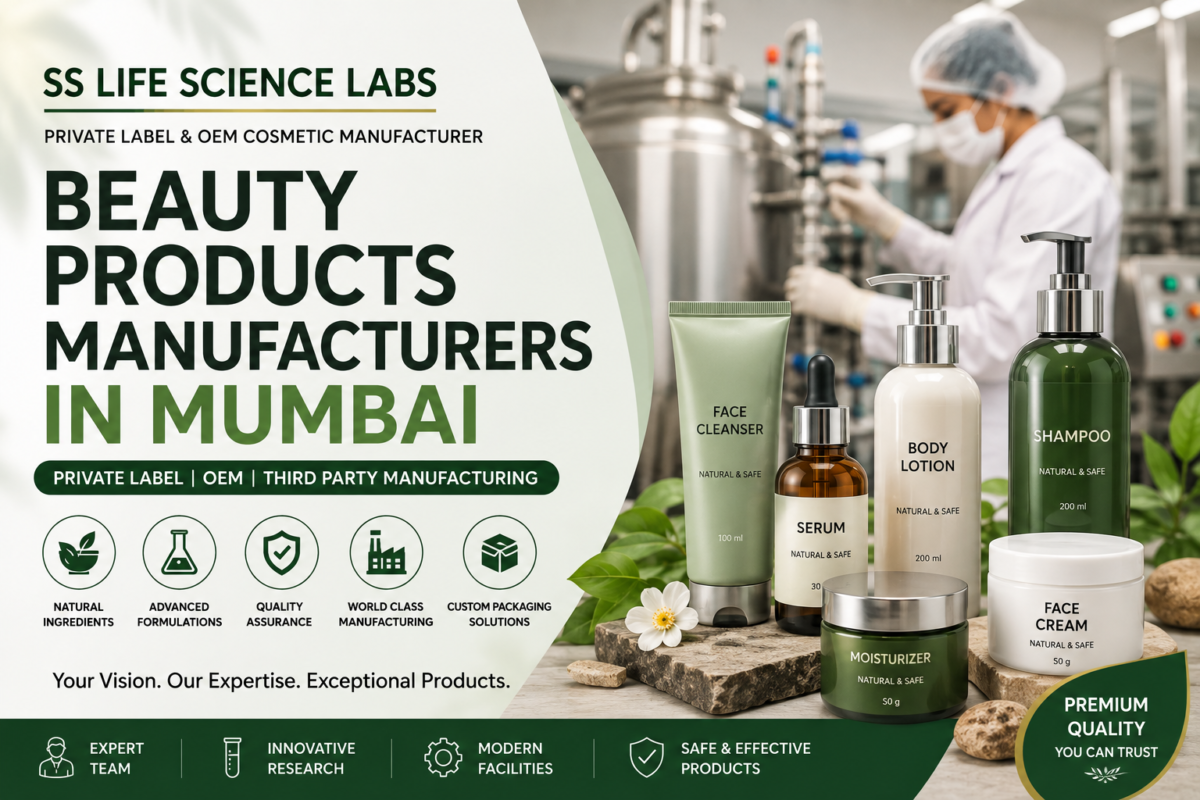
Beauty Products Manufacturers in Mumbai: Complete Guide for Beauty Brands 2026
Mumbai is more than one of India’s largest commercial centres. It is a city where beauty, fashion, retail, entertainment, digital commerce and consumer trends continuously intersect. For a beauty entrepreneur, skincare startup, salon-focused brand, retailer, distributor or established personal care company, this creates enormous opportunity—but opportunity alone does not build a successful beauty brand. Behind every serum, cleanser, shampoo, body lotion, face cream or personal care product is a manufacturing decision that can directly influence product quality, consistency, pricing, packaging and the ability to scale.
This is why choosing the right beauty products manufacturers in Mumbai should never begin and end with the question, “Who is offering the lowest price?” A manufacturing partner becomes part of the operational foundation of a beauty business. The right company should understand the intended product category, manufacturing model, quality expectations, order quantities, packaging requirements and long-term expansion plans.
At the same time, brands do not necessarily have to restrict their search to one city. A Mumbai-based business can compare local manufacturing options with an experienced Cosmetic Products Manufacturer in India to evaluate broader capabilities, product categories, private label services and scalability. The objective should be to identify the manufacturing arrangement that best fits the brand rather than simply choosing the nearest factory.
This complete 2026 guide explains what beauty product manufacturing involves, why manufacturer selection matters, how private label and OEM models differ, what products brands can consider, how MOQ and pricing work, what questions to ask, how startups should plan launches, and how to compare manufacturers systematically.
What Do Beauty Products Manufacturers in Mumbai Actually Do?
Beauty product manufacturing involves considerably more than filling creams or lotions into attractive containers. Depending on the company and the agreed scope of work, a manufacturer may support formulation selection, product customization, ingredient sourcing, production, filling, packaging coordination, batch-level processes and other services required to convert a product idea into a commercially viable beauty product.
Consider a startup that wants to introduce a skincare range containing a face cleanser, serum and moisturizer. The founders may understand their target audience and desired market positioning but may not own manufacturing equipment or have an in-house formulation and production team. A manufacturing partner can allow that company to concentrate on branding, distribution, marketing and customer acquisition while outsourcing agreed production responsibilities.
However, not every manufacturer provides the same services. One company may specialize primarily in skincare, another may have a broader personal care portfolio, while another may focus heavily on private label production.
Before approaching manufacturers, brands should therefore define exactly what they require.
Before approaching manufacturers, brands should therefore define exactly what they require.
| Brand Requirement | Questions to Consider |
|---|---|
| Product Category | Skincare, haircare, body care or personal care? |
| Manufacturing Model | Private label, OEM, third-party or custom? |
| Quantity | What is the expected first production volume? |
| Customization | Existing formulation or differentiated product? |
| Packaging | Bottle, jar, tube, pump, dropper or another format? |
| Market Positioning | Mass, premium, professional or another segment? |
| Timeline | When does the brand intend to launch? |
| Future Growth | Will more products/categories be introduced? |
A clear requirement makes manufacturer comparison far more meaningful.
Why Is Mumbai Important for Beauty and Cosmetic Brands?
Mumbai has a unique position in India’s consumer economy. Beauty businesses operating in or targeting the region can interact with a broad ecosystem involving retail, e-commerce, salons, fashion, entertainment, advertising, distribution and digital-first consumer brands.
For a beauty company, however, being located in a strong commercial market does not automatically solve manufacturing challenges. The manufacturer still needs to produce products that align with the intended customer, price point and brand proposition.
When evaluating beauty products manufacturers in Mumbai, businesses should consider the city as one part of a wider manufacturing strategy. Logistics and proximity can be useful, but they should be balanced against product capabilities, manufacturing model, quality processes, MOQ, packaging support, communication and scalability.
A beauty brand should ultimately ask:
Can this manufacturing partner support the products we want to sell today and the brand we want to build tomorrow?
That question is much more valuable than simply asking which manufacturer is closest.
Beauty Products Manufacturer vs Cosmetic Manufacturer: Is There a Difference?
The terms are often used broadly and can overlap.
A beauty products manufacturer may support products across skincare, haircare, body care, cosmetics and personal care. A cosmetic manufacturer can similarly operate across multiple cosmetic categories depending on its capabilities.
The important distinction is therefore not always the terminology used on the manufacturer’s website. Brands should examine the actual product categories and services available.
Businesses comparing Cosmetic Manufacturers in Delhi,or cosmetic manufacturers in Mumbai should follow the same principle: verify whether the manufacturer has relevant capabilities for your intended product rather than making assumptions based on the company’s marketing terminology.
What Beauty Products Can Brands Manufacture?
The beauty industry contains multiple categories, and a company does not need to enter all of them at once. A focused initial portfolio can often create stronger positioning than a large collection of unrelated products.
Skincare Products
Skincare can include products such as:
- Face cleansers
- Facial serums
- Moisturizers
- Face creams
- Toners
- Gels
- Scrubs
- Masks
- Body creams
- Other targeted skincare products
For a brand specifically planning this category, working with a relevant Skin Care Product Manufacturer can be more important than selecting a general supplier with an extremely large but unrelated product catalogue.
Skincare brands should think beyond individual products. A cleanser, serum and moisturizer, for example, can be positioned as a connected routine. This can simplify both manufacturing planning and customer communication.
Haircare Products
Haircare can potentially include shampoos, conditioners, hair oils, serums, masks and other category-specific products depending on manufacturer capabilities.
Product positioning is especially important here because consumers may choose haircare products according to concerns such as dryness, appearance, manageability, scalp care or styling preferences.
Body Care Products
Body washes, lotions, scrubs, creams and related products can allow skincare brands to extend into wider personal care categories.
Body care can also provide opportunities for fragrance-led positioning, gifting and routine-based product bundles.
Personal Care Products
The personal care category can include various everyday-use products. Brands entering this segment should consider usability, packaging, customer expectations, repeat purchase potential and price positioning.
Businesses researching personal care manufacturers Mumbai should ask which categories the manufacturer genuinely supports and whether those capabilities align with the intended portfolio.
Aromatherapy and Oil-Based Products
Aromatherapy and essential-oil categories can complement beauty and wellness portfolios when they fit the brand’s positioning. Companies considering this direction should evaluate an experienced Aromatherapy Oils Manufacturer in India for relevant product capabilities rather than assuming every cosmetic manufacturer specializes in oils.
The goal should not be to add as many categories as possible. Expansion should make commercial sense for the same or an adjacent customer audience.
Private Label Cosmetics Mumbai: What Does Private Label Mean?
Private label cosmetic manufacturing can provide a practical route for entrepreneurs who want to sell products under their own brand without establishing an independent production facility.
Depending on the manufacturing partner, a brand may be able to choose from available product options and customize selected elements such as packaging, presentation, fragrance or other supported specifications.
An experienced Private Label Cosmetics Supplier can therefore become particularly relevant for startups, retailers, salon brands, e-commerce companies and existing businesses expanding into beauty products.
Why do brands consider private label?
Private label can potentially provide:
- A simpler route to market
- Lower development complexity compared with highly customized projects
- Access to manufacturer-supported product categories
- Opportunity to create branded packaging
- Ability to test a category before wider expansion
- Reduced need for own manufacturing infrastructure
However, private label manufacturing does not replace brand strategy.
Two businesses can source similar product categories but achieve very different commercial results because of differences in positioning, packaging, distribution, marketing and customer experience.
Private Label vs OEM vs Third-Party Manufacturing
These manufacturing terms frequently appear during supplier research. Understanding the broad difference helps businesses communicate their requirements more clearly.
| Factor | Private Label | OEM | Third-Party | Custom Manufacturing |
|---|---|---|---|---|
| Best For | Startups/growing brands | Defined product requirements | Outsourced production | Differentiated brands |
| Customization | Low–Moderate | Moderate–High | Depends on agreement | High |
| Development Complexity | Lower | Moderate–Higher | Varies | Higher |
| Market Entry | Potentially faster | Depends on project | Depends on project | Usually more development |
| Brand Control | Moderate | Higher | Varies | Higher |
| Own Factory Required | No | No | No | No |
The boundaries between these models can vary from one manufacturer to another. Brands should therefore ask what is actually included rather than relying entirely on terminology.
What Is OEM Cosmetic Manufacturing?
OEM stands for Original Equipment Manufacturing. In the beauty sector, it generally refers to a manufacturing arrangement in which products are produced according to defined requirements of another business or brand.
A company may approach an OEM manufacturer because it wants more control over product characteristics, formulation direction, packaging or specifications than a basic private label arrangement provides.
For example, a premium skincare business may want a serum with a particular texture, sensory experience and brand positioning. Another company may want a more straightforward product designed for a broader market.
Both are “serums,” but their manufacturing requirements may differ considerably.
When comparing cosmetic manufacturers in Mumbai, brands interested in OEM production should ask:
- What can be customized?
- What information must the brand provide?
- How are samples handled?
- What MOQ applies?
- What packaging options are available?
- What is the approximate project workflow?
- How are repeat orders managed?
Specific answers matter more than an “OEM available” badge on a website.
What Is Third-Party Cosmetic Manufacturing?
Third-party manufacturing allows a company to outsource manufacturing activities to an external manufacturer.
This model can be relevant for businesses that want to focus their own resources on:
Branding → Sales → Distribution → Marketing → Customer Acquisition → Retail/E-commerce Expansion
instead of investing in their own manufacturing infrastructure.
Third-party manufacturing can be used by startups as well as established companies. The important question is whether the selected manufacturing arrangement supports the brand’s required product categories, quantities and quality expectations.
Private Label or Custom Manufacturing: Which Is Better?
Neither is universally better.
The correct option depends on the business.
| Business Situation | Potentially Suitable Model |
|---|---|
| First beauty startup | Private Label |
| Faster initial launch required | Private Label |
| Testing a new category | Private Label |
| Defined product requirements | OEM |
| Strong product differentiation | Custom Manufacturing |
| Existing company outsourcing production | Third-Party |
| Premium specialized concept | OEM / Custom |
| Large future product portfolio | Depends on manufacturing strategy |
A common startup mistake is assuming that maximum customization automatically creates a better brand. In reality, a well-positioned private label range can sometimes be more commercially practical than an expensive customized range launched without proven demand.
Likewise, an established premium brand may require greater differentiation than standard private label options provide.
The manufacturing model should support the commercial strategy of the brand.
How to Choose Beauty Products Manufacturers in Mumbai
Manufacturer selection should be systematic.
Step 1: Define Your Customer Before Your Product
Before deciding which cream, serum or shampoo to manufacture, understand who is expected to buy it.
Ask:
- What age/customer segment are we targeting?
- What problem or need are we addressing?
- What price range fits the customer?
- Where will the product be sold?
- What does the customer expect from packaging?
- What competing products already exist?
A product without a defined customer can become difficult to position even if manufacturing quality is good.
Step 2: Prepare a Product Brief
A basic manufacturing brief can include:
| Information | Example |
|---|---|
| Product | Facial Serum |
| Audience | Urban skincare consumers |
| Positioning | Premium |
| Manufacturing | Private Label/OEM |
| Quantity | Expected initial order |
| Packaging | Dropper/Pump |
| Customization | Required level |
| Sales Channel | Online/Retail |
| Launch | Target date |
Send approximately the same brief to shortlisted manufacturers so their proposals can be compared fairly.
Step 3: Evaluate Product Capabilities
If your business plans to sell skincare, prioritize skincare capability. If you plan to build a broad personal care brand, evaluate whether the manufacturer can support multiple relevant categories.
Do not select a manufacturer simply because it lists hundreds of products.
Relevant capability is more important than catalogue size.
Why Quality Matters More Than the Cheapest Manufacturing Quote
Cost is important. Every business needs commercially viable margins.
But selecting a manufacturer solely because it provides the lowest quotation can create other costs later.
Imagine three manufacturers:
| Factor | Manufacturer A | Manufacturer B | Manufacturer C |
|---|---|---|---|
| Unit Price | Lowest | Medium | Higher |
| Product Fit | Average | Strong | Strong |
| MOQ | High | Suitable | Suitable |
| Packaging Support | Limited | Good | Strong |
| Communication | Average | Strong | Strong |
| Scalability | Unknown | Good | Strong |
Manufacturer A may appear cheapest initially, but Manufacturer B could provide better overall value if the MOQ, product suitability and operational support fit the business more effectively.
The correct comparison is:
Manufacturing Value = Quality + Cost + MOQ + Capability + Reliability + Scalability
Not simply:
Manufacturing Value = Cheapest Price
This principle is equally important when evaluating manufacturers in Mumbai, Delhi, Surat, Vadodara or anywhere else.
What Is MOQ and Why Does It Matter?
MOQ stands for Minimum Order Quantity.
It refers to the minimum quantity a manufacturer requires for a particular product, variant, formulation or production arrangement.
MOQ has a direct impact on startup investment and inventory.
Suppose a brand wants:
- 5 products
- 3 variants each
- Different packaging for each range
The total inventory commitment can become much larger than expected if MOQ applies separately to every variant.
Ask manufacturers:
Does MOQ apply per product?
Per formulation?
Per fragrance?
Per shade?
Per packaging format?
These details should be clarified early.
How Much Does Beauty Product Manufacturing Cost in Mumbai?
There is no single accurate price applicable to every cosmetic or personal care product.
Manufacturing cost depends on multiple variables.
Product Type
A simple body-care product and a specialized skincare product can have very different manufacturing requirements.
Formulation
Ingredient selection and product specifications influence production economics.
Quantity
Production quantity can affect unit economics.
Packaging
Bottles, jars, tubes, pumps, droppers, labels, cartons and premium finishes can significantly influence the final cost.
Customization
A highly customized product may require more development work than an available private label option.
Additional Requirements
Project-specific quality, testing, packaging or documentation requirements can influence overall commercial terms.
Brands should therefore request quotations based on the same product brief before comparing prices.
Why Samples Matter Before Bulk Manufacturing
Where manufacturers provide sampling and where it is relevant to the project, samples can help businesses evaluate product characteristics before committing to larger quantities.
Depending on the product, brands may consider:
- Appearance
- Texture
- Fragrance
- Application experience
- Packaging compatibility
- Overall product positioning
Sampling also provides an opportunity to evaluate how effectively the manufacturer responds to feedback.
A brand should avoid making a major production decision purely from product descriptions and pricing when appropriate product evaluation is possible.
Packaging Is Part of the Product Experience
A consumer does not experience a beauty formulation in isolation.
They see the packaging first. They hold the container. They open the closure. They use the pump, tube or dropper. They read the label.
Packaging is therefore both functional and commercial.
Important packaging considerations
| Element | Why It Matters |
|---|---|
| Bottle/Jar/Tube | Product compatibility & presentation |
| Closure | Ease of use |
| Pump/Dropper | Dispensing experience |
| Label | Brand communication |
| Outer Carton | Presentation/protection |
| Material | Cost and positioning |
| Size | Pricing and usage |
| Finish | Premium/mass-market perception |
Packaging should not be left until the final stage of the project.
How Does the Beauty Product Manufacturing Process Work?
The exact workflow depends on the manufacturer and product, but a typical project can be understood through the following stages.
Stage 1 – Brand Requirement
The business communicates product category, intended customer, quantity, manufacturing model and other requirements.
Stage 2 – Product Direction
The parties determine whether an available private label product, OEM arrangement or customized development route is appropriate.
Stage 3 – Product Evaluation
Where applicable, samples or product options are reviewed.
Stage 4 – Packaging Planning
Packaging requirements are discussed and finalized according to the agreed project scope.
Stage 5 – Commercial Confirmation
Price, MOQ, responsibilities, specifications and production expectations are confirmed.
Stage 6 – Manufacturing
The product is manufactured according to agreed requirements and applicable manufacturing processes.
Stage 7 – Filling and Packaging
Products are filled and packed according to the finalized arrangement.
Stage 8 – Dispatch
Finished goods are prepared for dispatch according to agreed commercial terms.
A clear workflow helps both parties understand responsibilities and reduces avoidable confusion.
Manufacturer Comparison Scorecard
When evaluating several beauty products manufacturers in Mumbai, use a structured scorecard rather than relying on sales presentations.
| Selection Factor | Weight | Manufacturer A | Manufacturer B | Manufacturer C |
|---|---|---|---|---|
| Product Quality | 20% | /10 | /10 | /10 |
| Category Experience | 15% | /10 | /10 | /10 |
| Manufacturing Capability | 15% | /10 | /10 | /10 |
| MOQ Suitability | 10% | /10 | /10 | /10 |
| Commercial Terms | 10% | /10 | /10 | /10 |
| Customization | 10% | /10 | /10 | /10 |
| Packaging Support | 5% | /10 | /10 | /10 |
| Communication | 5% | /10 | /10 | /10 |
| Production Planning | 5% | /10 | /10 | /10 |
| Scalability | 5% | /10 | /10 | /10 |
| Total | 100% |
This framework makes supplier selection more objective.
Mumbai vs Other Manufacturing Locations: Should Location Decide?
Location matters, but it should not dominate the decision.
A Mumbai-based company may prefer a nearby supplier because of logistics or communication. However, a manufacturer elsewhere in India may provide stronger capabilities for the intended product category.
This is why businesses should compare suppliers across regions when appropriate.
For example, brands researching western India can also review the manufacturing-selection principles covered in Cosmetic Manufacturers in Surat and Cosmetic Manufacturers in Vadodara. These city-specific guides help businesses compare factors such as private label services, OEM capabilities, MOQ, product categories and supplier selection rather than relying exclusively on geography.
A simple comparison framework is:
| Factor | Local Manufacturer | Manufacturer Elsewhere |
|---|---|---|
| Logistics | Potentially easier | Requires planning |
| Communication | May allow easier visits | Can be managed remotely |
| Product Capability | Varies | Varies |
| Pricing | Varies | Varies |
| MOQ | Varies | Varies |
| Quality | Must be evaluated | Must be evaluated |
| Scalability | Must be evaluated | Must be evaluated |
There is no automatic winner.
How Should a New Beauty Brand Launch in 2026?
New businesses often assume that a larger catalogue makes them appear more established.
That can create unnecessary complexity.
A more controlled strategy is:
Research → Position → Select Category → Choose Hero Products → Find Manufacturer → Evaluate → Package → Launch → Measure → Expand
For example, instead of launching 15 skincare products immediately, a startup could begin with:
1 Cleanser + 1 Serum + 1 Moisturizer
This creates a simple routine.
The brand can focus its marketing budget on three products, understand customer response and then introduce additional products based on actual demand.
Building a Skincare Brand: Product Portfolio Example
A skincare brand can structure expansion in phases.
| Phase | Products | Objective |
|---|---|---|
| Phase 1 | Cleanser + Serum + Moisturizer | Core routine |
| Phase 2 | Toner + Mask | Routine expansion |
| Phase 3 | Body Care | Category expansion |
| Phase 4 | Haircare / Oils | Wider portfolio |
This approach reduces initial complexity and allows product expansion to follow business growth.
For businesses particularly focused on skincare, evaluating the right skincare products manufacturer Mumbai or a capable national manufacturing partner should begin with the Phase 1 requirements rather than the entire future catalogue.
What Should Established Beauty Brands Look For?
An established company generally evaluates manufacturers differently from a startup.
Initial MOQ may become less important, while other considerations gain importance:
- Production capacity
- Repeat-order consistency
- Multiple product categories
- Packaging coordination
- Production planning
- Communication structure
- Ability to support larger quantities
- New-product development capability
A manufacturer that worked well for a small launch may not automatically remain the ideal partner when the brand grows significantly.
Businesses should periodically review whether their manufacturing arrangement still supports their commercial direction.
Common Mistakes Beauty Brands Should Avoid
1. Choosing Only by Price
Low cost can be attractive, but quality, MOQ, communication and scalability also have commercial value.
2. Launching Too Many Products
A large catalogue increases inventory, packaging and marketing complexity.
3. Ignoring MOQ Until the End
MOQ should be understood before a brand commits to multiple SKUs.
4. Finalizing Packaging Too Late
Packaging can affect cost, timelines and product presentation.
5. Comparing Different Quotations
Manufacturers should receive similar requirements if quotations are going to be compared fairly.
6. Not Understanding the Manufacturing Model
Private label, OEM and third-party arrangements can involve different responsibilities.
7. Weak Customer Positioning
A manufacturer produces the product; it does not automatically create demand for the brand.
8. Ignoring Future Scalability
Ask what happens when order quantities increase.
Questions to Ask Beauty Products Manufacturers in Mumbai
Before selecting a partner, brands should ask structured questions.
| Question | Why Ask It? |
|---|---|
| Which product categories do you manufacture? | Establish relevance |
| Do you provide private label services? | Determine launch options |
| Do you support OEM requirements? | Assess customization |
| What is your MOQ? | Plan inventory |
| Can products be sampled? | Evaluate suitability |
| What can be customized? | Understand differentiation |
| Who handles packaging? | Clarify responsibility |
| What is the production workflow? | Plan timeline |
| How are repeat orders handled? | Assess operations |
| Can production scale? | Prepare for growth |
Keep written records of important commercial discussions.
How to Compare Private Label Cosmetics Mumbai Suppliers
Private label manufacturers should not be compared only on the number of available products.
Evaluate four broad areas.
1. Product Fit
Does the available range actually match your target customer?
2. Brand Fit
Can the products and packaging support your desired positioning?
3. Commercial Fit
Do MOQ and pricing work within your financial model?
4. Growth Fit
Can the supplier support additional products and quantities later?
A manufacturer that performs reasonably across all four areas may be more valuable than one that excels only in price.
Why Communication Matters in Cosmetic Manufacturing
Communication is an operational factor.
A beauty manufacturing project can involve product requirements, samples, packaging, quantities, specifications, commercial terms and timelines. Poor communication increases the chance of misunderstanding.
Pay attention to communication from the first enquiry.
Does the supplier answer specific questions?
Are requirements documented?
Are responsibilities clear?
Does the company explain what information it needs from the brand?
Professional communication before production can be an important indicator of how future coordination may work.
How Can Beauty Brands Prepare for AI-Driven Search and Digital Discovery?
In 2026, beauty brands are increasingly discovered across traditional search results, AI-assisted search experiences, marketplaces, social media, creator content and direct recommendations. This means manufacturers and brands both benefit from providing clear, useful and structured information online.
For a beauty brand, product pages should clearly explain what the product is, who it is for, how it fits into a routine, key characteristics and relevant usage information rather than relying only on promotional slogans.
For manufacturing businesses, useful content should answer real buyer questions such as:
- What is private label manufacturing?
- How does MOQ work?
- How should a manufacturer be selected?
- What products can be manufactured?
- What is the difference between OEM and private label?
- How does the manufacturing process work?
Clear answers make content more useful to both users and search systems.
Who Should Consider Private Label Beauty Products?
Private label manufacturing is not limited to traditional cosmetic companies.
Depending on the business model, it may be considered by:
- Beauty startups
- E-commerce entrepreneurs
- Retail businesses
- Salon businesses
- Existing skincare brands
- Personal care companies
- Distributors
- Wellness brands
- Businesses expanding into beauty
The suitability still depends on product strategy, investment, MOQ and market opportunity.
When Is the Right Time to Add New Beauty Products?
Expansion should ideally follow evidence rather than excitement.
Possible indicators include:
Existing products are generating repeat demand.
Customers are requesting complementary products.
Distribution has expanded.
The brand has sufficient marketing capacity.
Inventory management is stable.
The new category fits the existing audience.
For example, a successful skincare company might logically expand into body care before entering an unrelated category.
Portfolio expansion should strengthen the brand rather than dilute it.
Where Should Beauty Brands Sell Their Products?
Manufacturing is only one part of the business model.
Brands should consider distribution before production because sales channels can influence packaging, pricing and quantity decisions.
Potential channels include:
| Channel | Consideration |
|---|---|
| Own Website | Brand control |
| Online Marketplaces | Large customer reach |
| Social Commerce | Discovery-led sales |
| Retail Stores | Physical visibility |
| Salons | Professional audience |
| Distributors | Wider geographic reach |
| Export | Additional requirements and planning |
A product intended primarily for premium direct-to-consumer sales may require different positioning from one designed for broad offline distribution.
How to Build a Long-Term Relationship With a Manufacturer
Once a suitable manufacturing partner is selected, the relationship should be managed professionally.
Brands can improve coordination by:
- Providing clear forecasts where possible
- Finalizing requirements before production
- Maintaining written specifications
- Planning repeat orders in advance
- Communicating packaging changes clearly
- Sharing structured feedback
- Discussing expansion plans before they become urgent
A manufacturer should understand what the brand requires, while the brand should understand the manufacturer’s processes and limitations.
When Should You Consider Changing a Manufacturing Partner?
Changing manufacturers is a significant decision, particularly for established products.
However, a business may need to evaluate alternatives if:
- Production capacity no longer supports growth
- Required categories are unavailable
- Communication becomes consistently difficult
- MOQ becomes commercially unsuitable
- Product requirements have changed
- Packaging needs have evolved
- Scaling requirements cannot be supported
The transition should be carefully planned to protect product consistency and supply continuity.
A Practical Manufacturer Selection Checklist
Before making the final decision, confirm that you have evaluated:
| Check | Status |
|---|---|
| Product category capability | ☐ |
| Manufacturing model | ☐ |
| Product/sample evaluation | ☐ |
| MOQ | ☐ |
| Commercial quotation | ☐ |
| Packaging responsibility | ☐ |
| Customization | ☐ |
| Production workflow | ☐ |
| Communication | ☐ |
| Repeat-order process | ☐ |
| Scalability | ☐ |
| Relevant quality requirements | ☐ |
Do not rush through this stage simply because the brand wants to launch quickly.
Frequently Asked Questions
What do beauty products manufacturers in Mumbai offer?
Services vary by manufacturer but may include skincare, haircare, body care and personal care manufacturing along with private label, OEM, third-party manufacturing, filling or packaging-related support. Businesses should confirm the exact scope with each manufacturer.
How do I choose the best beauty products manufacturer in Mumbai?
Start with your product requirements and compare manufacturers according to relevant category experience, product quality, MOQ, customization, packaging support, commercial terms, communication and scalability. “Best” depends on your brand’s requirements.
Are private label cosmetics suitable for new beauty brands?
Private label can be suitable for businesses that want to launch branded cosmetic products without building their own manufacturing facility. The decision should still consider MOQ, product positioning, differentiation and budget.
What is the difference between OEM and private label cosmetics?
Private label generally offers a more streamlined route using manufacturer-supported product options, while OEM can involve more defined brand-specific manufacturing requirements. The exact scope varies between manufacturers.
What is third-party cosmetic manufacturing?
Third-party manufacturing is an arrangement where a business outsources agreed manufacturing activities to an external manufacturer rather than producing the goods within its own facility.
What does MOQ mean in cosmetic manufacturing?
MOQ means Minimum Order Quantity. It is the minimum quantity required for a specific product or manufacturing arrangement.
Can a manufacturer produce both skincare and personal care products?
Some manufacturers support multiple categories while others specialize. Brands should verify capabilities for every intended category.
Can Mumbai brands work with manufacturers outside Mumbai?
Yes. A business can evaluate manufacturers across India based on product capabilities, quality expectations, logistics, commercial suitability and scalability rather than restricting its search entirely by city.
Should a beauty startup launch many products at once?
Not necessarily. A smaller collection of strategically selected hero products can make inventory, positioning and marketing easier to manage during the initial launch.
How important is packaging in cosmetic manufacturing?
Packaging is important because it affects functionality, presentation, customer experience, positioning and overall product cost. It should be considered relatively early in the manufacturing process.
Should I request samples before bulk manufacturing?
Where sampling is available and appropriate, it can help businesses evaluate product characteristics before making a larger production commitment.
What should I ask a private label cosmetics manufacturer?
Ask about product categories, MOQ, customization, samples, packaging, production workflow, commercial terms, repeat orders and scalability.
How can established beauty brands select manufacturers?
Established brands should pay particular attention to capacity, repeat-order consistency, multi-category support, communication, packaging coordination and ability to scale production.
Is the cheapest cosmetic manufacturer always the best choice?
No. Price is important, but product suitability, quality, MOQ, communication, packaging and scalability can materially affect the overall value of a manufacturing relationship.
What should beauty brands prioritize in 2026?
Brands should prioritize clear customer positioning, product consistency, manufacturing reliability, sensible inventory planning, differentiated branding and scalable operations.
Final Thoughts: Choosing Beauty Products Manufacturers in Mumbai in 2026
Choosing among beauty products manufacturers in Mumbai is not simply a sourcing exercise. The manufacturing decision can influence product quality, inventory requirements, packaging, commercial margins, launch timelines and the brand’s ability to expand.
A new business should begin by understanding its customer and defining a focused product strategy. Once the product category and positioning are clear, the brand can determine whether private label, OEM, third-party or customized manufacturing is appropriate. Manufacturers should then be compared against the same requirements rather than judged only by their marketing claims or quoted price.
For startups, a smaller launch can often provide valuable flexibility. Three well-positioned products with a coherent brand story may create a stronger foundation than fifteen products without clear demand. As customer response becomes clearer, additional categories can be introduced strategically.
Established businesses should look further ahead. Production capacity, repeat-order consistency, category expansion and scalability can become just as important as the immediate product quotation.
Mumbai offers a significant commercial environment for beauty businesses, but modern brands do not have to treat geography as a limitation. Manufacturers in Mumbai and elsewhere can be evaluated objectively using product capability, quality expectations, MOQ, manufacturing model, packaging support, communication and long-term fit.
Ultimately, the right manufacturing partner is not necessarily the company with the largest catalogue, the closest facility or the cheapest price. It is the company whose manufacturing capabilities align most effectively with your products, customers, commercial model and long-term brand strategy.
Related Cosmetic Manufacturing Guides
Cosmetic Manufacturers in Hyderabad
Cosmetic Manufacturers in Vadodara
Cosmetic Manufacturers in Surat
Cosmetic Manufacturers in Delhi
Cosmetic Manufacturing Companies in Delhi
Best Cosmetic Company in Delhi