
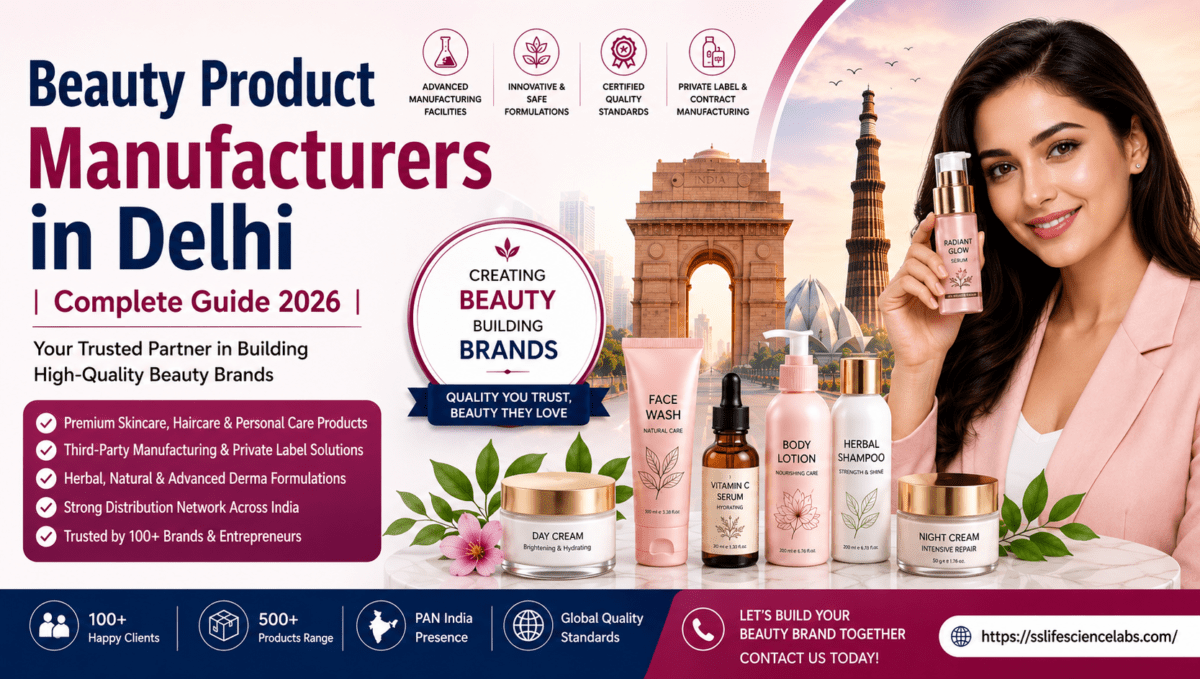
How to Find Trusted Beauty Product Manufacturers in Delhi: Complete Guide for Brands
Finding the right Beauty Product Manufacturers in Delhi is an important decision for anyone planning to start a beauty brand or expand an existing product range. Your manufacturer can affect product quality, consistency, packaging, production planning, cost, and ultimately the experience your customers have with your brand.
Delhi and the surrounding region offer many options for cosmetic and beauty product manufacturing. This gives brands more choice, but it can also make the selection process confusing. Two manufacturers may look similar online while offering very different product categories, minimum order quantities, formulation options, customization, packaging support, and manufacturing services.
This is why choosing a manufacturer should not begin with one question: “Who is offering the lowest price?”
A better approach is to first understand what your brand needs and then compare manufacturers against those requirements.
SS LifeScience Labs works with brands looking for cosmetic and beauty product manufacturing solutions. Whether you are considering SS LifeScience Labs or comparing different manufacturers, your decision should be based on your actual products, target customers, quantities, budget, and future plans.
This guide will help you understand what to check, which questions to ask, how to compare manufacturers, and what to review before moving ahead with bulk production.
What Does a Beauty Product Manufacturer Do?
A beauty product manufacturer helps brands move from a product idea toward a finished product that can eventually be sold in the market.
Depending on the manufacturer and manufacturing model, the process may involve product formulation options, sample development, manufacturing, filling, packaging support, labeling, and other production-related requirements.
However, every manufacturer does not provide exactly the same services.
One company may mainly work with Skin Care Product Manufacturer , while another may offer manufacturing across skincare, haircare, body care, personal care, and other beauty categories.
The level of customization can also differ. Some manufacturers may provide existing product options, while others may support different levels of product development or customization based on the requirements of the brand.
Therefore, seeing the words “cosmetic manufacturer” on a website is not enough to decide whether that company is right for you.
You need to understand whether it can actually support the products you want to launch.
If you are entering private-label manufacturing for the first time, our How to Choose the Best Private Label Cosmetics Supplier in India 2026: Complete Buyer’s Guide explains the important factors brands should consider while evaluating a manufacturing partner.
Define Your Brand Requirements Before Contacting Manufacturers
One of the most common mistakes new beauty brands make is contacting manufacturers before deciding what they actually want to sell.
You do not need to know the technical formulation of every product before your first discussion. However, you should have a basic idea of your product category, target customer, initial range, positioning, expected quantity, and approximate budget.
For example, simply telling a manufacturer:
“I want to start a beauty brand. Please send me your catalogue and prices.”
may result in a huge list of products without helping you decide what your brand actually needs.
A clearer requirement would be:
“We are planning to launch an initial skincare range with a face cleanser, serum, and moisturizer. We would like to understand the available manufacturing options, MOQ for each product, sample process, customization, packaging support, and commercial requirements.”
This gives the manufacturer useful information and helps keep the discussion focused.
It also makes it easier for you to compare multiple Beauty Product Manufacturers in Delhi because you can send approximately the same requirement to every shortlisted company.
Start With Your Target Customer
Before choosing products, think about the person who is expected to buy them.
Ask yourself:
Who is the product for?
What type of beauty or skincare problem is the customer trying to address?
What price range is appropriate for this customer?
Where do you plan to sell the product?
What type of product experience do you want to create?
These questions can help you avoid building a product range simply because certain products are available in a manufacturer’s catalogue.
For example, if your brand is positioned around a simple skincare routine, launching many unrelated beauty products at the same time may make your positioning less clear.
A smaller and more focused range can sometimes be easier for customers to understand and easier for the brand to market.
Prepare a Simple Product Requirement Sheet
Before contacting manufacturers, prepare a basic requirement sheet.
It does not need to contain complicated technical information. The purpose is simply to organize your ideas before discussions begin.
| Requirement | What You Need to Decide |
|---|---|
| Product Category | Skincare, haircare, body care, personal care, etc. |
| Initial Products | Products you want to launch first |
| Target Customer | Who you expect to buy them |
| Brand Positioning | Affordable, mid-range, premium, professional, etc. |
| Approximate Quantity | Expected requirement per SKU |
| Formulation | Existing option or customization required |
| Packaging | Own packaging or manufacturer support required |
| Budget | Approximate budget for the initial range |
| Launch Plan | When you expect to launch |
You do not need a final answer for every point at this stage.
Even approximate information gives you a much better starting point than entering manufacturer discussions without a clear plan.
If you are still deciding what type of skincare or haircare range to build, Top Trending Skincare and Haircare Products for 2025: What Brands Should Be Offering can provide additional ideas while you research possible product categories.
Understand Private Label, OEM and ODM Before Choosing
While searching for Beauty Product Manufacturers in Delhi, you may frequently see terms such as Private Label, OEM, and ODM.
Do not choose a manufacturing model simply because one term sounds more professional than another.
What matters is the level of product development and customization your brand actually requires.
Private Label Manufacturing
Private label can be relevant for businesses that want products manufactured under their own brand without setting up their own production facility.
The exact level of customization and service available can vary between manufacturers, so always ask what is included.
OEM Manufacturing
OEM may be suitable when a brand has more defined product requirements and needs manufacturing according to agreed specifications.
Again, the exact process and available options depend on the manufacturer.
ODM Manufacturing
ODM can involve broader product development and manufacturing support, depending on the company’s service model.
Instead of assuming what each term means in a particular company, ask the manufacturer to explain what its private label, OEM, or ODM service includes for your specific products.
For a deeper comparison, read Private Label Cosmetics vs OEM vs ODM Cosmetics: Which Manufacturing Model Is Right for Your Brand? before deciding which manufacturing approach fits your business.
Search for Manufacturers Based on Product Fit
Once your basic requirements are clear, you can start building a manufacturer shortlist.
Do not begin by searching only for the “biggest” or “cheapest” manufacturer.
Start by finding companies that appear capable of supporting the product categories you actually need.
If you are planning a skincare range, review the company’s skincare manufacturing options. If haircare, body care, or personal care products are part of your current or future plans, evaluate those capabilities separately.
Visit the manufacturer’s website and understand the services and product categories it presents. Then prepare questions about anything that is important but unclear.
After your initial research, shortlist around three to five relevant manufacturers rather than contacting a very large number of companies.
SS LifeScience Labs can be included in this comparison when brands are evaluating a Cosmetic Products Manufacturer in India for beauty, skincare, haircare, personal care, or related manufacturing requirements.
Send Similar Requirements to Every Shortlisted Manufacturer
A fair comparison requires similar information.
If you ask Manufacturer A for 500 units of three products but ask Manufacturer B for 2,000 units of six products, comparing their quotations will not tell you which manufacturer is actually more suitable.
Prepare one basic enquiry and use the same product requirements when starting discussions with shortlisted manufacturers.
Record the answers in a spreadsheet or document.
You can track:
| Comparison Point | Manufacturer A | Manufacturer B | Manufacturer C |
|---|---|---|---|
| Required Products Available | Yes/No | Yes/No | Yes/No |
| MOQ Suitable | Yes/No | Yes/No | Yes/No |
| Samples Available | Yes/No | Yes/No | Yes/No |
| Customization Available | Yes/No | Yes/No | Yes/No |
| Packaging Support | Yes/No | Yes/No | Yes/No |
| Commercial Terms Clear | Yes/No | Yes/No | Yes/No |
| Repeat Order Support | Yes/No | Yes/No | Yes/No |
| Communication | Good/Average/Poor | Good/Average/Poor | Good/Average/Poor |
This makes your decision much easier than trying to remember several WhatsApp chats, calls, catalogues, and quotations.
Understand MOQ Before Finalizing Your Product Range
MOQ means Minimum Order Quantity. It is the minimum quantity a manufacturer requires for a particular product or production arrangement.
This is especially important for new beauty brands.
Suppose you plan to launch eight products and each SKU requires its own minimum quantity. Your total inventory and investment can become much larger than expected.
Ask the manufacturer about the applicable MOQ for each product you are considering.
Also ask whether customization, packaging, formulation requirements, or other project details can affect the required quantity.
Do not automatically choose the manufacturer offering the lowest MOQ. A manageable MOQ is useful, but it should be considered alongside product suitability, samples, manufacturing support, packaging, and overall commercial requirements.
For a new beauty business, launching a smaller number of carefully selected products can sometimes be more practical than creating a large catalogue before you know what customers will actually buy.
Review Samples Before Moving Toward Bulk Production
Samples give you an opportunity to understand the product before committing to a larger order.
Depending on the product, review relevant factors such as appearance, texture, fragrance, feel, usability, and how the product works with the proposed packaging.
Compare the sample against your original product brief instead of judging it only on whether you personally like it.
For example, a rich cream may feel premium, but if your original plan was a lightweight product for your target customer, it may not match the product you intended to create.
Keep simple written notes for every sample.
Instead of writing:
“Sample 2 is good.”
write:
“Face Serum – Sample 02: texture matches the planned direction; fragrance needs further discussion; packaging not yet finalized.”
This becomes particularly useful when several products and sample versions are being reviewed at the same time.
Do Not Choose a Manufacturer Based Only on Price
Price is an important part of manufacturer selection, but it should not decide everything.
A lower manufacturing quotation may not necessarily mean a lower final product cost.
One manufacturer may quote only for manufacturing while another quotation may cover additional requirements. Packaging, printing, samples or development where applicable, transportation, and other agreed expenses can also affect your total investment.
Ask each manufacturer what is included in the quotation and what needs to be considered separately.
This gives you a fairer comparison and helps you understand whether the product fits your planned selling price.
Brands exploring outsourced production can also read 3rd Party Cosmetic Manufacturing in India | OEM Cosmetics for additional information about this manufacturing route.
Think About the Complete Product Cost
Before approving production, consider the complete finished-product cost rather than looking only at the manufacturing price per unit.
Depending on your arrangement, the overall cost may involve manufacturing, primary packaging, labels or printing, outer packaging, product development or samples where applicable, transportation, and other agreed requirements.
Ask for actual project-specific information rather than filling your calculations with random estimated prices.
You also need to leave room in your business plan for costs outside manufacturing, such as marketing, logistics, website operations, marketplace charges where applicable, and other expenses involved in selling the product.
A product may appear affordable during the initial manufacturing discussion but become difficult to price once all relevant business expenses are considered.
Working this out before bulk production gives you more flexibility to adjust the product range or packaging plan if needed.
Evaluate SS LifeScience Labs Using the Same Process
If SS LifeScience Labs is part of your manufacturer shortlist, evaluate it using the same practical criteria you would use for any other company.
Discuss the exact products you want to manufacture, expected quantities, manufacturing model, formulation or customization requirements, sample process, packaging needs, and commercial considerations.
Do not select any manufacturer only because it uses words such as “trusted,” “premium,” or “experienced.” Your own product requirements should remain the basis of the decision.
Brands researching the company’s manufacturing positioning can also read Why SSL Life Science Labs is a Trusted Cosmetic Products Manufacturer in India as part of their wider research.
The final question should always be whether the available manufacturing solution makes sense for your particular beauty brand.
Check Product Quality Before You Approve Manufacturing
Once you have shortlisted suitable Beauty Product Manufacturers in Delhi, the next step is to look more closely at product quality. A catalogue can show you what a manufacturer offers, but it cannot tell you whether a particular product is right for your brand.
Quality should be discussed before bulk production, not after your products are ready.
Ask the manufacturer how product requirements are managed during production and what quality-related checks are relevant to the products you are planning to manufacture. If a particular certification, manufacturing standard, or testing requirement is important to your business, discuss it directly and ask for relevant information where appropriate.
You do not need to understand every technical part of cosmetic manufacturing. However, you should understand enough about the process to know what you are approving.
The most important point is that the finished product should match the requirements agreed between your brand and the manufacturer.
Product Consistency Matters for Repeat Customers
Your first sample may look and feel exactly how you want it, but consistency becomes even more important after customers start buying the product.
Imagine that customers purchase your moisturizer and like its texture and overall experience. A few months later, they reorder it and notice that the new product feels noticeably different.
From the customer’s point of view, this is not a manufacturing issue. It is a brand experience issue because your name is on the product.
Before approving production, ask how the final product requirements are recorded and referred to when repeat orders are manufactured.
Your brand should also maintain its own records of approved samples, packaging, artwork, and other important product information.
This becomes increasingly important as your product range grows.
Understand Your Formulation Options
Different beauty brands need different levels of formulation support.
Some brands may prefer to evaluate available product options and select something suitable for their target market. Others may have more specific requirements and want to discuss customization.
There is no single approach that works for every brand.
The right choice depends on your target customer, product positioning, budget, expected quantity, and how different you want the product to be from other options in the market.
When discussing formulation with SS LifeScience Labs, explain the product experience you are trying to create instead of simply saying:
“We need a premium serum.”
A more useful brief could explain that you want a lightweight serum for a particular customer segment, have a preferred product feel, want to discuss specific formulation requirements, and plan to sell within a particular market position.
Clear requirements make the conversation much more useful.
Do Not Add Ingredients Only Because They Are Trending
Beauty trends can change quickly. An ingredient may suddenly become popular across social media, advertisements, and competitor products.
That does not mean it belongs in every formulation.
Start with the purpose of the product.
Ask what you want the product to add to your range, who will use it, and how it fits your overall brand positioning.
Then discuss suitable formulation options with the manufacturer.
Adding ingredients simply because they are currently popular can make your product concept unnecessarily complicated. Changes may also affect other aspects of product development.
Your goal should be to create a product with a clear purpose rather than trying to include every trend in one formula.
Give Clear Feedback During Sample Development
Receiving a sample is only part of the development process. The quality of your feedback also matters.
Avoid vague comments such as:
“It doesn’t feel premium enough.”
Explain what you actually want changed.
For example:
“The texture feels heavier than the product direction we planned. We would prefer to discuss a lighter feel for the next version.”
This tells the manufacturer what you are reacting to.
If you are reviewing several products, keep feedback separate for each SKU. Do not combine comments about a serum, moisturizer, cleanser, and shampoo in one unclear message.
This makes revisions easier to track and reduces confusion.
Understand What “Customization” Means for Your Product
You may see the word customization frequently while researching manufacturers, but it can cover different things depending on the company and product.
Ask what can actually be customized for the product you are discussing.
Depending on the project, brands may want to discuss aspects of the formulation, product experience, fragrance, packaging, or other requirements. The available options can differ from product to product.
Also ask whether the requested change affects other parts of the project.
A change that sounds small may affect the sample process, commercial requirements, MOQ, packaging, or production planning.
This is why customization should always have a business reason.
Do not keep changing a product simply because more options are available.
Keep Your Target Customer Involved in Every Product Decision
During product development, it is easy to become focused on what you personally like.
But you are not necessarily the customer.
Suppose you personally prefer a rich moisturizer, while your brand is being developed for customers looking for a lightweight daily-use product. Your personal preference should not automatically override the original product direction.
Return to your target customer whenever you review samples.
Ask:
Does this product fit the customer we are targeting?
Does the experience match our brand positioning?
Would it make sense at our planned selling price?
Does it fit naturally with the other products in our range?
These questions help keep product development connected to the business plan.
Plan Packaging Alongside the Product
Packaging should not be treated as the final decoration added after the product has already been developed.
It is part of the customer experience.
A bottle, pump, tube, jar, or another packaging format should make sense for the product inside it.
Something can look attractive in a photograph but still be inconvenient for customers to use.
For example, the way a product dispenses can affect the experience even when the formulation itself is good.
Discuss packaging requirements early enough that the product and packaging can be considered together.
For brands exploring private-label production, understanding how product development and manufacturing fit together is also important. Our Private Label Cosmetics Supplier in India: Complete OEM & ODM Manufacturing Guide (2026) provides more information about the overall private-label manufacturing approach.
Make Packaging Match Your Brand Positioning
Packaging does not need to be expensive to be effective.
It needs to make sense for the product and the customer.
If you are building a premium beauty brand, your presentation may be different from a brand focused on an affordable everyday range. But simply choosing expensive packaging will not automatically make customers see the product as premium.
The product, packaging, website, photography, pricing, and overall brand message should feel connected.
New brands should be especially careful about spending too much of their initial budget on packaging before they have tested customer demand.
A beautiful package is useful, but you also need money for inventory, marketing, logistics, website management, and other parts of the business.
Balance presentation with practicality.
Review Artwork Before It Goes Into Production
Once your packaging direction is finalized, artwork and labels become another important approval stage.
Do not approve artwork only because it looks good on a large computer screen.
Think about how it will appear on the actual bottle, tube, jar, or box.
Important text should be readable, the brand name should be presented clearly, and the final artwork should correspond with the product being manufactured.
Any information that needs to follow applicable product labeling or regulatory requirements should be handled appropriately before printing.
Take time to review spellings, product names, quantities, and other important details.
A small mistake in a design file can become a much larger problem if it is repeated across an entire production quantity.
Do Not Finalize Packaging Without Thinking About Shipping
Your product does not stay on a display shelf from the moment it is manufactured.
It may need to travel from the manufacturer to your warehouse, from your warehouse to a marketplace or fulfillment partner, and eventually to the customer.
Packaging decisions should therefore consider handling and transportation as well as appearance.
If you plan to sell primarily online, the customer may receive the product after several stages of shipping.
Think about how the complete product presentation will hold up through that process.
The outer shipping solution is separate from the cosmetic packaging itself, but both contribute to what the customer eventually receives.
Understand Production Planning Before Announcing a Launch Date
Do not announce a major launch date simply because your first sample has been approved.
Several steps may still need to be completed before finished inventory is ready.
Depending on the project, this can include final product approval, packaging arrangements, artwork, commercial confirmation, production, and other agreed stages.
Ask the manufacturer about the expected process for your project before committing to marketing dates.
If you have already paid influencers, scheduled advertising, announced a launch, or started taking customer interest, a delay can create unnecessary pressure.
A better approach is to build reasonable room into your launch plan.
This allows you to focus on getting the product right instead of approving decisions too quickly because a marketing deadline is approaching.
Ask About Repeat Production Before Your First Order
It may seem early to discuss repeat production when you have not even placed the first order, but this information can help you plan ahead.
Ask what you should know if you need the same product again.
For example, understand how the previously approved product requirements will be identified, whether packaging availability needs to be planned, and whether any important commercial or quantity considerations apply to repeat orders.
You do not need to predict exactly how much you will sell.
You simply need to understand how the next order would work if the product becomes successful.
This is one of the differences between thinking about a single manufacturing order and building a beauty brand for the longer term.
Evaluate Communication Throughout the Process
Communication is an important part of your experience with Beauty Product Manufacturers in Delhi.
Pay attention to how clearly important questions are answered.
If you ask about samples, MOQ, packaging, customization, or production, do you understand the response?
If something changes, is the updated requirement clear?
If you are developing several products, does everyone understand which version is currently being discussed?
You should not expect a manufacturer to respond instantly to every message. Some questions may require information from different teams.
What matters is whether important business decisions can be communicated clearly.
Keep Important Approvals in Writing
Calls and meetings can be useful for discussing ideas, but important decisions should also have a written record.
Keep your approved product information, final packaging selection, artwork, quantities, quotation, and other important agreed requirements organized.
If something changes during a call, send or request written confirmation of the updated requirement.
For example:
Face Serum – Final Product Review: Product version approved. Packaging finalized separately. Final quantity to follow the confirmed commercial order.
This is much clearer than depending on memory several months later.
When your range grows, good documentation becomes even more valuable.
Review SS LifeScience Labs Based on Your Actual Requirements
If you are considering SS LifeScience Labs for your beauty brand, use the same quality, formulation, packaging, and communication checks discussed above.
Do not evaluate the company only by the number of products shown in a catalogue.
Share your actual requirements and discuss what manufacturing options are suitable for those products.
If your business is specifically evaluating Delhi-based cosmetic companies, How to Choose the Best Cosmetic Company in Delhi: A Complete Guide for Beauty Brands can also help you understand the wider manufacturer-selection process.
The aim is to determine whether the manufacturing arrangement fits your brand rather than trying to force your product plan into whatever option is easiest to order.
Do a Final Product Review From the Customer’s Point of View
Before moving closer to bulk production, put all the technical and commercial discussions aside for a moment and look at the product like a customer.
Pick up the sample.
Look at the packaging.
Use the product in the way a customer would.
Think about whether the overall experience matches the brand you are trying to build.
A product can meet your internal requirements and still need improvement from a customer-experience perspective.
This final review can reveal practical issues that are easy to miss when you have spent weeks focusing on quotations, sample versions, and manufacturing discussions.
Your customer will never see those discussions.
They will only see and use the finished product.
Check Product Quality Before You Approve Manufacturing
Once you have shortlisted suitable Beauty Product Manufacturers in Delhi, the next step is to look more closely at product quality. A catalogue can show you what a manufacturer offers, but it cannot tell you whether a particular product is right for your brand.
Quality should be discussed before bulk production, not after your products are ready.
Ask the manufacturer how product requirements are managed during production and what quality-related checks are relevant to the products you are planning to manufacture. If a particular certification, manufacturing standard, or testing requirement is important to your business, discuss it directly and ask for relevant information where appropriate.
You do not need to understand every technical part of cosmetic manufacturing. However, you should understand enough about the process to know what you are approving.
The most important point is that the finished product should match the requirements agreed between your brand and the manufacturer.
Product Consistency Matters for Repeat Customers
Your first sample may look and feel exactly how you want it, but consistency becomes even more important after customers start buying the product.
Imagine that customers purchase your moisturizer and like its texture and overall experience. A few months later, they reorder it and notice that the new product feels noticeably different.
From the customer’s point of view, this is not a manufacturing issue. It is a brand experience issue because your name is on the product.
Before approving production, ask how the final product requirements are recorded and referred to when repeat orders are manufactured.
Your brand should also maintain its own records of approved samples, packaging, artwork, and other important product information.
This becomes increasingly important as your product range grows.
Understand Your Formulation Options
Different beauty brands need different levels of formulation support.
Some brands may prefer to evaluate available product options and select something suitable for their target market. Others may have more specific requirements and want to discuss customization.
There is no single approach that works for every brand.
The right choice depends on your target customer, product positioning, budget, expected quantity, and how different you want the product to be from other options in the market.
When discussing formulation with SS LifeScience Labs, explain the product experience you are trying to create instead of simply saying:
“We need a premium serum.”
A more useful brief could explain that you want a lightweight serum for a particular customer segment, have a preferred product feel, want to discuss specific formulation requirements, and plan to sell within a particular market position.
Clear requirements make the conversation much more useful.
Do Not Add Ingredients Only Because They Are Trending
Beauty trends can change quickly. An ingredient may suddenly become popular across social media, advertisements, and competitor products.
That does not mean it belongs in every formulation.
Start with the purpose of the product.
Ask what you want the product to add to your range, who will use it, and how it fits your overall brand positioning.
Then discuss suitable formulation options with the manufacturer.
Adding ingredients simply because they are currently popular can make your product concept unnecessarily complicated. Changes may also affect other aspects of product development.
Your goal should be to create a product with a clear purpose rather than trying to include every trend in one formula.
Give Clear Feedback During Sample Development
Receiving a sample is only part of the development process. The quality of your feedback also matters.
Avoid vague comments such as:
“It doesn’t feel premium enough.”
Explain what you actually want changed.
For example:
“The texture feels heavier than the product direction we planned. We would prefer to discuss a lighter feel for the next version.”
This tells the manufacturer what you are reacting to.
If you are reviewing several products, keep feedback separate for each SKU. Do not combine comments about a serum, moisturizer, cleanser, and shampoo in one unclear message.
This makes revisions easier to track and reduces confusion.
Understand What “Customization” Means for Your Product
You may see the word customization frequently while researching manufacturers, but it can cover different things depending on the company and product.
Ask what can actually be customized for the product you are discussing.
Depending on the project, brands may want to discuss aspects of the formulation, product experience, fragrance, packaging, or other requirements. The available options can differ from product to product.
Also ask whether the requested change affects other parts of the project.
A change that sounds small may affect the sample process, commercial requirements, MOQ, packaging, or production planning.
This is why customization should always have a business reason.
Do not keep changing a product simply because more options are available.
Keep Your Target Customer Involved in Every Product Decision
During product development, it is easy to become focused on what you personally like.
But you are not necessarily the customer.
Suppose you personally prefer a rich moisturizer, while your brand is being developed for customers looking for a lightweight daily-use product. Your personal preference should not automatically override the original product direction.
Return to your target customer whenever you review samples.
Ask:
Does this product fit the customer we are targeting?
Does the experience match our brand positioning?
Would it make sense at our planned selling price?
Does it fit naturally with the other products in our range?
These questions help keep product development connected to the business plan.
Plan Packaging Alongside the Product
Packaging should not be treated as the final decoration added after the product has already been developed.
It is part of the customer experience.
A bottle, pump, tube, jar, or another packaging format should make sense for the product inside it.
Something can look attractive in a photograph but still be inconvenient for customers to use.
For example, the way a product dispenses can affect the experience even when the formulation itself is good.
Discuss packaging requirements early enough that the product and packaging can be considered together.
For brands exploring private-label production, understanding how product development and manufacturing fit together is also important. Our Private Label Cosmetics Supplier in India: Complete OEM & ODM Manufacturing Guide (2026) provides more information about the overall private-label manufacturing approach.
How to Choose the Best Cosmetic Company in Delhi: A Complete Guide for Beauty Brands Match Your Brand Positioning
Packaging does not need to be expensive to be effective.
It needs to make sense for the product and the customer.
If you are building a premium beauty brand, your presentation may be different from a brand focused on an affordable everyday range. But simply choosing expensive packaging will not automatically make customers see the product as premium.
The product, packaging, website, photography, pricing, and overall brand message should feel connected.
New brands should be especially careful about spending too much of their initial budget on packaging before they have tested customer demand.
A beautiful package is useful, but you also need money for inventory, marketing, logistics, website management, and other parts of the business.
Balance presentation with practicality.
Review Artwork Before It Goes Into Production
Once your packaging direction is finalized, artwork and labels become another important approval stage.
Do not approve artwork only because it looks good on a large computer screen.
Think about how it will appear on the actual bottle, tube, jar, or box.
Important text should be readable, the brand name should be presented clearly, and the final artwork should correspond with the product being manufactured.
Any information that needs to follow applicable product labeling or regulatory requirements should be handled appropriately before printing.
Take time to review spellings, product names, quantities, and other important details.
A small mistake in a design file can become a much larger problem if it is repeated across an entire production quantity.
Do Not Finalize Packaging Without Thinking About Shipping
Your product does not stay on a display shelf from the moment it is manufactured.
It may need to travel from the manufacturer to your warehouse, from your warehouse to a marketplace or fulfillment partner, and eventually to the customer.
Packaging decisions should therefore consider handling and transportation as well as appearance.
If you plan to sell primarily online, the customer may receive the product after several stages of shipping.
Think about how the complete product presentation will hold up through that process.
The outer shipping solution is separate from the cosmetic packaging itself, but both contribute to what the customer eventually receives.
Understand Production Planning Before Announcing a Launch Date
Do not announce a major launch date simply because your first sample has been approved.
Several steps may still need to be completed before finished inventory is ready.
Depending on the project, this can include final product approval, packaging arrangements, artwork, commercial confirmation, production, and other agreed stages.
Ask the manufacturer about the expected process for your project before committing to marketing dates.
If you have already paid influencers, scheduled advertising, announced a launch, or started taking customer interest, a delay can create unnecessary pressure.
A better approach is to build reasonable room into your launch plan.
This allows you to focus on getting the product right instead of approving decisions too quickly because a marketing deadline is approaching.
Ask About Repeat Production Before Your First Order
It may seem early to discuss repeat production when you have not even placed the first order, but this information can help you plan ahead.
Ask what you should know if you need the same product again.
For example, understand how the previously approved product requirements will be identified, whether packaging availability needs to be planned, and whether any important commercial or quantity considerations apply to repeat orders.
You do not need to predict exactly how much you will sell.
You simply need to understand how the next order would work if the product becomes successful.
This is one of the differences between thinking about a single manufacturing order and building a beauty brand for the longer term.
Evaluate Communication Throughout the Process
Communication is an important part of your experience with Beauty Product Manufacturers in Delhi.
Pay attention to how clearly important questions are answered.
If you ask about samples, MOQ, packaging, customization, or production, do you understand the response?
If something changes, is the updated requirement clear?
If you are developing several products, does everyone understand which version is currently being discussed?
You should not expect a manufacturer to respond instantly to every message. Some questions may require information from different teams.
What matters is whether important business decisions can be communicated clearly.
Keep Important Approvals in Writing
Calls and meetings can be useful for discussing ideas, but important decisions should also have a written record.
Keep your approved product information, final packaging selection, artwork, quantities, quotation, and other important agreed requirements organized.
If something changes during a call, send or request written confirmation of the updated requirement.
For example:
Face Serum – Final Product Review: Product version approved. Packaging finalized separately. Final quantity to follow the confirmed commercial order.
This is much clearer than depending on memory several months later.
When your range grows, good documentation becomes even more valuable.
Review SS LifeScience Labs Based on Your Actual Requirements
If you are considering SS LifeScience Labs for your beauty brand, use the same quality, formulation, packaging, and communication checks discussed above.
Do not evaluate the company only by the number of products shown in a catalogue.
Share your actual requirements and discuss what manufacturing options are suitable for those products.
If your business is specifically evaluating Delhi-based cosmetic companies, How to Choose the Best Cosmetic Company in Delhi: A Complete Guide for Beauty Brands can also help you understand the wider manufacturer-selection process.
The aim is to determine whether the manufacturing arrangement fits your brand rather than trying to force your product plan into whatever option is easiest to order.
Do a Final Product Review From the Customer’s Point of View
Before moving closer to bulk production, put all the technical and commercial discussions aside for a moment and look at the product like a customer.
Pick up the sample.
Look at the packaging.
Use the product in the way a customer would.
Think about whether the overall experience matches the brand you are trying to build.
A product can meet your internal requirements and still need improvement from a customer-experience perspective.
This final review can reveal practical issues that are easy to miss when you have spent weeks focusing on quotations, sample versions, and manufacturing discussions.
Your customer will never see those discussions.
They will only see and use the finished product.
Turn Your Product Idea Into a Clear Manufacturing Plan
After selecting the manufacturer you want to work with, the next stage is moving from research and comparison to actual product development and production.
This is where many beauty brands make avoidable mistakes. They may have a clear idea in their mind but fail to communicate it properly to the manufacturer. As a result, several sample revisions are needed, packaging decisions keep changing, or the final cost becomes different from what was originally expected.
Whether you choose SS LifeScience Labs or another option among Beauty Product Manufacturers in Delhi, begin with a clear manufacturing plan.
Your plan should identify the products being developed, approximate quantities, product positioning, required customization, packaging direction, and any important requirements that have already been discussed.
The clearer the starting information, the easier it becomes to manage the stages that follow.
Finalize Your Initial Product Range
Before beginning detailed product development, decide which products will actually be included in your first launch.
You may have shortlisted many interesting products during manufacturer research, but that does not mean all of them need to launch together.
Think about how the products work as a range.
For example, a skincare-focused brand might begin with a cleanser, serum, and moisturizer rather than launching skincare, haircare, body care, and several unrelated products at the same time.
A focused range can make the launch easier to understand for customers. It can also simplify inventory management, product photography, website creation, marketing, and future reorder planning.
You can always expand after you have real information about what customers are buying.
Create a Separate Brief for Every Product
Once you know which products you want to launch, create an individual brief for each SKU.
Do not manage an entire product range through one general description.
A face serum, moisturizer, cleanser, shampoo, and body lotion can have very different requirements.
A basic product brief might include:
| Product Requirement | Details to Provide |
|---|---|
| Product Name/Type | What you want to manufacture |
| Target Customer | Intended customer group |
| Product Positioning | Affordable, mid-range, premium, etc. |
| Product Direction | The experience you want to create |
| Customization | Requirements you want to discuss |
| Packaging Preference | Bottle, tube, pump, jar, etc. |
| Approximate Quantity | Planned units/SKU |
| Launch Plan | Expected launch period |
Keep this document simple.
Its purpose is to make sure both your team and the manufacturer understand the same product direction.
Discuss What Is Practical Before Developing Samples
Your first product idea may change slightly after speaking with the manufacturer, and that is not necessarily a problem.
A manufacturing discussion can help you understand what is practical for your product, budget, quantity, packaging, and expected launch plan.
For example, you may have a particular packaging format in mind but discover that another option works better for the product. A customization request may also affect the development process or commercial requirements.
Discuss these points before moving too far into sample development.
The goal is not to accept every suggestion from the manufacturer. It is to combine your brand direction with practical manufacturing information and make a better product decision.
Develop and Review the First Sample
Once the product direction is clear, the sample stage can begin according to the manufacturing arrangement you have discussed.
Treat the first sample as something to evaluate, not something you automatically have to approve.
Return to your product brief.
Check whether the sample matches the direction you originally discussed. Depending on the product, you may need to review its appearance, texture, fragrance, feel, usability, or other relevant characteristics.
Write down your feedback instead of giving it from memory.
For example:
Face Serum – Sample 01: Overall direction is suitable. Texture needs further discussion. Packaging is not yet finalized.
This creates a clear record of what you liked and what still needs attention.
Handle Sample Revisions One Step at a Time
If the first sample needs changes, keep each revision clearly identified.
You could use a simple system such as:
Face Serum – Sample 01: Initial version
Face Serum – Sample 02: Revised version
Face Serum – Sample 03: Final version under review
This becomes particularly important when several products are being developed simultaneously.
Imagine reviewing four products with three versions of each. Without clear names, you could easily end up discussing the wrong sample.
Avoid messages such as:
“Use the serum you sent before the last one.”
Instead, use the exact sample identification used in your records.
This makes communication with SS LifeScience Labs or another manufacturer much clearer.
Know When to Stop Making Unnecessary Changes
Product development can become an endless process if every sample creates a new idea.
Once the product meets your original brief and fits the target customer, ask whether another change is actually necessary.
Changing something simply because you can change it may add more development time without making the product meaningfully better.
Use your original product requirements as the reference point.
If the sample matches the planned product experience, customer positioning, and business requirements, you may be closer to approval than you think.
The aim is not to create a theoretically perfect product. It is to create a product that is appropriate for the customer and commercially practical for the brand.
Finalize the Product Before Moving to Bulk Production
Once you are satisfied with the product, clearly record which version has been approved.
Do not allow several sample versions to remain informally “almost approved.”
You should be able to identify the final version without confusion.
Keep the approved product information with your other project records.
This can also help later if the product performs well and you need another production run.
At this point, avoid casually requesting additional formulation changes unless there is a genuine reason. A significant change may mean that the product needs to be reviewed again before production.
Finalize Packaging With the Approved Product
The packaging decision should now connect directly with the product you have approved.
Review how the product and packaging work together.
Think about dispensing, usability, presentation, storage, and the experience customers will have when they use it.
Also make sure you know which packaging option has received final approval.
If several bottles, pumps, jars, tubes, or other options were discussed during development, clearly identify the final selection in your project records.
Do not rely on statements such as:
“Use the bottle we discussed earlier.”
Record the actual approved packaging option clearly.
Review the Final Artwork on the Correct Packaging
Once the packaging has been selected, review the final artwork in the context of the actual packaging size.
A design can look very different when moved from a large screen to a small bottle or box.
Check the product name, brand presentation, readability, and other important details carefully.
Where applicable, make sure required product information is handled according to relevant labeling requirements before printing.
You should also make sure the latest approved artwork is the version being used.
Simple file names can help.
For example:
Serum_Label_Final_Approved
is much easier to identify later than files named:
final2, final-new, or latest-final-new2.
Confirm Quantity for Every SKU
Do not approve one total quantity for the complete range without understanding how that inventory is divided.
Record the confirmed quantity for every individual SKU.
For example:
| Product | Final Quantity |
|---|---|
| Face Cleanser | Confirmed quantity |
| Face Serum | Confirmed quantity |
| Moisturizer | Confirmed quantity |
| Body Care Product | Confirmed quantity |
Use your actual confirmed quantities rather than estimated or random numbers.
Your order should reflect your available budget and realistic sales expectations.
If one product is more important to your launch than another, your inventory planning does not necessarily need to be identical across the complete range, subject to the applicable manufacturing requirements.
Review the Final Commercial Information
Before giving the final go-ahead, return to the quotation and commercial discussion.
Make sure the final commercial information reflects the product you are now approving.
This matters because your project may have changed since the first quotation.
Perhaps the packaging changed.
Perhaps the quantity changed.
Perhaps you requested additional customization.
Perhaps one product was removed from the launch.
The final commercial discussion should reflect the final project, not an older version of your requirements.
If something is unclear, clarify it before production rather than making assumptions.
Create a Final Approval Checklist
Before bulk manufacturing starts, review the complete project one final time.
| Final Approval | Status |
|---|---|
| Product/SKU confirmed | ✓ / Review |
| Final sample identified | ✓ / Review |
| Requested customization confirmed | ✓ / Review |
| Packaging confirmed | ✓ / Review |
| Artwork reviewed | ✓ / Review |
| Quantity confirmed | ✓ / Review |
| Commercial information understood | ✓ / Review |
| Important requirements recorded | ✓ / Review |
| Production next steps understood | ✓ / Review |
If an important item still shows Review, resolve it before giving final approval.
This small step can prevent much larger confusion later.
Understand What Happens After Final Approval
Once the product, packaging, quantity, artwork, and commercial requirements are finalized, ask what happens next.
You do not need to manage the manufacturer’s internal production operations. But as the brand owner, you should understand the major stages relevant to your order.
Ask what information is still required from your side and how you will know when the order reaches the next important stage.
Keep communication organized during this period.
If you are manufacturing several SKUs, use product names in messages rather than sending general questions such as:
“What’s the update?”
A clearer question would identify the particular product or order you are asking about.
Do Not Start Heavy Marketing Too Early
Launching a beauty brand is exciting, and it is natural to want to begin promotion quickly.
However, avoid creating a situation where your marketing schedule forces you to rush manufacturing approvals.
If you announce a fixed launch date too early and later discover that packaging, artwork, or another important stage still needs attention, you may feel pressured to approve something simply to meet the deadline.
Plan your marketing around a realistic manufacturing process.
You can prepare your website, content, photography strategy, social media plan, advertising campaigns, and launch assets while manufacturing is progressing.
But major customer-facing commitments should take into account when your finished inventory will realistically be available.
Review the Finished Production Against What You Approved
When the production order is completed, compare the finished products with the requirements you approved.
Look at the complete product experience rather than checking only one element.
Review the product, packaging, labels, presentation, and other relevant details.
Keep notes from your first production experience.
If there is something that should be handled differently during the next order, record it while the information is fresh.
This turns your first manufacturing run into useful information for future production rather than treating every order as a completely separate project.
Use Your First Launch to Learn What Customers Actually Want
Once products reach customers, you finally gain information that no manufacturer catalogue or competitor research can give you: real customer behaviour.
Pay attention to which products sell faster.
Look at repeat purchases.
Read customer questions and reviews.
Notice whether customers repeatedly mention the same positive feature or practical issue.
Do not react to one isolated comment by immediately changing the product. Look for patterns.
If several customers mention the same issue, it may deserve attention before the next production run.
Likewise, if customers repeatedly praise something about a product, think carefully before changing it.
Plan Repeat Orders Before Inventory Becomes Critical
If a product begins selling consistently, do not wait until the last few units remain before thinking about manufacturing again.
Monitor inventory and sales regularly.
Your reorder planning should consider how quickly stock is selling and what process is required before the next production run becomes available.
As your brand grows, this becomes increasingly important.
Running out of a popular product can interrupt sales, advertising, and repeat purchases.
On the other hand, ordering too much inventory too early can tie up cash that could be used elsewhere in the business.
Good reorder planning tries to balance both risks.
Use Sales Data to Decide Which Products to Expand
Your first launch may change your assumptions about the market.
Suppose you launch a cleanser, serum, moisturizer, and body lotion. You may expect the moisturizer to become your bestseller but discover that customers respond much more strongly to the serum.
That information should influence your next decision.
Instead of immediately launching several unrelated products, you might strengthen the category customers are already buying.
Future products should ideally have a clear role in the range.
This creates a more customer-led approach to product expansion rather than adding products simply because they are available to manufacture.
Build a Repeatable Manufacturing Process
Once you have completed the process successfully, turn it into a workflow that can be used again.
A simple structure could be:
Product Idea → Product Brief → Manufacturer Discussion → Sample → Feedback → Final Sample → Packaging → Artwork → Commercial Confirmation → Final Approval → Production → Finished Product Review → Customer Feedback → Reorder Planning
This becomes increasingly useful as your product catalogue grows.
When your brand has only two or three products, it may be possible to remember most details.
When it grows to ten, twenty, or more SKUs, relying on memory becomes much harder.
A structured process allows your team and manufacturing partner to work from clearer information.
Keep SS LifeScience Labs Updated With Clear Product Information
If you decide to work with SS LifeScience Labs, keep communication product-specific as your range develops.
When discussing a repeat order, identify the product clearly.
When requesting a new product, provide a fresh brief.
When requesting a change to an existing product, clearly separate that change from any new product development.
This helps prevent different projects from becoming mixed together.
A good manufacturer relationship should become easier to manage over time because both sides have clearer records and understand the process being followed.
The aim is not simply to complete one production order. It is to create a manufacturing workflow that remains manageable as your beauty brand develops.
Make the Final Manufacturer Decision Based on Overall Business Fit
After product planning, sample development, packaging decisions, commercial discussions, and manufacturer verification, you should have enough information to make a final decision.
When choosing between Beauty Product Manufacturers in Delhi, avoid searching for a manufacturer that looks perfect in every possible area. Instead, focus on the company that fits the requirements that matter most to your brand.
For one business, manageable order quantities may be the priority. Another may need greater customization. An established beauty brand may care more about repeat production and the ability to support a growing range.
Your final decision should reflect the stage your business is currently at.
New Beauty Brands Should Control Their Initial Risk
A new beauty brand usually has limited sales data.
You may have competitor research and a strong product idea, but until customers actually begin buying, you do not know exactly which products will perform best.
For this reason, avoid building your first manufacturing plan around unrealistic sales expectations.
Focus on a product range that you can realistically manage.
You need enough inventory to launch properly, but unnecessarily large quantities can tie up money that may also be needed for marketing, website development, product photography, logistics, and customer acquisition.
Your first production run should help you enter the market and learn from real customers.
Established Brands Should Use Their Existing Sales Data
An established beauty brand has an advantage: previous sales information.
If you already know how quickly a product sells, how often customers reorder it, and which SKUs perform best, use that information when discussing manufacturing quantities.
Do not automatically order the same quantity of every product.
Your bestselling products may require different inventory planning from slower-moving products.
Historical sales can also help you identify seasonal demand and understand when repeat manufacturing needs to begin.
As your brand grows, manufacturing should become increasingly connected to actual sales rather than estimates.
Balance Price, Product Quality and Business Requirements
It is easy to focus heavily on manufacturing price because it directly affects your investment.
However, the lowest quotation should not automatically win.
Consider what you are receiving for the quoted price and whether it matches your requirements.
At the same time, do not assume that a more expensive option must be better simply because it costs more.
The best commercial decision is usually the option that provides the right balance for your particular product and customer.
Ask yourself whether the finished product can be sold at your planned price while still leaving enough room for the other costs involved in operating and growing the business.
Do Not Build a Large Catalogue Just to Look Established
New beauty brands sometimes believe they need many products to look professional.
That is not necessarily true.
A focused range can make your positioning much clearer.
Every additional SKU requires its own inventory, packaging, content, product page, photography, marketing, stock management, and eventually repeat-order planning.
If you launch too many products at once, your investment becomes spread across the entire range before you know which products customers actually want.
Start with products that have a clear reason to exist.
You can expand later using real customer and sales information.
Check Everything Again Before Making the Final Payment
Before making an important production payment, review the latest version of your project.
Do not rely on the first quotation or an old discussion because your requirements may have changed during product development.
Check the final product, approved sample, quantity, packaging, artwork, customization, and commercial information.
If you originally planned six products but eventually selected four, make sure the final order reflects those four.
If the packaging changed during development, make sure the latest selection is the one being used.
If the quantity changed, check that the final commercial information reflects the updated quantity.
A short final review can prevent a much larger misunderstanding later.
Ask Yourself These Questions Before Confirming the Order
Before giving your final approval, you should be able to answer these questions clearly:
Which products are being manufactured?
Which product or sample versions have been approved?
What quantity has been confirmed for each SKU?
Which packaging option has been finalized?
Which artwork version has been approved?
What customization has been agreed?
What is included in the final commercial arrangement?
Is anything still waiting for approval from our side?
What happens after the order is confirmed?
How will we approach repeat production if the products sell well?
If an important answer is still unclear, resolve it before proceeding.
Choose a Manufacturer That Can Support Your Next Stage
Your first order is important, but think one step beyond it.
If the product succeeds, what happens next?
You may need another production run. Your quantity may increase. You may want to add another product to the same range.
Discuss these possibilities without making unrealistic forecasts.
You do not need a manufacturer that promises to support every possible product you might launch over the next ten years.
You need one that fits your current requirements and appears capable of supporting your reasonable next stage.
This is a more practical way to think about a long-term manufacturing relationship.
Use Customer Demand to Guide Future Production
After launch, manufacturing decisions should gradually become more data-driven.
Suppose you launch four products and discover that one generates significantly more repeat purchases than the others.
That product may deserve greater attention in your next production plan.
Look at sales speed, repeat orders, customer feedback, inventory levels, and your marketing plans before deciding the next quantity.
Do not continue ordering identical quantities simply because that was how your first order was structured.
As your business develops, each SKU should increasingly be managed according to its actual performance.
Know When to Improve an Existing Product
Customer feedback can sometimes reveal opportunities for improvement.
If several customers independently mention the same packaging issue, it may be worth reviewing before the next order.
If customers consistently praise the product itself but find the packaging inconvenient, you may not need to change the formulation at all.
Separate the actual problem from the rest of the product.
Likewise, avoid changing a successful formulation simply because you want to make something “new.”
Existing customers may already like the product exactly as it is.
Make changes when there is a clear product, customer, or business reason.
Know When to Add a New Product
Adding a new SKU should have a purpose.
Ask what gap it fills in your existing range.
For example, if customers regularly buy two skincare products together, another complementary product may make sense.
If customers repeatedly ask for a particular category, that can also provide useful direction.
Do not add products only because you received a new manufacturer catalogue.
Every new product needs investment and attention.
A smaller collection of products that sell consistently can be more valuable than a very large catalogue with weak demand.
Review Your Manufacturing Relationship as Your Brand Grows
The manufacturer that fits your first launch may continue to work well as your business grows.
If so, maintaining a clear working relationship can make future production easier.
However, your requirements can also change.
You may need larger quantities, different product categories, additional customization, or a different type of packaging support later.
Review your manufacturing arrangement based on actual business requirements rather than assuming that it must remain unchanged forever.
At the same time, do not change a manufacturer without a clear reason if the existing relationship is working well.
Changing suppliers can create its own development, communication, and operational work.
When SS LifeScience Labs May Be Suitable for Your Brand
Brands evaluating SS LifeScience Labs should begin by sharing specific product requirements.
Explain what you want to manufacture, the approximate quantities you are considering, your product positioning, customization needs, and packaging requirements.
This creates a more useful discussion than simply asking:
“What is your lowest price?”
SS LifeScience Labs can then be evaluated against the same factors discussed throughout this guide, including product fit, manufacturing options, samples, order requirements, packaging, commercial clarity, and repeat production needs.
Brands specifically considering private-label manufacturing can also review Private Label Cosmetics Supplier in India: Complete OEM & ODM Manufacturing Guide (2026) for more information about the manufacturing model.
Location Matters, but It Should Not Decide Everything
If you are searching specifically for Beauty Product Manufacturers in Delhi, location is clearly part of your manufacturer research.
However, location should be considered alongside manufacturing suitability.
A company being nearby does not automatically mean it is the right manufacturing partner.
Your product requirements, available manufacturing options, MOQ, customization, packaging, communication, commercial fit, and future needs are also important.
Evaluate the complete manufacturing arrangement rather than choosing a company only because of its location.
For broader Delhi-focused research, How to Choose the Best Cosmetic Company in Delhi: A Complete Guide for Beauty Brands provides additional guidance for brands comparing cosmetic companies in the region.
Build a Professional Relationship With Your Manufacturer
Once you have selected a manufacturing partner, communication should become more organized over time.
Keep product-specific records.
Use clear product names when discussing reorders.
Separate new product development from changes to existing products.
Keep the latest approved artwork and packaging information easy to identify.
If your requirements change, explain the change clearly instead of assuming that the manufacturer remembers every previous conversation.
These habits become particularly important as your range grows.
A brand managing three products can work relatively simply. A business managing twenty SKUs needs a much more organized system.
Measure Manufacturer Performance After the First Order
Your manufacturer evaluation should not stop the day your first production order is completed.
The first order gives you real experience to review.
Consider whether communication remained clear throughout the project, whether the final products matched what was approved, and whether there were issues that should be addressed before another order.
Keep these notes internally.
When you plan the next production run, review them before repeating the process.
This helps your manufacturing workflow improve over time rather than making the same mistakes with every order.
Focus on Building Products Customers Want to Buy Again
The long-term goal is not simply to manufacture products.
It is to build products that customers value enough to purchase and, where relevant, purchase again.
Manufacturing, packaging, marketing, pricing, customer service, and product experience all contribute to that goal.
When comparing Beauty Product Manufacturers in Delhi, keep this bigger objective in mind.
The right manufacturing partner should fit into your business strategy rather than becoming the strategy itself.
For SS LifeScience Labs, this means the decision should ultimately depend on whether its available manufacturing solutions match the real requirements of your beauty brand and provide a practical foundation for your current products and future growth.
Frequently Asked Questions About Beauty Product Manufacturers in Delhi
1. How do I find reliable Beauty Product Manufacturers in Delhi?
Start by defining the exact products you want to manufacture. Then shortlist manufacturers that work with those product categories and compare their manufacturing options, MOQ, samples, customization, packaging support, commercial terms, and communication.
Do not select a company only because it appears first in search results or offers the lowest quotation. The manufacturer should fit your complete product and business requirements.
2. What should I ask a beauty product manufacturer before placing an order?
Ask about the products you want to manufacture, MOQ for each SKU, sample process, customization options, packaging support, commercial requirements, and the steps involved before bulk production.
You should also understand how product approvals are recorded and how repeat orders will be managed if your products perform well.
3. What is MOQ in beauty product manufacturing?
MOQ stands for Minimum Order Quantity. It is the minimum quantity required for a particular product or production arrangement.
MOQ can vary depending on the product and manufacturing requirements. New brands should consider the total inventory investment across all SKUs rather than looking at the MOQ of only one product.
4. Should I choose the cheapest beauty product manufacturer?
Not necessarily. A low quotation can be attractive, but you need to understand what is included.
Compare the complete manufacturing arrangement, including the product, applicable packaging requirements, customization, quantities, and other commercial considerations discussed for your project.
The cheapest initial quotation is not always the best overall business option.
5. Should I review samples before bulk manufacturing?
Yes. Samples help you evaluate whether the proposed product matches your original brief before you commit to bulk production.
Depending on the product, you may review factors such as texture, appearance, fragrance, feel, usability, and how it works with the proposed packaging.
Keep a clear record of the final sample or product version you approve.
6. What is the difference between private label, OEM and ODM cosmetics?
The exact services can vary between manufacturers.
Private label generally allows brands to sell products under their own brand using the manufacturing options available from a supplier. OEM may involve manufacturing based on more defined brand requirements, while ODM can involve broader product development and manufacturing support.
Always ask the manufacturer what each model specifically includes for your project instead of relying only on these terms.
7. Can a new beauty brand start with only a few products?
Yes. A new beauty brand does not need a large catalogue to look professional.
Starting with a focused range can make inventory, marketing, photography, website management, and repeat-order planning easier.
Once you have real sales and customer feedback, you can decide which categories deserve expansion.
8. How should I compare different cosmetic manufacturers?
Give shortlisted manufacturers approximately the same product requirements and compare them using the same criteria.
Consider product fit, samples, MOQ, customization, packaging support, commercial clarity, communication, and repeat-order requirements.
This creates a more useful comparison than looking only at price.
9. How important is packaging when selecting a manufacturer?
Packaging is an important part of the finished product experience.
It should work properly with the product, be practical for customers, and fit your brand positioning. Packaging decisions should therefore be considered alongside product development rather than being left until the very end.
10. When should I place a repeat manufacturing order?
Do not wait until inventory reaches zero.
Monitor stock levels and sales regularly. If a product is selling consistently, begin planning the next production run early enough to account for the manufacturing process required for your order.
This can reduce the risk of a successful product going out of stock.
11. How can I reduce risk when launching my first beauty products?
Start with a clear target customer and a focused product range. Avoid ordering unnecessarily large quantities before you have real sales data.
Review samples carefully, understand the complete commercial requirements, and keep enough budget available for marketing, logistics, and other business expenses.
After launch, use customer feedback and sales information to guide your next production decision.
12. What should I check before approving bulk manufacturing?
Before approval, confirm the final product or sample, packaging, artwork, quantity, customization, and commercial information.
Make sure important requirements are recorded clearly and that you understand what happens after approval.
If an important point is still unclear, resolve it before production begins.
13. Can SS LifeScience Labs work with new beauty brands?
Brands considering SS LifeScience Labs should share their specific product requirements, approximate quantities, customization needs, packaging requirements, and other project details.
The available manufacturing solution can then be evaluated against the needs of the particular brand rather than assuming one manufacturing model will suit every business.
14. Can SS LifeScience Labs support private label cosmetic manufacturing?
Brands exploring private-label options can discuss their specific requirements with SS LifeScience Labs and understand which available manufacturing options are relevant to their project.
For a more detailed explanation of this route, read How to Choose the Best Private Label Cosmetics Supplier in India 2026: Complete Buyer’s Guide.
15. Is Delhi location enough to choose a beauty product manufacturer?
No. Location can be useful when researching Beauty Product Manufacturers in Delhi, but it should not be the only selection factor.
Product capabilities, MOQ, samples, customization, packaging, commercial requirements, communication, and future production needs should also be considered.
The manufacturer should ultimately fit your business requirements.
Final Thoughts
Finding trusted Beauty Product Manufacturers in Delhi requires more than searching online and collecting quotations. The manufacturer you choose can influence your product development, packaging, inventory planning, customer experience, and ability to manage future production.
Start with your own business requirements. Decide who your target customer is, which products you want to launch, how you want to position them, and approximately how much inventory your business can realistically manage.
Then compare manufacturers using the same criteria. Review samples against your original product brief, understand MOQ and customization requirements, evaluate packaging, clarify the commercial arrangement, and keep important approvals organized before moving to bulk production.
For brands evaluating SS LifeScience Labs, the same practical selection process should apply. Discuss your exact requirements and determine whether the available manufacturing solution fits your product range, quantities, positioning, and future plans.
Most importantly, do not think of manufacturing as the final goal. The goal is to create products that solve a real customer need, fit your brand positioning, and give customers a reason to return.
A strong manufacturing process should also improve over time. Your first launch gives you sales information and customer feedback that can help you make better decisions about repeat orders, inventory, and future products.
Related Blogs for Beauty & Cosmetic Brands
If you are planning to start, expand, or improve a cosmetic brand, these guides can help you understand manufacturer selection, private label production, OEM, ODM, skincare trends, and cosmetic manufacturing in more detail.
How to Choose the Best Private Label Cosmetics Supplier in India 2026: Complete Buyer’s Guide
A detailed guide for brands comparing private-label cosmetic suppliers and planning their first or next manufacturing project.
Top Trending Skincare and Haircare Products for 2025: What Brands Should Be Offering
Useful for brands researching skincare and haircare categories while planning future product ranges.
Private Label Cosmetics vs OEM vs ODM Cosmetics: Which Manufacturing Model Is Right for Your Brand?
Understand the differences between common cosmetic manufacturing models before deciding which approach fits your requirements.
Why SSL Life Science Labs is a Trusted Cosmetic Products Manufacturer in India
Learn more about SS LifeScience Labs and its positioning within cosmetic product manufacturing.
Cosmetic Products Manufacturer in India | OEM Cosmetic Manufacturer
Additional information for businesses researching cosmetic product and OEM manufacturing options in India.
3rd Party Cosmetic Manufacturing in India | OEM Cosmetics
A useful resource for brands exploring third-party cosmetic production and OEM manufacturing.
Private Label Cosmetics Supplier in India: Complete OEM & ODM Manufacturing Guide (2026)
Learn more about private label, OEM, and ODM manufacturing options for cosmetic brands.
How to Choose the Best Cosmetic Company in Delhi: A Complete Guide for Beauty Brands
A Delhi-focused guide for brands researching and comparing cosmetic companies.
Top Cosmetics Manufacturers in Delhi: Complete Guide (2026)
Additional guidance for businesses researching cosmetic manufacturers in Delhi and comparing their options.