
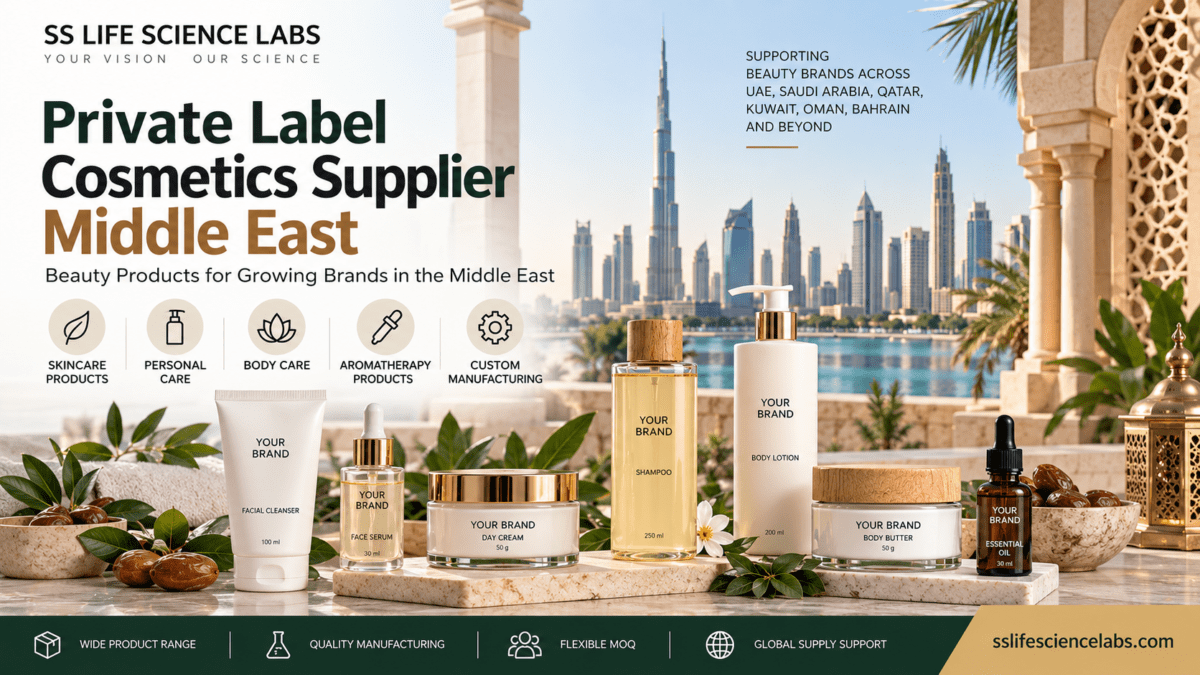
Private Label Cosmetics Supplier Middle East: Opportunities for Beauty Businesses
The Middle East beauty market continues to create opportunities for startups, retailers, eCommerce businesses, salons, beauty entrepreneurs, and established brands looking to develop their own cosmetic product ranges. With growing interest in skincare, personal care, body care, hair care, wellness, and premium beauty products, businesses are looking for flexible ways to build products under their own brand identity.
For a growing beauty business, selecting the right Private Label Cosmetics Supplier Middle East can be an important part of the product development and sourcing strategy. The right partner can help businesses develop a focused product range while supporting areas such as product selection, customization, packaging, production, and future portfolio expansion.
However, choosing a supplier should involve more than comparing prices. Beauty businesses should consider product quality, customization capabilities, minimum order quantities, packaging options, communication, production capacity, product categories, and the supplier’s ability to support long-term growth.
SS Life Science Labs is an India-based cosmetic manufacturing company that supports businesses with private label and customized cosmetic product solutions for international markets. Its product categories include skincare, personal care, body care, and aromatherapy-related products. Businesses can explore the SS Life Science Labs website for a broader overview of its cosmetic product and manufacturing capabilities.
Why Private Label Cosmetics Are Growing in the Middle East
Private label cosmetics can provide businesses with an opportunity to create products under their own brand instead of developing their own manufacturing infrastructure.
This can be useful for startups and established businesses that want to enter or expand within the beauty industry while focusing their resources on branding, marketing, distribution, and customer relationships.
A private label project may involve product selection, sample evaluation, customization, packaging, labeling, manufacturing, and production planning. The exact level of support depends on the supplier and the requirements of the brand.
For businesses targeting Middle Eastern customers, the first step should be understanding the intended customer segment and deciding what type of beauty products the brand wants to offer.
A company may begin with a focused skincare range and later expand into body care, hair care, personal care, or wellness products.
This gradual approach can make it easier to manage inventory, marketing, and product development while allowing the business to understand customer demand.
What to Look for in a Private Label Cosmetics Supplier Middle East
Choosing a suitable supplier can influence the quality and consistency of a beauty brand’s products. Before making a decision, businesses should evaluate several areas.
Manufacturing Experience
Start by checking whether the supplier has experience with the product category you want to launch.
For example, a skincare brand should look for a partner with relevant skincare capabilities, while a company planning a broader personal care portfolio should evaluate whether the supplier can support multiple categories.
A large catalogue does not automatically mean that a supplier is the right fit. The important factor is whether its capabilities match the brand’s requirements.
Product Customization
Private label products can vary in their level of customization.
Some projects may involve selecting existing product concepts and applying the brand’s identity, while other projects may require additional customization around product specifications, packaging, fragrance, texture, or product format.
Before moving forward, brands should ask what can be customized and what limitations may apply.
Minimum Order Quantity
MOQ is another important factor for beauty startups.
A supplier offering a low per-unit price may not necessarily be the best option if the required minimum order is too large for the business.
Brands should compare MOQ with their expected sales, available investment, storage capacity, and launch strategy.
Starting with a smaller, focused range can sometimes be more practical than launching too many products at once.
Private Label Cosmetics Supplier UAE: A Growing Opportunity
The UAE is an important destination for businesses operating within the Middle Eastern beauty market. Dubai and other commercial hubs attract beauty retailers, entrepreneurs, eCommerce businesses, salons, distributors, and international brands.
Businesses searching for a Private Label Cosmetics Supplier UAE should evaluate suppliers based on their complete product development and sourcing requirements rather than focusing only on location.
A UAE-focused beauty business may want to develop skincare, body care, personal care, hair care, or wellness products under its own brand.
The supplier selection process should therefore consider:
- Product categories
- Product quality
- Customization
- MOQ
- Packaging
- Samples
- Production capacity
- Communication
- Repeat-order capabilities
- Future product expansion
A well-planned supplier relationship can help a business create a more consistent product portfolio as it grows.
Cosmetic Products Supplier Middle East: Planning Your Product Range
Businesses searching for a Cosmetic Products Supplier Middle East should first determine which products are most relevant to their customers.
Instead of launching a large catalogue immediately, a focused product range can provide a clearer starting point.
For example, a skincare-focused brand could begin with:
Cleanser → Serum → Moisturizer
Once the brand establishes customer demand, it can gradually introduce complementary products.
A body care brand could follow a similar approach with:
Body Wash → Body Lotion → Body Scrub
The objective is not simply to have more products. The objective is to create products that work together and make sense for the target customer.
Skincare Opportunities for Middle Eastern Beauty Brands
Skincare remains an important category for businesses looking to develop private label products.
Brands may consider products such as cleansers, serums, creams, moisturizers, face oils, masks, and other skincare formats depending on their positioning and customer requirements.
A skincare brand should define its product concept before approaching a supplier.
Questions to consider include:
Who is the target customer?
What type of skincare routine does the brand want to support?
What price segment will the products target?
What packaging style fits the brand?
Which products should be launched first?
Businesses interested in skincare product development can explore the Skin Care Product Manufacturer category from SS Life Science Labs.
Building a Premium Beauty Brand
The Middle Eastern beauty market includes businesses positioned across different price segments.
A brand may choose to compete through premium presentation, specialized products, accessible pricing, natural-inspired positioning, wellness, or another clearly defined identity.
Private label manufacturing can support different brand strategies, but the brand itself must define its positioning first.
Packaging, product presentation, naming, photography, website design, and marketing should all communicate a consistent identity.
A premium product with weak presentation can struggle to communicate its value, while attractive packaging cannot compensate for an inconsistent product experience.
This is why product development and branding should be considered together.
Packaging for Middle Eastern Beauty Products
Packaging is one of the first elements a customer notices.
A brand should select packaging that matches the product, customer, positioning, and price segment.
For example, a premium skincare line may choose a sophisticated and minimal packaging approach, while a wellness-focused brand may use a more natural visual direction.
Before finalizing packaging, brands should consider:
- Product protection
- Brand identity
- Label space
- Product information
- Packaging format
- Customer experience
- Storage and shipping requirements
A consistent packaging system can also help different products look like part of the same brand.
Why Sampling Matters
A sample gives the brand an opportunity to evaluate a product before moving toward larger production.
Depending on the product, businesses may review appearance, texture, fragrance, application, packaging compatibility, and overall product experience.
Sample evaluation can also help identify changes that should be made before production.
For startups, this step can be particularly useful because it reduces the risk of committing to a large quantity before the product has been properly evaluated.
India-Based Manufacturing for Middle Eastern Brands
A brand’s target market and manufacturing location do not necessarily have to be the same.
A Middle Eastern beauty business can work with an India-based cosmetic manufacturing partner while targeting customers in the UAE, Saudi Arabia, and other international markets, provided that the relevant product, commercial, shipping, labeling, import, and market requirements are addressed.
This gives brands the opportunity to evaluate manufacturers based on capabilities rather than simply limiting their search to a particular geography.
SS Life Science Labs is an India-based manufacturer supporting private label and customized cosmetic product requirements. The company works across product categories including skincare, personal care, body care, and aromatherapy-related products.
For businesses interested in private label manufacturing, the Private Label Cosmetics Supplier service provides more information about the company’s private label offering.
Expanding From the Middle East Into Other Markets
A beauty business may initially target the Middle East and later expand into other international markets.
For example, a company could begin with the UAE or Saudi Arabia and later explore the UK, USA, Europe, Australia, or other regions.
This makes scalability an important consideration when selecting a manufacturing partner.
A supplier that can support the brand as it grows can make future product expansion easier.
Brands that are also researching the US market can read the Private Label Cosmetics Supplier USA guide.
For businesses considering the UK, the Private Label Cosmetics Supplier UK guide provides additional information about private label sourcing and supplier selection.
For wider European opportunities, businesses can also explore the Private Label Cosmetics Supplier Europe guide.
Choosing Between Different Manufacturing Models
Beauty businesses may encounter different manufacturing terms while researching suppliers.
Private label, OEM, and ODM can involve different approaches to product development and customization.
| Manufacturing Model | General Approach | Suitable For |
|---|---|---|
| Private Label | Existing or adaptable products under a brand’s identity | Startups and growing brands |
| OEM | Production based more closely on brand requirements | Businesses needing specific product requirements |
| ODM | Supplier-supported product development | Brands seeking developed product concepts |
The appropriate model depends on the brand’s budget, product requirements, customization needs, and development strategy.
How to Build a Strong Product Portfolio
A successful beauty brand does not need to launch dozens of products immediately.
A more controlled strategy can be:
Hero Product → Complementary Products → New Category → Wider Market
For example, a skincare business might start with a serum, add a cleanser and moisturizer, then introduce body care or wellness products.
This allows the company to build around products that already have customer interest.
The same approach can work for brands targeting the Middle East.
Common Mistakes Beauty Businesses Should Avoid
Choosing Only on Price
The cheapest supplier is not always the best long-term option. Product consistency, communication, quality, MOQ, and scalability also matter.
Launching Too Many Products
A large initial catalogue can increase inventory requirements and make marketing more complicated.
Ignoring MOQ
Minimum order quantity can significantly influence the initial investment required.
Skipping Samples
Brands should understand and evaluate the product before committing to larger production.
Ignoring Packaging
Packaging contributes to the customer’s first impression and should align with the brand’s identity.
Not Planning Future Growth
A supplier should ideally be evaluated not only for today’s requirements but also for the brand’s future needs.
Aromatherapy and Wellness Opportunities
The beauty and wellness industries increasingly overlap, giving brands opportunities to expand into aromatherapy and related categories.
A business that already sells skincare or body care may eventually introduce complementary wellness products.
This can create a broader self-care product portfolio without moving too far away from the existing target audience.
Businesses interested in aromatherapy products can explore the Aromatherapy Oils Supplier category.
Supplier Evaluation Checklist
Before selecting a private label cosmetics supplier, businesses can compare suppliers using the following checklist:
| Area | What to Evaluate |
|---|---|
| Product Category | Does the supplier manufacture your required products? |
| Quality | Is product consistency a clear priority? |
| MOQ | Does the minimum order suit your budget? |
| Customization | What product and packaging options are available? |
| Samples | Can you evaluate products before larger production? |
| Packaging | Can the supplier support your desired presentation? |
| Production | Can it handle your expected quantity? |
| Scalability | Can production increase as the brand grows? |
| Communication | Is the supplier responsive and clear? |
| Product Range | Can it support future product expansion? |
Frequently Asked Questions
What is a Private Label Cosmetics Supplier Middle East?
A Private Label Cosmetics Supplier Middle East is a supplier that supports beauty businesses looking to develop cosmetic products under their own brand identity for Middle Eastern markets.
Can a Middle Eastern brand work with an India-based manufacturer?
Yes. A Middle Eastern brand can work with an India-based manufacturer, provided the products and supply process meet the applicable requirements for the intended market.
What is a Private Label Cosmetics Supplier UAE?
A Private Label Cosmetics Supplier UAE is a supplier or manufacturing partner considered by businesses targeting the UAE beauty market for their own branded cosmetic products.
What products can be developed through private label manufacturing?
Depending on the manufacturer’s capabilities, brands may explore skincare, body care, personal care, hair care, wellness, and aromatherapy-related products.
What is MOQ?
MOQ stands for Minimum Order Quantity. It refers to the minimum number of units a supplier requires for a particular production order.
Is private label suitable for startups?
Yes. Private label manufacturing can allow startups to develop branded products without establishing their own manufacturing infrastructure.
Should a new brand launch many products?
Not necessarily. Starting with a focused product range can make inventory management, branding, and marketing easier.
How important is packaging?
Packaging is important because it protects the product and communicates the brand’s identity and positioning to customers.
Conclusion
The Middle East provides opportunities for beauty businesses looking to build and expand private label product ranges. Selecting the right Private Label Cosmetics Supplier Middle East can help a brand develop products while maintaining focus on branding, marketing, distribution, and customer growth.
For businesses targeting the UAE, Saudi Arabia, and wider Middle Eastern markets, supplier selection should be based on product quality, customization, MOQ, packaging, sampling, production capacity, communication, and long-term scalability.
An India-based manufacturing partner can also be considered by international beauty brands when its capabilities and supply process match the requirements of the intended market.
SS Life Science Labs supports private label and customized cosmetic product requirements across skincare, personal care, body care, and aromatherapy-related categories.
Whether a business is launching its first beauty product or expanding an existing portfolio, a clear product strategy and carefully selected manufacturing partner can provide a stronger foundation for long-term growth.