
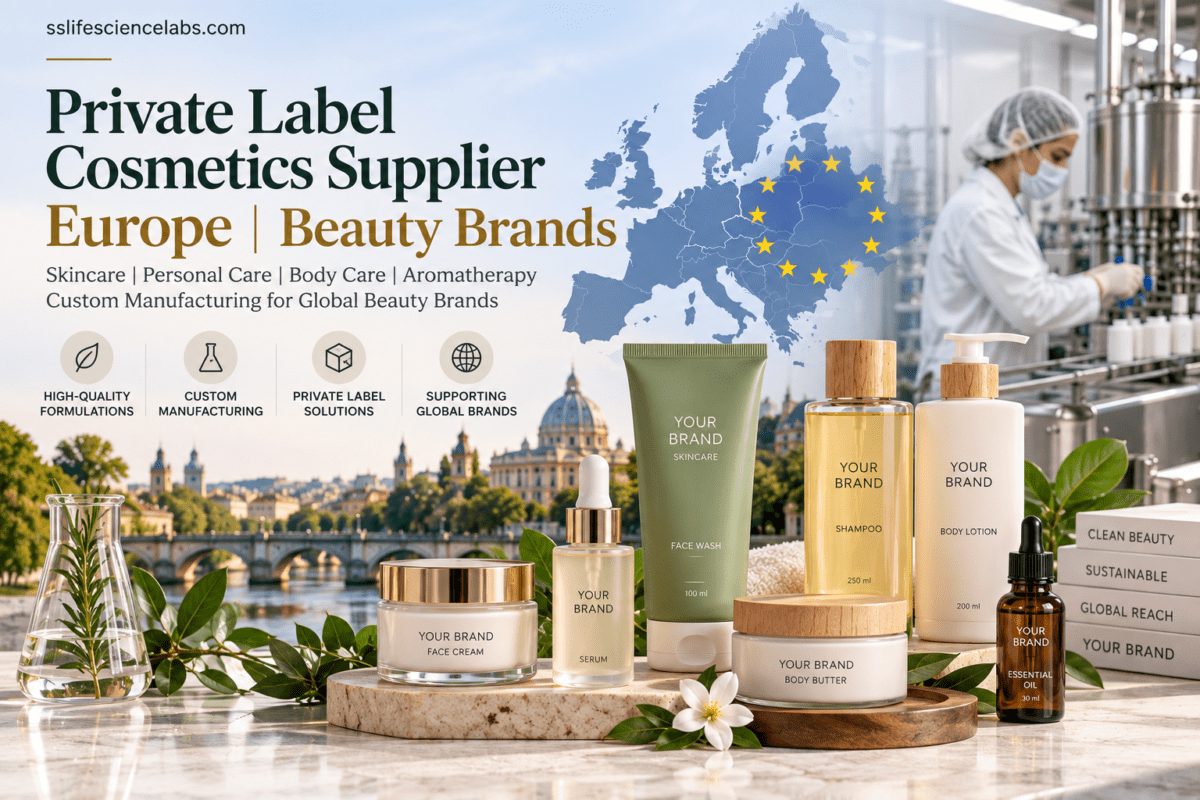
Private Label Cosmetics Supplier Europe: Choosing the Right Partner for European Beauty Brands
Europe’s beauty market offers opportunities for startups, independent beauty brands, retailers, eCommerce businesses, and established companies looking to develop their own skincare and personal care ranges. As consumers become more selective about product quality, ingredients, branding, packaging, and overall product experience, beauty businesses need a well-planned approach to product development and sourcing.
For a growing beauty brand, choosing the right Private Label Cosmetics Supplier Europe can be an important step in building a reliable product portfolio. A suitable manufacturing partner can help with product development, manufacturing, packaging, customization, and production requirements while the brand focuses on marketing, positioning, customer relationships, and business growth.
However, choosing a supplier should not be based only on location or price. European beauty brands should evaluate manufacturing capabilities, product quality, customization options, minimum order quantities, packaging support, communication, production capacity, and the ability to support future expansion.
SS Life Science Labs is an India-based cosmetic manufacturing company supporting businesses with private label and customized cosmetic product solutions. Brands looking for an India-based manufacturing partner for international beauty markets can explore the Cosmetic Products Manufacturer in India website to understand its broader product and manufacturing focus.
Why Private Label Cosmetics Are Important for European Beauty Brands
Private label manufacturing gives businesses an opportunity to develop products under their own brand without establishing their own manufacturing facility.
This can be especially useful for startups and growing beauty companies that want to enter the market without investing in factories, production equipment, laboratories, and large manufacturing teams.
Instead, the brand can focus on building its identity and understanding its customers while a manufacturing partner handles the production side of the business.
A typical private label project may involve:
- Product selection
- Formulation support
- Sample development
- Product customization
- Packaging selection
- Labeling
- Manufacturing
- Production planning
The exact services depend on the supplier, which is why brands should always discuss their requirements before selecting a manufacturing partner.
For a business entering the European market, the goal should not simply be to find a supplier that offers many products. The supplier should be able to support the specific product category, quantity, positioning, packaging, and future growth plans of the brand.
What Does a Private Label Cosmetics Supplier Europe Do?
A Private Label Cosmetics Supplier Europe can support beauty businesses that want to create products under their own brand identity.
Depending on the supplier’s capabilities, the process can start with selecting an existing product concept or discussing a customized product requirement.
The brand may then evaluate samples, finalize product specifications, choose packaging, approve branding details, and proceed toward production.
The advantage is that the business does not have to create an entire manufacturing infrastructure before launching its product.
For example, a new skincare company may want to introduce a cleanser, serum, and moisturizer. Instead of establishing its own manufacturing operation, it can work with an appropriate cosmetic manufacturing partner and concentrate on building the brand around those products.
This approach can also allow a company to expand gradually.
Once the initial products establish demand, the brand can add body care, hair care, wellness, or aromatherapy products.
European Beauty Brands Can Source From Outside Europe
One important point for international beauty businesses is that the target market and manufacturing location do not necessarily have to be the same.
A European beauty brand can work with an international manufacturing partner while selling products to European customers, provided that the relevant product, commercial, import, labeling, distribution, and regulatory requirements are properly addressed.
This means a business searching for a Cosmetic Products Supplier Europe does not necessarily need to limit its supplier search to companies physically located within Europe.
Instead, the brand should evaluate whether the manufacturing partner can support the product requirements and international supply process.
For example, an India-based manufacturer can support an international beauty brand with cosmetic production while the brand handles its own European market strategy.
This can be particularly useful for businesses that want to develop a broader international sourcing strategy.
How to Choose the Right Private Label Cosmetics Supplier Europe
Choosing a manufacturing partner should be treated as a long-term business decision.
A supplier affects product quality, inventory planning, production consistency, packaging, delivery planning, and ultimately the customer’s experience with the brand.
1. Check Manufacturing Experience
Start by understanding the supplier’s actual manufacturing experience.
If your business wants to develop skincare products, evaluate the supplier’s skincare capabilities.
If you want body care, hair care, personal care, and wellness products, check whether the supplier has experience across those categories.
A large product catalogue alone does not guarantee that the supplier is suitable for your project.
2. Understand Product Customization
Private label does not mean exactly the same thing for every manufacturer.
Some suppliers may provide ready-developed products that can be branded by the customer.
Others may provide greater customization around formulations, textures, fragrances, product formats, packaging, or other specifications.
Before starting a project, ask exactly what can be customized and what limitations apply.
3. Evaluate Minimum Order Quantity
MOQ is particularly important for startups.
A supplier may offer an attractive unit price, but if the minimum order is too large, the total investment may become difficult for a new brand.
Therefore, compare MOQ with your expected sales, available budget, storage capacity, and launch strategy.
A smaller initial product range can sometimes be more practical than purchasing a large amount of inventory before the market has been tested.
4. Check Packaging Options
Packaging plays a major role in the beauty industry.
Customers often make an initial impression based on the appearance of a product before they understand its formulation.
A brand should therefore consider packaging as part of its product strategy rather than treating it as an afterthought.
The packaging should match:
- Target customer
- Product positioning
- Price point
- Brand identity
- Product category
- Distribution model
5. Ask About Production Capacity
A supplier may be suitable for a small startup order but may not have the same suitability when the brand begins receiving larger orders.
Before choosing a manufacturing partner, consider what happens if your product becomes successful.
Can the supplier support increased production?
Can repeat orders be handled efficiently?
Can additional products be developed later?
These questions can help prevent supply-chain problems during future growth.
Private Label Skincare Supplier Europe: What Should Brands Look For?
Skincare is one of the most competitive areas of the beauty industry. A new skincare brand therefore needs more than an attractive product name.
It needs a clear product concept, target customer, brand positioning, packaging strategy, and reliable manufacturing support.
Businesses searching for a Private Label Skincare Supplier Europe should evaluate the complete product-development process rather than looking only at the final product price.
A good skincare strategy can begin with a focused product range.
For example, a brand could introduce:
Cleanser → Serum → Moisturizer
This creates a simple skincare routine and gives the brand an opportunity to build its marketing around a clear product journey.
As the business grows, it can introduce additional products such as face creams, masks, oils, body care, or other complementary products.
Brands exploring skincare manufacturing can also visit the Skin Care Product Manufacturer category to explore the skincare product range.
Building a European Beauty Brand Around Customer Needs
One of the most important decisions in private label manufacturing is understanding the difference between a manufacturer’s product catalogue and a customer’s actual needs.
A manufacturer may have dozens or hundreds of possible products.
That does not mean a brand needs to launch all of them.
Instead, the brand should start with questions such as:
Who is the customer?
What does the customer need?
What problem is the product designed to address?
What price range is appropriate?
What makes the brand different?
What products should come next?
This customer-first approach can make the product portfolio easier to understand and market.
Product Portfolio Planning for Growing Beauty Brands
A beauty brand should ideally think beyond its first product.
A strong product portfolio can develop in stages.
Stage One: Hero Product
Start with one strong product that represents the brand.
Stage Two: Complementary Products
Add products that naturally fit the customer’s existing routine.
Stage Three: Category Expansion
Introduce related categories such as body care, hair care, or wellness.
Stage Four: International Expansion
Use the established product portfolio to enter additional markets.
This gradual approach can reduce unnecessary inventory and allow the brand to understand customer demand before making larger investments.
Private Label Cosmetics vs OEM vs ODM
European beauty businesses often come across terms such as private label, OEM, and ODM when researching manufacturing options.
These models can have different levels of customization and development support.
| Factor | Private Label | OEM | ODM |
|---|---|---|---|
| Product Development | Existing or adaptable products | Based on brand requirements | Supplier-developed products |
| Customization | Depends on supplier | Generally higher | Varies by supplier |
| Launch Speed | Usually faster | Can require more development | Often faster |
| Investment | Generally manageable | Can be higher | Moderate |
| Best For | Startups and growing brands | Brands with specific requirements | Brands seeking developed concepts |
The right option depends on the brand’s product concept, budget, customization requirements, and development timeline.
Businesses that want to understand the differences in greater detail can read Private Label Cosmetics vs OEM vs ODM Cosmetics.
What Makes a Good Cosmetic Products Supplier Europe?
A reliable supplier should provide clear information before the brand places a large order.
The business should understand the supplier’s:
- Product categories
- Manufacturing capabilities
- MOQ
- Customization options
- Packaging support
- Sample process
- Production capacity
- Communication process
- Repeat-order capabilities
This information allows the brand to compare suppliers based on the complete value they provide instead of simply comparing product prices.
A good supplier relationship should also become easier to manage over time.
Once the brand has approved products and established production processes, repeat orders and new product development can become more streamlined.
Beauty Products Supplier Europe: What Should International Brands Consider?
Businesses searching for a Beauty Products Supplier Europe may be looking for products across multiple categories rather than a single cosmetic product.
This could include skincare, body care, hair care, personal care, wellness, or aromatherapy.
For such businesses, it can be useful to find a manufacturing partner that can support multiple complementary categories.
However, product expansion should still be driven by customer demand.
Launching too many products without a clear market strategy can increase inventory requirements and make marketing more difficult.
A better approach is to establish one category first and then expand based on customer response.
Why Product Quality Matters More Than Low Pricing
Price is naturally an important consideration, but choosing a supplier only because it offers the lowest price can create problems later.
A beauty product represents the brand.
If product quality is inconsistent, customers may associate that problem with the brand rather than the manufacturer.
This is why businesses should consider:
Product quality + consistency + packaging + communication + MOQ + scalability
instead of focusing only on:
Lowest price
A slightly higher manufacturing cost can be reasonable if the overall supply relationship provides better reliability and product consistency.
How Sampling Helps European Beauty Brands
Sampling is an important stage before larger production.
It allows the brand to evaluate the product before committing to a significant inventory quantity.
Depending on the product, a brand may evaluate:
- Texture
- Fragrance
- Appearance
- Application
- Packaging compatibility
- Overall product experience
Sample evaluation can also help the brand identify changes before production.
For this reason, businesses should understand the supplier’s sample process before placing a large order.
Packaging and Brand Identity
In the beauty industry, packaging is closely connected with brand identity.
A premium skincare brand may require a different packaging style from a natural wellness brand or a mass-market personal care company.
The packaging should communicate the product’s positioning without creating unnecessary complexity.
For a new beauty brand, consistency across products is also important.
If the cleanser, serum, moisturizer, body lotion, and other products all look like they belong to completely different brands, the customer may find it harder to understand the overall identity.
A coordinated packaging system can create a stronger visual connection across the product range.
India-Based Cosmetic Manufacturing for European Brands
India has a large cosmetic and personal care manufacturing ecosystem, making it a potential sourcing destination for international beauty businesses.
For European brands, the important question should not simply be where the manufacturer is located.
Instead, businesses should evaluate whether the manufacturer can support the required product categories, quality expectations, customization, packaging, production quantity, and international supply requirements.
SS Life Science Labs is an India-based cosmetic manufacturing company supporting private label and customized product requirements across skincare, personal care, body care, and aromatherapy-related categories.
For businesses interested in private label manufacturing, the Private Label Cosmetics Supplier service provides a relevant starting point for understanding the company’s manufacturing approach.
The homepage can also be explored for a broader overview of the company’s cosmetic manufacturing and product capabilities.
How Previous USA and UK Markets Connect With European Expansion
A beauty brand that starts by targeting one international market may eventually expand into another.
For example, a business may begin with the USA, enter the UK, and later explore wider European opportunities.
This makes it important to build a manufacturing strategy that can support long-term growth rather than focusing only on the first launch.
For brands researching the US market, our Private Label Cosmetics Supplier USA guide explains how beauty businesses can approach private label cosmetic sourcing for the US market.
Similarly, businesses targeting the UK can read our Private Label Cosmetics Supplier UK guide for additional information about supplier selection and product development.
These markets have different customer environments, but the fundamental supplier evaluation process remains similar: understand your customer, select the right products, evaluate the manufacturer, and build a scalable supply chain.
Aromatherapy and Wellness Product Opportunities
The beauty industry increasingly overlaps with wellness, self-care, and lifestyle products.
This creates opportunities for brands that want to expand beyond conventional skincare and personal care.
Aromatherapy products can complement an existing beauty range and provide another category for customers interested in wellness-focused routines.
Brands considering this category can explore the Aromatherapy Oils Supplier product range.
A brand does not necessarily need to enter aromatherapy immediately. It can be introduced later as part of a wider product expansion strategy.
A Practical Supplier Evaluation Checklist
Before choosing a private label manufacturer, European beauty brands can use a simple checklist.
| Evaluation Area | What to Check |
|---|---|
| Manufacturing | Experience with your product category |
| Product Quality | Consistency and quality-control approach |
| MOQ | Whether the minimum order fits your launch plan |
| Customization | Available formulation and product options |
| Packaging | Available formats and branding options |
| Sampling | How products are tested and approved |
| Production | Capacity for initial and repeat orders |
| Scalability | Ability to support future growth |
| Communication | Responsiveness and project coordination |
| Product Range | Ability to support future categories |
This checklist can help a business compare different suppliers more objectively.
Common Mistakes When Choosing a Private Label Cosmetics Supplier
Choosing Only on Price
A low price does not automatically mean better value.
Launching Too Many Products
A large catalogue can increase inventory costs and make marketing difficult.
Ignoring MOQ
Minimum order quantity can have a major impact on startup investment.
Not Testing Samples
Skipping product evaluation can create unnecessary problems after production.
Ignoring Packaging
Packaging is an important part of the customer’s first impression.
Choosing a Supplier Without Future Planning
A supplier that works for 500 units may not necessarily be suitable when the brand needs significantly higher production.
Using the Same Product Strategy in Every Market
Different markets may have different customer expectations, distribution models, and applicable requirements.
How to Build a Scalable European Beauty Product Strategy
A scalable product strategy does not mean launching everything at once.
It means creating a structure that can grow.
A practical model could look like this:
One Hero Product → Complementary Products → Wider Category → International Expansion
For example, a skincare brand could start with one hero product, add two complementary skincare products, introduce body care, and later expand into wellness or aromatherapy.
This approach provides the brand with room to grow without creating unnecessary complexity at the beginning.
What Should a New European Beauty Brand Do First?
The first step should be understanding the customer.
Before contacting manufacturers, the business should define:
Target customer: Who will buy the product?
Product category: What will the brand sell?
Positioning: Premium, accessible, specialist, natural-inspired, professional, or another positioning?
Launch range: Which products should come first?
Budget: How much can be invested in product development and inventory?
Future plan: Where should the product range go after the first launch?
Once these questions are clear, comparing private label manufacturers becomes much easier.
Frequently Asked Questions
What is a Private Label Cosmetics Supplier Europe?
A Private Label Cosmetics Supplier Europe supports businesses that want to develop cosmetic products under their own brand. Depending on the supplier, services may include product selection, formulation support, manufacturing, packaging, labeling, and product development.
Can a European beauty brand work with an India-based manufacturer?
Yes. A European brand can work with an India-based manufacturing partner, provided the products and supply process meet the requirements applicable to the markets where the products will be sold.
What is the difference between a cosmetic supplier and manufacturer?
A manufacturer produces the products, while supplier can be a broader term for a business providing products or sourcing solutions. An India-based manufacturer can therefore act as a supplier to international beauty brands.
What products can be developed through private label manufacturing?
Depending on the manufacturer’s capabilities, businesses can explore skincare, body care, hair care, personal care, wellness, aromatherapy, and other cosmetic categories.
What should I ask a private label cosmetics supplier?
Ask about manufacturing experience, MOQ, customization, samples, packaging, production capacity, quality processes, communication, and future scalability.
What is MOQ in cosmetics?
MOQ means Minimum Order Quantity. It is the minimum number of units a manufacturer requires for a particular product or production arrangement.
Is private label suitable for a startup?
Yes. Private label can help startups enter the beauty market without establishing their own manufacturing facility.
Should a beauty brand launch many products at once?
Not necessarily. A focused range or hero product can be easier to manage and market while the business learns about customer demand.
Can a skincare brand expand into body care?
Yes. Body care can be a natural expansion category for a skincare brand when the products fit the same target audience and brand positioning.
How important is packaging for private label cosmetics?
Packaging is highly important because it protects the product while also communicating brand identity, positioning, and product information.
Can one supplier manufacture different beauty categories?
Some manufacturers support multiple categories, while others specialize in specific products. Brands should confirm the supplier’s actual capabilities before planning a multi-category range.
What should I check before placing a large cosmetic order?
Review samples, MOQ, packaging, product specifications, manufacturing capacity, quality processes, production timelines, and future repeat-order capabilities before committing to a larger order.
Conclusion
Choosing the right Private Label Cosmetics Supplier Europe is an important decision for beauty brands planning to build and expand their own product ranges.
A successful supplier relationship should provide more than competitive pricing. Brands should consider product quality, manufacturing experience, customization, MOQ, packaging, sampling, communication, production capacity, and future scalability.
For European beauty businesses, an international manufacturing partner can be a practical sourcing option when the supplier has the capabilities needed to support the brand’s product and market strategy.
SS Life Science Labs supports businesses with private label and customized cosmetic manufacturing solutions across skincare, personal care, body care, and aromatherapy-related categories.
Whether a brand is entering Europe for the first time or expanding from markets such as the USA and UK, the fundamentals remain the same: understand the customer, choose the right product range, evaluate manufacturing partners carefully, and build a supply chain that can grow with the business.
A focused product strategy combined with reliable manufacturing can give beauty brands a stronger foundation for long-term growth across competitive international markets.
Related Reading
For brands researching the US market, read Private Label Cosmetics Supplier USA:
https://sslifesciencelabs.com/private-label-cosmetics-supplier-usa/
For UK-focused supplier research, read Private Label Cosmetics Supplier UK:
https://sslifesciencelabs.com/private-label-cosmetics-supplier-uk/
For private label manufacturing solutions, explore Private Label Cosmetics Supplier:
https://sslifesciencelabs.com/services/private-label-cosmetics-supplier/
For skincare manufacturing, explore Skin Care Product Manufacturer:
https://sslifesciencelabs.com/product-category/skin-care/
For aromatherapy and wellness products, explore Aromatherapy Oils Supplier:
https://sslifesciencelabs.com/product-category/aromatherapy-oils/