
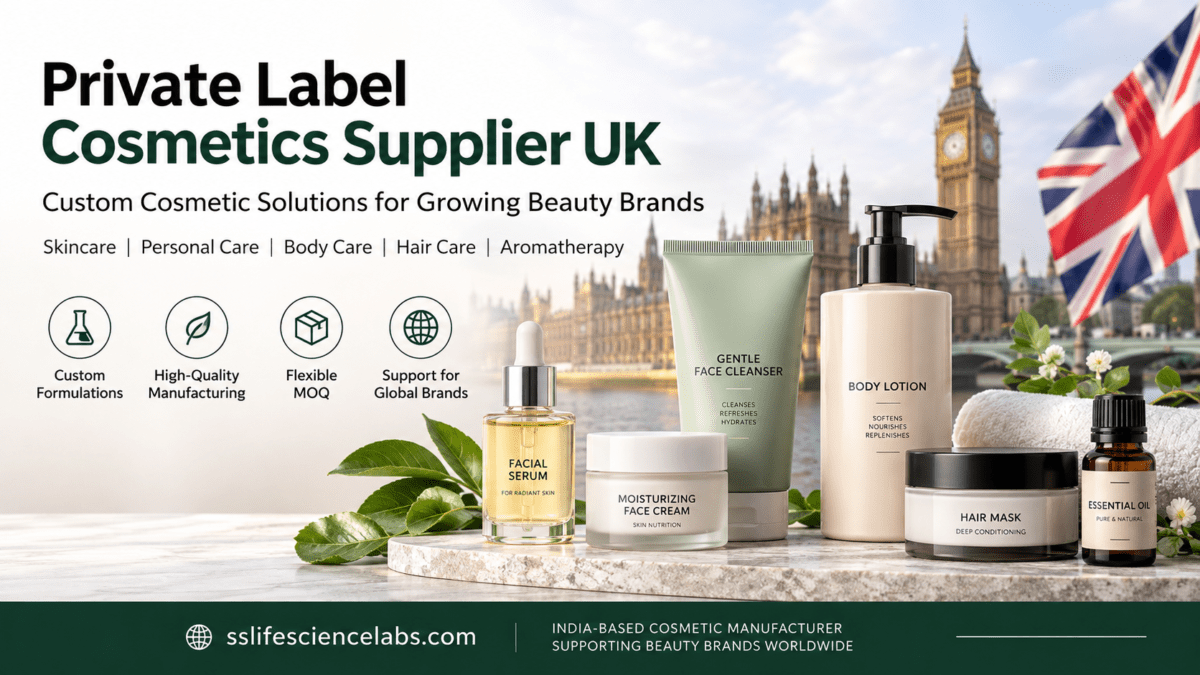
Private Label Cosmetics Supplier UK: A Complete Guide for Growing Beauty Brands
The UK beauty market continues to create opportunities for startups, independent beauty brands, retailers, eCommerce businesses, and established companies looking to develop their own cosmetic product ranges. Customers are becoming more interested in skincare, personal care, wellness, and beauty products that combine quality, convenience, attractive branding, and a clear purpose. For businesses entering this competitive market, choosing the right Private Label Cosmetics Supplier UK can make the product development and brand-building process much more manageable.
Private label manufacturing allows a business to sell products under its own brand name without building and operating a complete manufacturing facility. Instead, the manufacturing partner can support product development, formulation, production, packaging, and other stages of the supply process. This allows beauty brands to concentrate more on branding, marketing, customer acquisition, distribution, and long-term growth.
For brands targeting the UK, a supplier does not necessarily need to be physically located in the UK. An international manufacturing partner can produce products in its home country while supplying a brand that sells to customers in the UK or wider European markets. This makes supplier selection more about manufacturing capability, product quality, customization, MOQ, packaging, communication, and scalability than simply the supplier’s geographical location.
SS Life Science Labs is an India-based cosmetic manufacturing company supporting businesses with private label and customized cosmetic product solutions across skincare, personal care, body care, and aromatherapy categories. Brands looking for an India-based production partner can explore Cosmetic Products Manufacturer in India solutions for developing beauty products for international markets.
What Is a Private Label Cosmetics Supplier?
A private label cosmetics supplier helps businesses develop or source cosmetic products that are ultimately sold under the buyer’s own brand identity. Depending on the supplier and project requirements, the process can involve product selection, formulation support, sample development, manufacturing, packaging, labeling, and final product preparation.
The main attraction of private label manufacturing is that the brand does not need to establish its own factory, production equipment, laboratory infrastructure, or manufacturing team before entering the beauty market.
Instead, the business can focus on questions such as:
Who is the target customer?
What problem should the product solve?
How should the brand be positioned?
What price range should the product target?
Which products should be launched first?
How will the products be marketed?
The manufacturing partner then becomes an important part of the supply chain that turns the product concept into a physical product.
For a growing beauty business, this can be especially useful because the company can start with a focused product range and expand as customer demand develops.
Why UK Beauty Brands Are Exploring Private Label Manufacturing
The beauty market is highly competitive, and customers have more choices than ever. New brands therefore need to create products that have a clear purpose and a strong identity.
Private label manufacturing can help reduce some of the barriers associated with entering the industry. A business does not necessarily need to invest in its own production facility before launching its first product.
Instead, the company can work with an experienced manufacturing partner and direct its resources toward areas where the brand can create differentiation.
These areas can include:
- Brand positioning
- Product selection
- Packaging
- Digital marketing
- Customer experience
- Social media
- Retail distribution
- eCommerce
- Influencer partnerships
The manufacturing model can therefore allow a small business to behave more like a focused beauty brand rather than attempting to become a complete manufacturing company from day one.
UK Beauty Brands Can Work With India-Based Manufacturers
One important point for international beauty businesses is that the target market and manufacturing location do not have to be the same.
A brand may be based in the UK and sell primarily to UK customers while working with an India-based cosmetic manufacturer.
This can be useful when the manufacturer offers the required product categories, production capabilities, customization options, packaging support, and supply capacity.
For example, a UK beauty company could develop a skincare collection with an India-based manufacturer and then focus its own operations on branding, marketing, customer acquisition, sales, and distribution.
SS Life Science Labs follows this India-based manufacturing positioning while supporting businesses that require private label and customized cosmetic production solutions.
The important consideration is not simply whether a company appears when searching for a Private Label Cosmetics Supplier UK. The more important question is whether the supplier can actually support the product and commercial requirements of the brand.
What Should You Look for in a Private Label Cosmetics Supplier UK?
Choosing a supplier should not be based only on the lowest quotation. A supplier becomes part of the brand’s supply chain, so its manufacturing capabilities can directly affect product consistency, inventory planning, customer satisfaction, and future expansion.
A strong supplier evaluation should consider manufacturing experience, product categories, customization, MOQ, packaging, quality processes, communication, production capacity, and scalability.
Manufacturing Experience
Experience matters because cosmetic manufacturing involves multiple stages. A supplier should understand the requirements of the product categories it manufactures and be able to explain the process clearly.
For example, a company looking for skincare products should evaluate the supplier’s skincare capabilities rather than assuming that every cosmetic manufacturer has the same expertise across all categories.
Product Category Capability
A supplier may offer skincare but have limited capabilities in hair care. Another may specialize in body care. Another may support several personal care categories.
The best supplier is therefore not necessarily the one with the longest product list. It is the one whose capabilities match the products the brand actually wants to develop.
Customization Options
Customization can help a brand create a stronger identity.
Depending on the supplier, customization may involve:
- Product formulation
- Texture
- Fragrance
- Product format
- Packaging
- Labeling
- Product size
- Brand presentation
However, brands should always confirm exactly what the supplier means by “customized.” Different companies may use the term differently.
Minimum Order Quantity
MOQ, or Minimum Order Quantity, is particularly important for startups and smaller brands.
A low unit price may appear attractive, but if the required order quantity is too large, the business may have to invest heavily in inventory before knowing how customers will respond.
For this reason, MOQ should always be evaluated together with expected sales, available working capital, storage capacity, and product launch strategy.
Packaging Support
Packaging is an important part of beauty branding.
A product can have a strong formulation but still struggle to communicate its value if the packaging does not match the intended positioning.
Brands should therefore discuss packaging early rather than treating it as a final-stage decision.
Scalability
A supplier should ideally be able to support the business beyond its first order.
If a product becomes successful, the brand may need significantly larger production quantities. A supplier that can support future growth can make the transition easier.
Popular Product Categories for Private Label Beauty Brands
Private label cosmetics are no longer limited to traditional makeup products. Beauty businesses can build product portfolios around skincare, body care, hair care, wellness, and personal care.
Skincare Products
Skincare is one of the strongest categories for private label beauty brands.
Common products include:
- Face cleansers
- Face serums
- Moisturizers
- Face creams
- Face masks
- Toners
- Face oils
- Specialized skincare products
Brands entering skincare should think about the product range as a complete customer journey rather than simply selecting random products from a catalogue.
For example, a brand could develop a simple daily routine consisting of a cleanser, serum, and moisturizer.
Businesses looking for dedicated skincare solutions can explore the Skin Care Product Manufacturer category when planning their skincare portfolio.
Body Care Products
Body care can help a skincare brand expand its portfolio while staying within the broader beauty and personal care space.
Potential categories include:
- Body lotions
- Body washes
- Body scrubs
- Body creams
- Body oils
- Hand care
- Foot care
The advantage of expanding into body care is that the existing customer base may already be interested in complementary products.
Instead of launching completely unrelated categories, a brand can gradually expand around the needs of its existing audience.
Hair Care Products
Hair care provides another opportunity for brands that want to build a wider beauty portfolio.
Depending on manufacturing capabilities, brands may consider:
- Shampoo
- Conditioner
- Hair serum
- Hair mask
- Hair oil
- Scalp care products
However, brands should avoid expanding too quickly. A focused product portfolio is often easier to market and manage than a large collection with no clear positioning.
Aromatherapy and Wellness Products
The connection between beauty and wellness has created opportunities for businesses that want to offer products beyond traditional cosmetics.
Aromatherapy products can complement skincare and personal care collections by adding a wellness-oriented category.
Brands exploring this segment can view Aromatherapy Oils Supplier solutions as part of a broader beauty and wellness strategy.
UK and European Beauty Markets
A brand targeting the UK may eventually want to expand into other European markets. This makes it useful to think about the product portfolio from an international perspective from the beginning.
Businesses researching a Cosmetic Products Supplier Europe, Beauty Products Supplier Europe, or Private Label Skincare Supplier Europe should evaluate suppliers based on actual manufacturing capabilities rather than simply focusing on country names.
The UK and wider European markets can have different customer expectations, distribution models, packaging preferences, and product requirements. Therefore, a brand should understand the requirements of each market where it plans to sell.
A strong manufacturing relationship can make product expansion easier because the brand does not have to rebuild its supply chain every time it enters a new market.
Private Label Skincare Supplier Europe: What Should Brands Consider?
Skincare is particularly competitive, which makes product differentiation important.
A brand looking for a Private Label Skincare Supplier Europe should consider the complete product concept rather than only the formulation.
The product should have:
- A defined target customer
- A clear purpose
- Suitable packaging
- Strong brand positioning
- Consistent product quality
- Practical pricing
- A realistic launch quantity
For example, a brand targeting young customers may choose a different product range and packaging direction from a premium anti-aging skincare company.
The manufacturing partner should therefore understand the intended product concept before production begins.
How the Private Label Cosmetic Manufacturing Process Works
Understanding the manufacturing process helps brands communicate better with suppliers and avoid unnecessary delays.
Step 1: Define the Product Concept
Before contacting a manufacturer, the brand should define what it wants to create.
This includes:
- Product category
- Target customer
- Product purpose
- Brand positioning
- Desired price range
- Expected quantity
The clearer the initial brief, the easier it becomes for the supplier to understand the project.
Step 2: Select the Manufacturing Model
The brand should decide whether private label, OEM, ODM, or another manufacturing model is most suitable.
For many startups, private label can provide a practical starting point because the business can focus on branding and market development while the manufacturing partner handles production.
Step 3: Product Development
The next stage involves selecting or developing the product.
Depending on the project, the supplier may provide formulation options or work according to specific product requirements.
Step 4: Sample Evaluation
Samples allow the brand to assess the product before moving toward larger-scale manufacturing.
The brand may review:
- Texture
- Fragrance
- Appearance
- Application
- Packaging compatibility
- Overall product experience
Step 5: Packaging and Branding
After the product direction is established, packaging and labeling requirements can be finalized.
The packaging should reflect the brand’s positioning and target audience.
Step 6: Production
Once the relevant requirements are approved, the product can move toward manufacturing.
The exact production timeline depends on factors such as product type, quantity, customization, packaging, and project requirements.
Step 7: Final Product Preparation
The final stage involves preparing the finished products for distribution according to the agreed requirements.
Private Label vs OEM vs ODM: Which Model Is Better?
| Factor | Private Label | OEM | ODM |
|---|---|---|---|
| Product Development | Existing or adaptable product options | Based on specific brand requirements | Supplier-developed product options |
| Customization | Depends on supplier | Generally higher | Moderate to high depending on supplier |
| Launch Speed | Usually faster | Can take longer | Often faster than fully custom development |
| Investment | Generally lower | Can be higher | Moderate |
| Suitable For | Startups and growing brands | Brands with specific product requirements | Businesses wanting developed product concepts |
| Branding | Brand’s own identity | Brand’s own identity | Brand’s own identity |
The right choice depends on the brand’s objectives. A startup may prioritize speed and manageable investment, while an established business may want greater control over product development.
Brands that want to understand these models in more detail can read Private Label Cosmetics vs OEM vs ODM Cosmetics before deciding which approach fits their project.
How Many Products Should a New UK Beauty Brand Launch?
One of the most common mistakes made by new beauty businesses is trying to launch too many products at once.
A manufacturer may have dozens of products available, but that does not mean the brand needs to launch all of them.
A more controlled approach is to start with a small product family.
For example:
Cleanser → Serum → Moisturizer
This gives customers a simple routine while allowing the brand to focus its marketing around one clear skincare concept.
After the brand understands which products generate interest and repeat purchases, it can gradually introduce additional products.
This approach can reduce unnecessary inventory and make the brand easier for customers to understand.
Building a Product Range Around Customer Intent
The strongest private label product portfolios are usually built around customer needs rather than manufacturer catalogues.
Imagine a customer searching for a skincare solution. They are unlikely to think in terms of manufacturing categories. They are thinking about their skin, routine, budget, preferences, and desired result.
The brand therefore needs to translate manufacturing capability into customer-focused products.
A good product strategy can follow this path:
Customer Need → Product Concept → Formulation → Packaging → Brand Positioning → Marketing
This approach can help the brand create products that are easier to explain and market.
What Makes a Good Beauty Product Supplier?
A reliable supplier should be able to communicate clearly throughout the product development process.
The brand should understand:
- What the supplier provides
- What the brand needs to provide
- How product development works
- How samples are handled
- How MOQ is calculated
- What packaging options are available
- How production is managed
- How future orders are handled
Clear communication is especially important when the manufacturer and brand are located in different countries.
For international businesses, communication is part of supply-chain reliability.
Two Practical Strategies for Growing Beauty Brands
| Strategy | How It Works | Suitable For |
|---|---|---|
| Hero Product Strategy | Start with one strong product and build the brand around it | Startups and new brands |
| Focused Product Range | Launch a small group of complementary products | Growing beauty businesses |
| Category Expansion | Add body care, hair care, skincare or wellness products gradually | Established brands |
| International Expansion | Use an existing product portfolio to enter additional markets | Brands targeting UK and Europe |
A brand does not have to choose the same strategy forever. It can begin with a hero product and later develop a complete product range.
Why India Can Be a Manufacturing Base for UK Beauty Brands
India has a large cosmetic and personal care manufacturing ecosystem, making it a potential sourcing destination for international beauty businesses.
For a UK brand, working with an India-based manufacturer can allow the business to separate its manufacturing operations from its target market.
The brand can focus on UK customers while its manufacturing partner manages production in India.
However, brands should always evaluate the specific supplier rather than assuming that every India-based manufacturer provides the same services.
Important evaluation points include:
- Product categories
- Manufacturing experience
- Quality processes
- Customization
- MOQ
- Packaging
- Production capacity
- Communication
- Long-term scalability
SS Life Science Labs positions itself as an India-based cosmetic manufacturer supporting businesses with private label and customized product development solutions.
For brands interested in building a private label portfolio, Private Label Cosmetics Supplier services can be explored according to the brand’s product requirements.
How to Evaluate a Supplier Before Your First Order
Before placing a large order, a beauty brand should create a supplier evaluation checklist.
Product Capability
Does the supplier manufacture the category you actually need?
Customization
What aspects of the product can be customized?
MOQ
Is the minimum quantity suitable for your launch budget?
Packaging
Can the supplier support your desired packaging requirements?
Product Development
How are samples developed and approved?
Production
What happens after the product is approved?
Scalability
Can the supplier support larger future orders?
Communication
Can your team communicate efficiently with the supplier throughout the process?
A supplier that performs well across these areas may be a better long-term choice than a company offering only a lower initial quotation.
Common Mistakes When Choosing a Private Label Cosmetics Supplier
Choosing Only on Price
The cheapest quotation is not automatically the best manufacturing solution.
Product quality, packaging, production consistency, communication, MOQ, and long-term support can have a much larger effect on the brand’s overall success.
Launching Too Many Products
A large product range can increase inventory requirements and make marketing more complicated.
Ignoring the Target Customer
A product should be developed for a clearly defined audience.
Treating Packaging as an Afterthought
Packaging contributes to product presentation and brand recognition.
Not Understanding MOQ
A brand should understand exactly how MOQ affects inventory and cash flow.
Failing to Plan Future Products
A supplier relationship should ideally support the brand beyond its first launch.
How UK Beauty Brands Can Build a Stronger Product Portfolio
A successful beauty brand usually does not depend on a single product forever.
Once the initial product has gained traction, the brand can identify complementary products.
For example:
Stage 1: Launch a hero skincare product.
Stage 2: Add products that complement the original product.
Stage 3: Introduce body care or hair care.
Stage 4: Expand into wellness or aromatherapy.
Stage 5: Enter additional international markets.
This approach allows the brand to grow gradually rather than investing heavily in a large catalogue before understanding customer demand.
International Beauty Supply: UK, Europe and Beyond
Although the primary focus of this guide is the UK, international beauty brands may also be interested in other markets.
Businesses can target the UK while developing products that have potential for broader European distribution. They may also eventually explore markets such as the Middle East, UAE, Saudi Arabia, Australia, Russia, and the USA.
The key is to maintain a clear distinction between:
Manufacturing location
and
Target sales market
A company can manufacture in India while targeting customers in the UK, Europe, or another international market.
This is why an India-based manufacturer can still be relevant when a business is searching for a Private Label Cosmetics Supplier UK.
Why SS Life Science Labs Can Be Considered by Growing Beauty Brands
SS Life Science Labs is an India-based cosmetic manufacturing company focused on supporting businesses that want to develop cosmetic and personal care products.
Its product focus includes skincare, body care, personal care, and aromatherapy-related categories.
For a growing beauty brand, having access to multiple product categories can make future expansion easier because the business can potentially develop complementary products through the same manufacturing relationship.
The objective should always be to select products according to customer demand and brand strategy rather than simply expanding the catalogue.
A strong manufacturing relationship should help the brand maintain consistency while it develops its market presence.
Frequently Asked Questions
What is a Private Label Cosmetics Supplier UK?
A Private Label Cosmetics Supplier UK supports businesses that want to sell cosmetic products under their own brand. Depending on the supplier, the service can include product development, manufacturing, packaging, labeling, and related production support.
Can a UK beauty brand work with an India-based cosmetic manufacturer?
Yes. A UK-targeted brand can work with an India-based manufacturer. The manufacturing location and target customer market do not have to be the same.
What products can I develop through private label manufacturing?
Depending on the supplier, products can include skincare, body care, hair care, personal care, wellness, aromatherapy, and other beauty categories.
What is the difference between private label and OEM cosmetics?
Private label generally allows a brand to use supplier-developed or adaptable product options, while OEM manufacturing can involve more specific product requirements from the brand. Exact services vary by manufacturer.
Is private label cosmetics suitable for startups?
Yes. Private label manufacturing can be useful for startups because it allows them to enter the market without establishing their own manufacturing facility.
What should I ask a cosmetic supplier before placing an order?
Ask about product capabilities, MOQ, customization, packaging, samples, production timelines, quality processes, communication, and future production capacity.
What is MOQ in private label cosmetics?
MOQ means Minimum Order Quantity. It refers to the minimum quantity a supplier requires for a particular product or production arrangement.
Can private label skincare products be supplied to Europe?
A brand can work with an appropriate international manufacturing partner to develop products for European markets. The brand should independently confirm the requirements applicable to the markets where the products will actually be sold.
How many products should a new beauty brand launch?
There is no universal number. A focused launch with one hero product or a small group of complementary products can be easier to manage than launching a very large catalogue.
Can I expand from skincare into body care?
Yes. Skincare brands can gradually expand into complementary categories such as body care, hair care, personal care, and wellness when the expansion fits their customers and brand positioning.
Why is packaging important for private label cosmetics?
Packaging protects and presents the product while also communicating the brand’s positioning. It should therefore be considered as part of the product strategy rather than only as a final production step.
Can one supplier support multiple cosmetic categories?
Some manufacturers support multiple categories, while others specialize in specific products. Brands should confirm the supplier’s actual capabilities before planning a multi-category portfolio.
Conclusion
Choosing the right Private Label Cosmetics Supplier UK is an important decision for any beauty brand planning to develop and grow its own product range.
The right manufacturing relationship can help a business move from an initial product idea to a market-ready beauty product while allowing the brand to focus on marketing, branding, sales, and customer relationships.
For UK businesses, an India-based manufacturing partner can be a practical option when the supplier offers the required product categories, customization, quality processes, packaging support, MOQ, communication, and production capacity.
The strongest approach is not to choose a supplier simply because it appears for a particular country keyword. Instead, evaluate whether the supplier can genuinely support the products, quantities, quality expectations, packaging requirements, and long-term growth plans of the business.
SS Life Science Labs supports beauty businesses with private label and customized cosmetic manufacturing solutions across skincare, personal care, body care, and aromatherapy categories.
Whether a brand is starting with one hero product or building a broader beauty portfolio, a carefully selected manufacturing partner can become an important part of its long-term growth strategy.
For brands planning to expand from the UK into wider European markets, the same principle applies: build a clear product strategy, understand your customer, choose the right manufacturing model, and develop your product portfolio step by step.
Related Reading
For the USA-focused international sourcing guide, read our Private Label Cosmetics Supplier USA guide.
For private label manufacturing, explore Private Label Cosmetics Supplier.
For skincare product development, explore Skin Care Product Manufacturer.
For wellness and aromatherapy products, explore Aromatherapy Oils Supplier.