
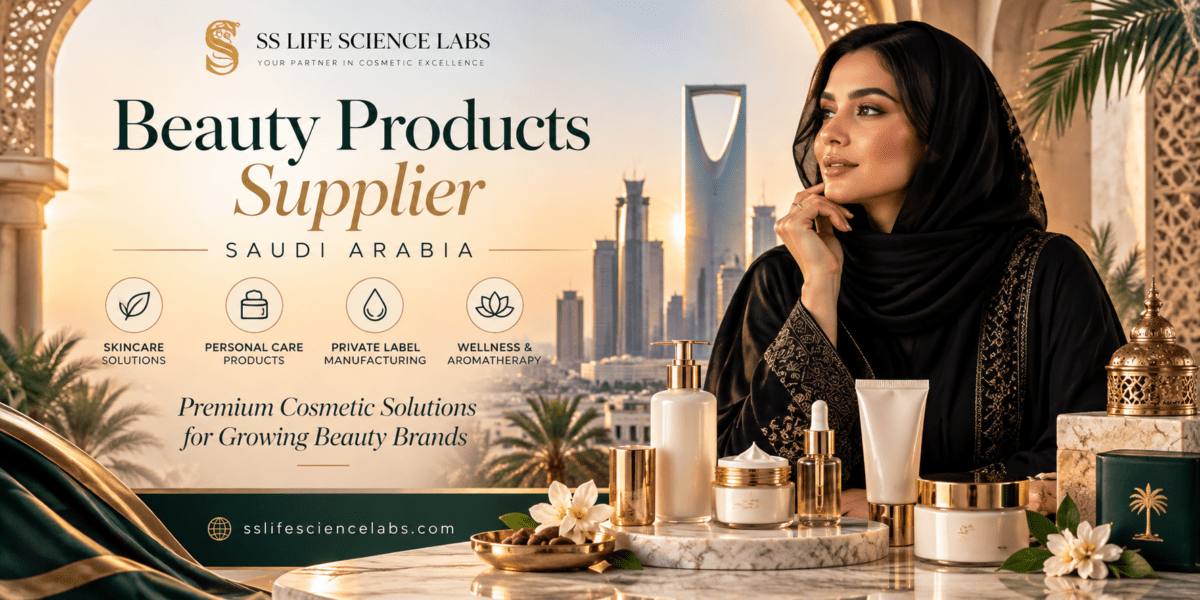
Beauty Products Supplier Saudi Arabia: Guide for Brands Entering the Market
Saudi Arabia has become an important market for beauty, skincare, personal care, wellness, and cosmetic businesses. As consumer interest in beauty and self-care continues to develop, brands are looking for reliable ways to build product ranges that match their customers, brand positioning, and long-term business goals.
For a new or growing beauty business, choosing the right Beauty Products Supplier Saudi Arabia can be one of the most important decisions during product development. A supplier is not simply a source of products. The right manufacturing partner can influence product consistency, packaging, customization, minimum order quantities, production planning, and the ability to expand the product range in the future.
For international brands targeting Saudi Arabia, the supplier does not necessarily have to be physically located in Saudi Arabia. An experienced India-based manufacturer can also support international beauty businesses, provided the products, documentation, packaging, shipping, import, labeling, and other applicable market requirements are properly addressed.
SS Life Science Labs is an India-based cosmetic manufacturing company providing private label and customized cosmetic product solutions for businesses looking to develop and expand beauty product ranges. Its product categories include skincare, personal care, body care, and aromatherapy-related products.
Businesses interested in understanding the company’s broader manufacturing capabilities can explore the SS Life Science Labs website.
Understanding the Saudi Arabian Beauty Market
Before choosing a supplier, a beauty business should first understand what it wants to achieve in the Saudi market.
Some businesses may want to launch a specialized skincare brand, while others may be interested in cosmetics, personal care, body care, hair care, wellness, or a broader beauty portfolio.
The right product strategy depends on the intended customer and the brand’s positioning.
For example, a skincare startup may begin with a small collection of complementary products instead of launching dozens of products at once. A brand could start with a cleanser, serum, and moisturizer and then expand its portfolio after understanding customer response.
This approach can make product management easier while allowing the business to build a recognizable identity.
A supplier should therefore be selected according to the brand’s current requirements as well as its potential future plans.
What Is a Beauty Products Supplier Saudi Arabia?
A Beauty Products Supplier Saudi Arabia can support businesses that want to source, develop, manufacture, or sell beauty-related products for the Saudi market.
Depending on the supplier’s capabilities, services may include product development, private label manufacturing, customized formulations, packaging support, sampling, production, and repeat manufacturing.
For a business building its own brand, private label manufacturing can be particularly useful. Instead of establishing a complete manufacturing facility, the brand can work with a manufacturing partner and develop products under its own identity.
The exact services available will differ between manufacturers, which is why businesses should discuss their requirements before making a commercial decision.
Why Private Label Is Attractive for Beauty Brands
Private label allows a business to sell products under its own brand identity.
This can give a company greater control over how its products are presented to customers, including product positioning, packaging, branding, and portfolio development.
A new beauty company may use private label to launch its first products, while an established retailer may use it to develop an exclusive range.
The model can also support gradual expansion.
A brand might begin with one hero product, introduce complementary products, and eventually expand into other categories.
For businesses looking for a private label manufacturing partner, the Private Label Cosmetics Supplier page provides additional information about private label and customized cosmetic product solutions.
Choosing the Right Beauty Products Supplier Saudi Arabia
Choosing a supplier should not be based only on the lowest quotation.
A supplier may offer an attractive price but have limitations around customization, MOQ, packaging, production capacity, communication, or future scalability.
A more useful approach is to evaluate the complete supplier relationship.
Important areas include product range, quality, samples, MOQ, customization, packaging, manufacturing capacity, communication, and future product development.
A business should also understand exactly what the supplier can provide before finalizing the product strategy.
Supplier Selection Checklist
| 🔎 Evaluation Area | 💎 What Beauty Brands Should Check |
|---|---|
| Product Range | Skincare, personal care, body care, hair care, wellness, and other required categories |
| Product Quality | Consistency, formulation quality, and manufacturing standards |
| MOQ | Whether the minimum order quantity fits the planned launch |
| Customization | Product, formulation, fragrance and packaging options |
| Samples | Availability of samples before larger production |
| Packaging | Packaging options that match the brand’s positioning |
| Production Capacity | Ability to manage current and future order volumes |
| Scalability | Support for additional products and increasing demand |
| Communication | Clear, responsive and consistent communication |
Product Quality Should Come First
Beauty products are directly connected to the customer’s experience with a brand.
If the product quality is inconsistent, customers may lose confidence in the brand even if the packaging and marketing are strong.
For this reason, businesses should understand how a prospective manufacturer approaches product development and quality control.
Brands should also evaluate samples before committing to larger quantities.
A sample can provide an opportunity to assess the product’s appearance, texture, fragrance, application, packaging, and overall experience.
Product evaluation is especially important for new businesses because an early product launch can influence the customer’s perception of the entire brand.
Understanding MOQ Before Placing an Order
MOQ stands for Minimum Order Quantity.
It refers to the minimum quantity a supplier requires for a particular product or production order.
MOQ can have a significant effect on a new beauty brand’s initial investment.
A business that is still testing its market may not want to purchase an unnecessarily large quantity. On the other hand, a growing brand may need larger production volumes to maintain inventory.
The right MOQ therefore depends on expected demand, budget, storage capacity, sales channels, and launch strategy.
Before placing an order, brands should clearly understand the supplier’s MOQ and whether different products have different requirements.
Why Samples Matter
Sampling is one of the most useful stages of product development.
A business can use samples to determine whether the product meets its expectations before moving forward with larger production.
Depending on the product, a brand may evaluate:
- Texture
- Appearance
- Fragrance
- Application
- Packaging compatibility
- Overall product experience
Sampling can also help identify changes that should be made before production.
For startups, this can reduce the risk of committing a large amount of inventory before the product has been properly evaluated.
Cosmetic Products Supplier Saudi Arabia: What Should You Check?
Businesses searching for a Cosmetic Products Supplier Saudi Arabia should first define exactly what they want from the supplier.
A company looking for skincare products may have different requirements from a retailer seeking a broad beauty catalogue.
Similarly, a startup may prioritize smaller MOQs and flexibility, while an established company may prioritize production capacity and repeat-order consistency.
The supplier should therefore be evaluated according to the business model rather than simply comparing prices.
The following questions can help:
- What product categories does the supplier support?
- Can the products be customized?
- Are samples available?
- What is the MOQ?
- What packaging options are available?
- Can the supplier support repeat production?
- Can the product portfolio expand in the future?
- How does the supplier communicate with international clients?
- Can the supplier support the business as order volumes increase?
Skincare Opportunities for Saudi Beauty Brands
Skincare can be an important category for beauty businesses entering the Saudi market.
Rather than creating an unnecessarily large catalogue, brands can consider developing a focused product range around specific customer needs.
A basic range might include a cleanser, serum, moisturizer, cream, or other complementary products.
Once the brand understands customer response, it can consider adding additional products.
This gradual approach can help businesses manage inventory while building a stronger product identity.
For businesses looking for skincare manufacturing options, the Skin Care Product Manufacturer category from SS Life Science Labs can be explored.
Building a Product Portfolio Step by Step
A beauty brand does not have to launch every possible product at the beginning.
A more structured approach can be:
Hero Product → Complementary Products → New Category → Wider Market Expansion
For example, a skincare company may begin with one serum.
After establishing its first product, the brand could introduce a cleanser and moisturizer.
Later, it may expand into body care, personal care, hair care, or wellness.
This approach gives the business time to understand customer preferences and determine which products deserve further investment.
Packaging and Brand Presentation
Packaging is an important part of the overall beauty product experience.
Customers often see the packaging before using the product itself, making it an important element of brand presentation.
Packaging should therefore match the product’s positioning.
A premium skincare brand may prefer a sophisticated and minimal presentation, while a wellness-focused brand may choose a different visual direction.
Consistency is also important when developing multiple products.
When products share recognizable design elements, customers can more easily identify them as part of the same brand.
Packaging should also be considered from a practical perspective, including product protection, labeling space, storage, transportation, and customer usability.
Working With an India-Based Cosmetic Manufacturer
A Saudi beauty business does not necessarily need to work with a manufacturer located within Saudi Arabia.
International sourcing can allow businesses to compare manufacturers based on their product capabilities, customization, production capacity, communication, and commercial requirements.
India has an established cosmetic and personal care manufacturing ecosystem, making it a potential sourcing destination for international beauty businesses.
SS Life Science Labs is an India-based manufacturer supporting private label and customized cosmetic product requirements across skincare, personal care, body care, and aromatherapy-related categories.
For an international brand, the key question should be whether the manufacturing partner can support the product and supply requirements of the intended market.
The manufacturer’s location and the brand’s target market can therefore be different.
Private Label Cosmetics Supplier Middle East
Saudi Arabia can also be considered as part of a broader Middle Eastern beauty strategy.
A company may initially target Saudi Arabia and later expand into other regional markets.
This makes scalability important when selecting a manufacturing partner.
A supplier that can support additional products and increasing production requirements can potentially make regional expansion easier to manage.
Businesses researching the wider region can read the Private Label Cosmetics Supplier Middle East guide for additional information.
Private Label Cosmetics Supplier UAE and Saudi Arabia
Saudi Arabia and the UAE are both important markets for businesses exploring the Middle Eastern beauty sector.
However, brands should not automatically assume that one product strategy will work identically in every market.
Customer preferences, pricing, positioning, distribution channels, and business requirements can vary.
A business planning regional expansion should therefore create a flexible product strategy.
For businesses also researching UAE opportunities, the Private Label Cosmetics Supplier UAE resource can be used for further supplier research.
Expanding From Saudi Arabia to International Markets
A beauty brand may begin by targeting Saudi Arabia and later explore additional markets such as the UAE, UK, Europe, USA, Australia, or other regions.
This is another reason why supplier selection should be viewed as a long-term decision.
The manufacturing partner should ideally be able to support the brand as its product portfolio develops.
For brands researching the United States, the Private Label Cosmetics Supplier USA guide provides additional information about supplier considerations.
Businesses researching the UK market can explore the Private Label Cosmetics Supplier UK guide.
For European market research, the Private Label Cosmetics Supplier Europe guide can also be useful.
These resources can help businesses compare supplier considerations across different international markets.
Private Label, OEM and ODM: What’s the Difference?
Businesses entering cosmetic manufacturing often encounter terms such as private label, OEM, and ODM.
Although the exact definition can vary between manufacturers, these models generally represent different approaches to product development and customization.
Private Label vs OEM vs ODM
| 🏷️ Manufacturing Model | ⚙️ General Approach | 🎯 Best Suited For |
|---|---|---|
| Private Label | Products are offered under the brand’s own identity with suitable customization options | Startups and growing beauty brands |
| OEM | Products are developed according to specific brand requirements | Brands seeking greater customization |
| ODM | Supplier-supported product development using established product concepts | Brands looking for development support |
The appropriate model depends on the brand’s budget, product requirements, desired customization, and level of development involvement.
Wellness and Aromatherapy Opportunities
Beauty businesses can also explore the connection between beauty and wellness.
A skincare brand may eventually introduce wellness or aromatherapy products as complementary categories.
This can help create a broader lifestyle-oriented product portfolio when it fits the brand’s positioning.
Aromatherapy-related products may be considered by businesses interested in wellness, self-care, and lifestyle categories.
Brands researching this product category can explore the Aromatherapy Oils Supplier page from SS Life Science Labs.
As with any new category, businesses should first consider customer demand and whether the products fit naturally within the existing brand.
Common Mistakes When Choosing a Beauty Products Supplier
Choosing Only on Price
The lowest price does not necessarily represent the best overall value.
Quality, MOQ, customization, communication, production capacity, and scalability should also be evaluated.
Launching Too Many Products
A large catalogue can create unnecessary inventory and make it difficult for a new brand to establish a clear identity.
Ignoring MOQ
Businesses should understand the minimum quantity before finalizing a product plan.
Skipping Samples
Moving directly to bulk production without properly evaluating samples can create unnecessary product risk.
Ignoring Packaging
Packaging is part of the customer’s first impression and should support the overall brand identity.
Not Planning for Future Growth
A supplier may meet today’s requirements but struggle to support larger orders or additional categories later.
Brands should consider both current and future needs when evaluating a manufacturing partner.
How to Build a Strong Launch Strategy
A structured launch can make the process easier for a new beauty business.
Start by identifying the target customer.
Next, choose the primary product category.
Then determine which products are most relevant to the customer’s needs.
After that, shortlist suitable suppliers and compare their capabilities.
Request samples where appropriate and evaluate the products carefully.
Once the product direction is finalized, develop the packaging and branding strategy.
Finally, plan production, inventory, distribution, and marketing around the expected launch requirements.
The objective should be to build a sustainable product range rather than simply launch as many products as possible.
Why Supplier Communication Matters
Communication is sometimes overlooked when businesses compare manufacturers.
However, international product development involves multiple stages, and clear communication can make the process easier to manage.
Brands may need to discuss product requirements, samples, packaging, quantities, production schedules, documentation, and future orders.
A supplier that communicates clearly can help the business understand what is possible and what information is required at each stage.
This becomes even more important when the brand plans to develop multiple products.
How Can a Supplier Support Long-Term Brand Growth?
A manufacturing partner can become an important part of a brand’s supply chain.
At the beginning, the business may only require one or two products.
As the brand grows, it may need additional products, higher production quantities, new packaging options, or entry into additional markets.
A supplier that can support this progression can make the transition easier.
This is why businesses should not evaluate a supplier only according to the first order.
They should also consider whether the supplier can potentially support the next stage of the brand’s development.
Frequently Asked Questions
What should I look for in a Beauty Products Supplier Saudi Arabia?
Look at product quality, MOQ, customization, samples, packaging, manufacturing capabilities, communication, and scalability. Price is important, but it should not be the only factor used to select a supplier.
Can a Saudi beauty brand work with an India-based cosmetic manufacturer?
Yes. A Saudi beauty business can work with an India-based manufacturer when the supplier can provide the required products and the business properly addresses applicable product, labeling, import, shipping, and market requirements.
What is the difference between a cosmetic supplier and a private label supplier?
A cosmetic supplier may provide existing products or sourcing solutions, while a private label supplier can help a business develop products that are sold under its own brand identity. The level of formulation and packaging customization depends on the supplier.
What products can I develop for the Saudi beauty market?
Depending on the manufacturer’s capabilities, businesses can explore skincare, personal care, body care, hair care, wellness, and aromatherapy-related products. The final product range should be based on the target customer’s needs and the brand’s positioning.
Is private label suitable for a new beauty brand?
Private label can be a practical option for startups because it allows them to develop branded products without establishing their own manufacturing facility. Starting with a focused product range can also make inventory management easier.
What MOQ should a new beauty brand choose?
There is no universal MOQ that works for every business. The appropriate quantity depends on the brand’s budget, expected demand, storage capacity, sales strategy, and launch plans. New businesses should avoid committing to quantities that create unnecessary inventory pressure.
Should I order samples before placing a bulk order?
Yes. Samples allow the business to evaluate the product before committing to larger production. Depending on the category, brands can review texture, fragrance, appearance, application, packaging, and overall product experience.
Can one supplier provide skincare and other beauty products?
Some manufacturers support multiple categories, while others specialize in specific product types. Businesses planning a broader portfolio should confirm whether the supplier can support categories such as skincare, personal care, body care, wellness, and aromatherapy.
Can I start in Saudi Arabia and later expand into the UAE?
Yes. A brand can build a product strategy with regional expansion in mind. However, requirements can differ between markets, so businesses should evaluate applicable regulatory, labeling, import, shipping, and distribution requirements before entering each market.
Why is packaging important for a Saudi beauty brand?
Packaging protects the product while also communicating the brand’s identity and positioning. Consistent and professional packaging can help create a recognizable product range and a stronger customer experience.
How do I choose between Private Label, OEM and ODM?
The right model depends on the level of customization and development support required. Private label can suit brands looking for branded products, OEM can suit businesses requiring more specific customization, and ODM can be useful when a brand wants supplier-supported product development.
Can a beauty brand start with only one product?
Yes. A focused launch can be a practical strategy for a new business. Starting with a hero product allows the brand to test its positioning and customer response before expanding into complementary products.
Can SS Life Science Labs support international beauty brands?
SS Life Science Labs is an India-based cosmetic manufacturer providing private label and customized cosmetic product solutions across categories such as skincare, personal care, body care, and aromatherapy-related products. International businesses can evaluate its capabilities according to their specific product and target-market requirements.
Conclusion
Saudi Arabia presents opportunities for businesses looking to develop beauty, skincare, personal care, body care, wellness, and cosmetic brands. Choosing the right Beauty Products Supplier Saudi Arabia can help a business build a reliable product portfolio while creating a foundation for future growth.
The supplier-selection process should go beyond price. Product quality, MOQ, customization, samples, packaging, production capacity, communication, and scalability all deserve careful consideration.
For international beauty businesses, an India-based manufacturing partner can also be considered when its capabilities and supply process match the requirements of the intended market.
SS Life Science Labs provides private label and customized cosmetic product solutions across skincare, personal care, body care, and aromatherapy-related categories.
Whether a business is launching its first beauty product in Saudi Arabia or planning expansion across the Middle East and international markets, a focused product strategy and carefully selected manufacturing partner can provide a stronger foundation for sustainable brand growth.
Related Reading
For businesses researching international private label opportunities:
Private Label Cosmetics Supplier USA
Private Label Cosmetics Supplier UK
Private Label Cosmetics Supplier Europe
Private Label Cosmetics Supplier Middle East
Private Label Cosmetics Supplier UAE
For product and manufacturing information:
Private Label Cosmetics Supplier