
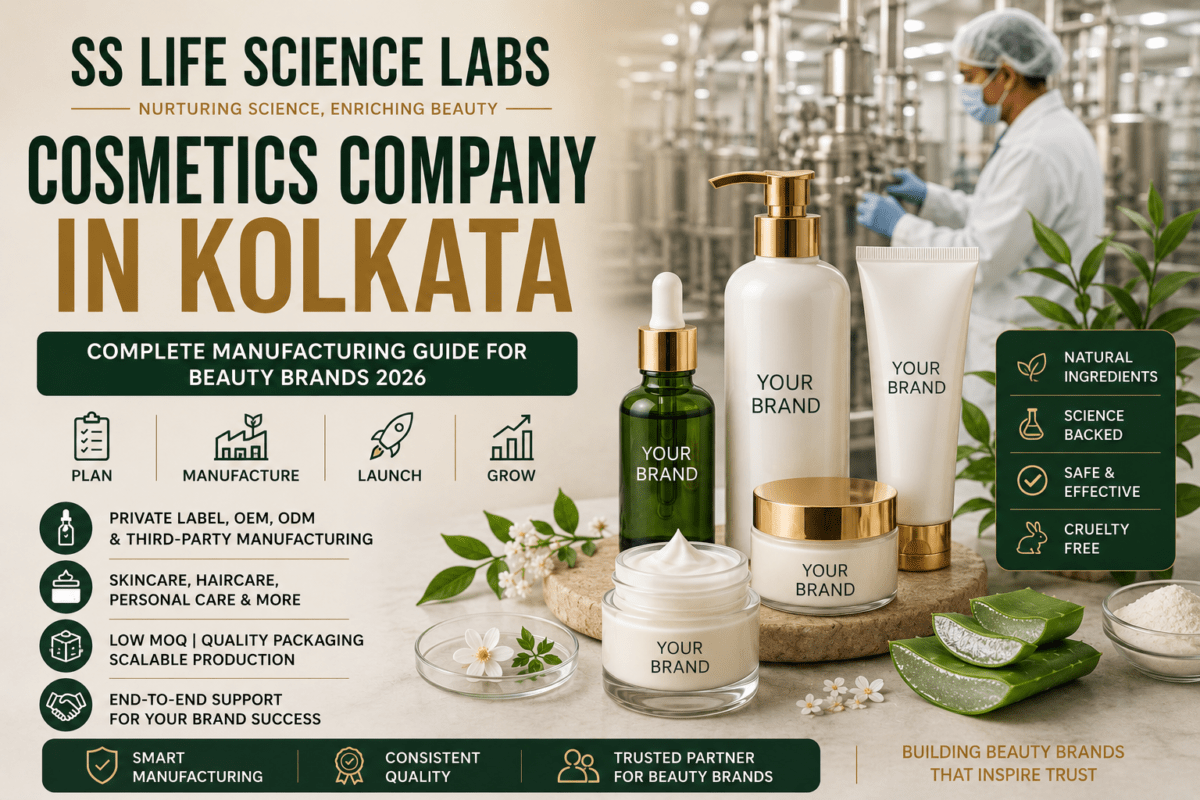
Cosmetics Company in Kolkata: Complete Manufacturing Guide for Beauty Brands 2026
Launching a cosmetic brand often begins with an exciting idea: a skincare range for a particular customer group, a premium haircare collection, a private label beauty line for an existing retail business, or a personal care portfolio designed for online marketplaces. But between that idea and the finished product lies a much more important business decision—who will manufacture the products, and can that manufacturer support the brand beyond its first order?
For entrepreneurs searching for a Cosmetics Company in Kolkata, the answer should not come from comparing prices alone. A manufacturing partner influences product development, minimum order quantities, packaging choices, production planning, consistency, commercial margins and the ability to expand into additional products later. A manufacturer that looks inexpensive during the first quotation can become an expensive choice if its capabilities do not match the brand’s requirements.
Kolkata-based beauty businesses also do not necessarily need to limit their manufacturing search to companies physically located within the city. Modern beauty brands can evaluate manufacturing partners across India while managing branding, marketing, distribution and customer acquisition from Kolkata. The better question is therefore not simply “Which cosmetic company is closest to me?” but “Which manufacturing partner is most suitable for the beauty business I want to build?”
A brand researching manufacturers can compare regional options with a broader Cosmetic Products Manufacturer in India to understand available product categories, manufacturing models, customization possibilities and long-term production capabilities.
This guide is designed to help beauty startups, existing cosmetic businesses, retailers, salon brands, distributors and entrepreneurs make that decision systematically. Instead of simply listing manufacturers, it explains what to evaluate, why each factor matters, when different manufacturing models make sense, how to compare suppliers and what should happen before a bulk order is placed.
Quick Answer: How Should You Choose a Cosmetics Company in Kolkata?
The right Cosmetics Company in Kolkata should be selected according to your product category, desired manufacturing model, quality expectations, MOQ, customization requirements, packaging needs, communication and future production plans—not price or location alone.
Before contacting manufacturers, define what you want to sell, who will buy it, how the product will be positioned and approximately how much inventory your business can realistically handle. Then provide shortlisted manufacturers with comparable requirements and evaluate their responses systematically.
For startups, a manufacturer that supports manageable quantities and a focused product portfolio may be more practical than one designed primarily for very large production volumes. Growing brands should additionally consider repeat-order consistency, wider product capabilities and scalability.
The goal is not simply to find a manufacturer. It is to find a manufacturing relationship that remains commercially workable as the brand develops.
Start With the Brand, Not the Manufacturer
One of the easiest mistakes in cosmetic manufacturing is starting supplier conversations too early.
A founder sees dozens of possible products—serums, face washes, moisturizers, shampoos, conditioners, body lotions and oils—and immediately begins requesting catalogues and quotations.
This reverses the correct order.
Before choosing products, define the customer and brand proposition.
Consider two hypothetical skincare businesses.
Brand A wants to target young consumers looking for a simple everyday skincare routine at an accessible price.
Brand B wants to build a premium skincare collection for customers willing to pay more for presentation, product experience and distinctive positioning.
Both businesses could sell cleanser, serum and moisturizer. Yet their packaging, price points, quantities, customization expectations and manufacturer requirements could be completely different.
That means the first manufacturing document should not be a supplier quotation.
It should be your brand brief.
| Decision | What the Brand Should Define |
|---|---|
| Target customer | Who is expected to purchase? |
| Product category | Skincare, haircare, body care, personal care, etc. |
| Positioning | Mass, premium, professional or another segment |
| Sales channel | Website, marketplaces, retail, salons, distributors |
| Launch range | Number of initial SKUs |
| Manufacturing route | Private label, OEM, ODM or third-party |
| Initial quantity | Realistic inventory requirement |
| Packaging direction | Functional, premium, minimal, etc. |
| Expansion plan | What could be added after launch? |
Once these answers are clear, evaluating manufacturers becomes significantly easier.
What Does a Cosmetic Manufacturing Company Actually Do?
A cosmetic manufacturing company converts a defined product requirement into a manufacturable product through an agreed production arrangement.
The exact scope varies from company to company. Depending on capabilities and the project, services may involve formulation-related work, product selection, customization, manufacturing, filling, packaging coordination and production support.
This distinction matters because the term “cosmetic manufacturer” alone tells a buyer very little.
A manufacturer might have strong skincare capabilities but a limited haircare portfolio. Another might specialize in private label products, while another is more suitable for brands requiring greater customization.
Instead of asking:
“Do you manufacture cosmetics?”
ask:
“Do your manufacturing capabilities match the specific products and commercial model of my brand?”
That single change produces a much more useful supplier conversation.
Who Should Consider Outsourced Cosmetic Manufacturing?
Outsourced manufacturing is not limited to first-time entrepreneurs.
It can potentially suit several types of businesses:
| Business Type | Why Manufacturing Outsourcing May Be Relevant |
|---|---|
| Beauty startup | Avoid establishing an in-house production facility |
| Existing skincare brand | Expand production or add new products |
| Retailer | Introduce an own-brand beauty range |
| Salon business | Build branded professional/customer products |
| E-commerce business | Develop a direct-to-consumer range |
| Distributor | Add proprietary products to distribution portfolio |
| Personal care company | Expand into adjacent categories |
| Established brand | Outsource additional capacity/categories |
Each type of business should evaluate manufacturers differently.
A startup may prioritize manageable MOQ and launch simplicity. An established company may place greater importance on production capacity, repeat-order reliability and multi-category capabilities.
Kolkata Beauty Brands: Local Manufacturer or Pan-India Partner?
For a Kolkata business, geographical proximity can be convenient. It may simplify physical meetings, product discussions or logistics in some cases.
But location should be treated as one variable, not the final decision.
A manufacturer elsewhere may offer a better product fit, while a local manufacturer may offer easier coordination. Neither should automatically win.
A more useful comparison looks like this:
| Factor | Kolkata/Regional Partner | Pan-India Partner |
|---|---|---|
| Physical proximity | Potential advantage | Lower |
| Product capabilities | Must be verified | Must be verified |
| MOQ | Varies | Varies |
| Customization | Varies | Varies |
| Packaging support | Varies | Varies |
| Communication | Evaluate directly | Evaluate directly |
| Logistics | Potentially simpler | Requires planning |
| Scalability | Must be assessed | Must be assessed |
Beauty brands can also study how supplier selection changes across different manufacturing hubs. For example, our guide to Beauty Products Manufacturers in Mumbai examines manufacturing decisions from the perspective of beauty brands operating in a major consumer and commercial market.
The important lesson is simple: city is context; capability is the decision.
Decide What You Actually Want to Manufacture
A beauty brand should avoid building its launch catalogue simply by selecting attractive items from a manufacturer’s product list.
Start with the customer problem and create a coherent portfolio around it.
Skincare
Skincare can include cleansers, creams, moisturizers, serums, toners, masks, gels and other category-specific products depending on manufacturer capabilities.
A skincare-focused business should evaluate whether a potential Skin Care Product Manufacturer in India has relevant category experience rather than assuming that every general cosmetic manufacturer offers the same depth across skincare.
A new skincare business might begin with a simple routine:
Cleanser → Serum → Moisturizer
This is easier for customers to understand and easier for the business to position than an unrelated collection of ten or fifteen products.
Haircare
Haircare businesses can evaluate shampoos, conditioners, hair serums, masks, oils and other products according to their target audience and manufacturer capabilities.
Instead of simply launching “a shampoo,” define its place within the brand.
Who is it intended for?
What other product accompanies it?
Is the range positioned for everyday use, premium customers or a particular consumer need?
Personal Care
Personal care can provide opportunities for businesses looking beyond face-focused skincare.
Companies planning this category can review a dedicated Personal Care Products Manufacturer in India guide to understand broader product and manufacturing considerations.
The key is portfolio coherence. Every new category should have a commercial reason to exist.
Build a Hero-Product Strategy Before Building a Large Catalogue
For a new brand, more products do not automatically mean more sales.
In fact, a large launch can create four immediate problems:
More inventory. More packaging requirements. More marketing messages. More working capital tied up in stock.
A hero-product strategy can be easier to manage.
Imagine a new Kolkata skincare brand has enough investment to develop ten different products. Instead of launching all ten, it might choose three products that form a recognizable routine.
| Stage | Product | Commercial Role |
|---|---|---|
| Step 1 | Cleanser | Entry product |
| Step 2 | Serum | Hero/differentiating product |
| Step 3 | Moisturizer | Routine completion |
Marketing can then focus on one clear customer journey.
Once real demand is visible, the brand can expand.
This is fundamentally different from manufacturing first and trying to invent demand afterward.
Private Label Cosmetic Manufacturer Kolkata: When Does Private Label Make Sense?
Private label manufacturing can be attractive to businesses that want to launch products under their own brand without building an independent manufacturing operation.
Depending on the supplier and project, a manufacturer may provide product options that can be sold under the client’s branding with agreed customization or packaging arrangements.
Private label can be particularly useful when the business priority is market entry and brand building rather than developing every product entirely from the beginning.
For a deeper selection framework, brands can review our guide on How to Choose a Private Label Cosmetics Supplier in India before approaching potential suppliers.
Private label may make sense when:
- The business is launching its first beauty range.
- Speed and operational simplicity matter.
- The company wants to test market demand.
- Building a manufacturing facility is not commercially practical.
- Existing product options fit the intended brand.
- The business wants to focus resources on branding and distribution.
But private label does not mean “easy success.”
The product still needs a clear audience, attractive positioning, appropriate packaging, realistic pricing and a customer acquisition strategy.
Private Label, OEM, ODM or Third-Party: Which Model Fits Your Brand?
Manufacturing terminology can become confusing because companies may use terms differently.
The practical question is what level of product development and manufacturing support your business requires.
| Model | General Approach | Suitable Situation |
|---|---|---|
| Private Label | Manufacturer-supported product options sold under your brand | Faster/simple market entry |
| OEM | Production aligned with more defined brand requirements | Brands wanting greater specification control |
| ODM | Manufacturer may support product design/development as part of the arrangement | Businesses seeking development support |
| Third-Party Manufacturing | Production outsourced to an external manufacturing company | Brands avoiding own production infrastructure |
| Custom Manufacturing | Greater degree of product-specific development | Differentiated product strategy |
Because exact service definitions can vary, businesses should confirm the manufacturer’s actual scope rather than relying on labels.
If you are unsure which route fits your project, the detailed Private Label Cosmetics vs OEM vs ODM Cosmetics comparison can help clarify the differences before requesting quotations.
Why Third-Party Manufacturing Can Change the Economics of a Beauty Business
Setting up an independent cosmetic manufacturing facility requires more than machinery.
A business needs production infrastructure, trained personnel, processes, procurement, maintenance, quality systems and ongoing operational management.
Outsourcing agreed manufacturing responsibilities can allow a brand to concentrate resources elsewhere.
The business can focus on:
Brand Development → Distribution → Marketing → Customer Acquisition → Retail Expansion → Repeat Sales
This is why 3rd Party Cosmetic Manufacturing in India can be relevant not only for startups but also for existing businesses that want to expand without immediately increasing their own manufacturing infrastructure.
The decision still requires due diligence. Outsourcing production does not outsource responsibility for choosing the right manufacturing partner.
Create a Manufacturing Brief Before Asking for Prices
A vague enquiry usually produces a vague quotation.
Instead of messaging a supplier with:
“Price for face serum?”
provide a structured requirement.
Sample Manufacturing Brief
| Requirement | Example |
|---|---|
| Product | Facial serum |
| Intended audience | Adult skincare consumers |
| Positioning | Mid-premium |
| Initial quantity | To be discussed based on MOQ |
| Manufacturing model | Private label/OEM |
| Packaging | Dropper or pump |
| Customization | To be discussed |
| Sales channel | D2C + marketplaces |
| Launch timeline | Defined target period |
| Future range | Cleanser + moisturizer |
The manufacturer now has enough context to have a meaningful conversation.
Use approximately the same brief with each shortlisted supplier. Otherwise, you may accidentally compare quotations for different products, packaging arrangements or quantities.
MOQ Is Not Just a Manufacturing Number—It Is an Inventory Decision
MOQ stands for Minimum Order Quantity.
For a startup, it is one of the most important commercial variables in the manufacturing process.
Consider a hypothetical business launching six products.
If each product requires a separate minimum quantity, the total inventory investment can become substantial. If each product also has multiple fragrances, shades or variants, the commitment can increase further.
Before agreeing to production, ask:
- Is MOQ calculated per SKU?
- Does each fragrance have a separate MOQ?
- Do different variants require separate quantities?
- Does packaging choice affect MOQ?
- Does customization change the required quantity?
- Will repeat orders follow the same MOQ?
The right MOQ is not necessarily the lowest possible MOQ.
It is the quantity that aligns reasonably with sales forecasts, working capital, storage and customer acquisition capacity.
A Simple Inventory Reality Check for New Brands
Before placing an order, estimate how quickly the inventory could realistically sell.
Suppose a brand orders 3,000 units but currently sells only 150 units per month.
Ignoring growth, that represents approximately 20 months of inventory.
Now suppose it has three products with similar inventory commitments.
Suddenly, a seemingly attractive manufacturing price has tied a large amount of capital into stock.
This is why brands should evaluate unit price and inventory exposure together.
A lower unit price at an excessively high quantity may be commercially worse than a somewhat higher unit cost at a manageable production quantity.
How Should You Compare Manufacturing Cost?
There is no universal cosmetic manufacturing price because cost depends on the project.
Important variables can include:
Product type – Different product categories involve different manufacturing requirements.
Formulation/specification – Product requirements influence production complexity.
Quantity – Order size can affect commercial terms.
Packaging – Bottle, tube, jar, pump, dropper, label and outer carton can materially affect overall cost.
Customization – Greater customization may require additional development.
Additional project requirements – Testing, documentation or other project-specific needs can affect the final quotation.
Instead of asking, “Which manufacturer is cheapest?”, ask:
Total Manufacturing Value
Product Fit + Quality + MOQ + Packaging + Communication + Commercial Cost + Scalability
A supplier does not need to score highest in every category. It needs to offer the best overall fit for your business model.
Why Product Sampling Deserves More Attention
A quotation tells you the price.
A catalogue tells you what the manufacturer says it can offer.
A relevant sample, where available, gives you something more tangible to evaluate.
Depending on the product, a brand may examine characteristics such as texture, fragrance, appearance, application experience and how well the product aligns with the intended positioning.
Sampling can also reveal something about the working relationship.
How clearly does the supplier collect feedback?
How are changes discussed?
Are expectations documented?
Does communication remain consistent?
These operational details become increasingly important once production begins.
Packaging Should Be Discussed Before the Last Minute
Packaging is not merely a decorative shell around the formulation.
It influences functionality, consumer perception, logistics and overall product economics.
Consider a serum. The same formulation presented in a basic container and a carefully selected premium pump can create very different customer perceptions and cost structures.
A brand should consider:
| Packaging Element | Question to Ask |
|---|---|
| Primary container | Is it suitable for the product? |
| Closure | Is it convenient and functional? |
| Dispensing | Pump, dropper, tube, etc.? |
| Label | What information and branding are required? |
| Outer packaging | Is a carton required? |
| Size | Does it align with price positioning? |
| Finish | Does it support the brand identity? |
| Logistics | Can it withstand normal handling/dispatch? |
Packaging decisions should support the product, customer and price point simultaneously.
How a Beauty Product Moves From Idea to Launch
A well-managed manufacturing project can be viewed as a sequence of decisions rather than one large production event.
Stage 1: Customer Definition
Identify who will buy the product and why.
Stage 2: Product Strategy
Select the category, initial products and market positioning.
Stage 3: Manufacturing Route
Determine whether private label, OEM, ODM, third-party or another arrangement is appropriate.
Stage 4: Manufacturer Shortlisting
Compare suppliers according to relevant capabilities rather than geography alone.
Stage 5: Product Evaluation
Review suitable product options or samples where applicable.
Stage 6: Commercial Planning
Clarify MOQ, price, packaging responsibilities and expected production arrangements.
Stage 7: Packaging and Brand Preparation
Coordinate branding and packaging requirements.
Stage 8: Production
Proceed according to finalized specifications and agreed processes.
Stage 9: Distribution Preparation
Ensure the website, marketplace listings, retailer/distributor arrangements and marketing assets are ready.
Stage 10: Launch and Measurement
Track customer response before expanding the range.
The important lesson is that manufacturing should not happen independently of sales planning.
What Should a Cosmetics Company in Kolkata Be Evaluated On?
Instead of relying on sales claims such as “premium,” “best,” “advanced” or “trusted,” convert manufacturer selection into measurable criteria.
Manufacturer Evaluation Scorecard
| Evaluation Area | Weight | Score |
|---|---|---|
| Product/category fit | 20% | /10 |
| Product evaluation/quality | 15% | /10 |
| MOQ suitability | 10% | /10 |
| Manufacturing model fit | 10% | /10 |
| Customization capability | 10% | /10 |
| Packaging coordination | 10% | /10 |
| Commercial viability | 10% | /10 |
| Communication | 5% | /10 |
| Repeat-order planning | 5% | /10 |
| Scalability | 5% | /10 |
| Total | 100% |
Use the same framework for every shortlisted manufacturer.
It reduces the chance of choosing a supplier simply because one salesperson was more persuasive.
12 Questions to Ask Before Finalizing a Cosmetic Manufacturer
The quality of your questions often determines the quality of the information you receive.
1. Which product categories do you currently manufacture?
This confirms whether your intended range aligns with actual capabilities.
2. Which manufacturing models do you support?
Clarify private label, OEM, ODM, third-party or custom arrangements.
3. What is the MOQ for my specific product?
Do not settle for a general MOQ statement.
4. Does MOQ change with variants or packaging?
This can significantly affect total inventory.
5. What can actually be customized?
Ask specifically about formulation-related options, fragrance, packaging and other relevant areas.
6. Are samples available?
Understand the process before bulk production.
7. What packaging support is available?
Clarify responsibilities early.
8. What information do you require from my business?
Professional manufacturers should be able to explain their process.
9. What does the typical project workflow look like?
You need visibility from enquiry to production.
10. How are repeat orders handled?
Your first order is only one part of the relationship.
11. Can manufacturing quantities scale if demand grows?
This matters for successful products.
12. What project-specific documentation and requirements apply?
Confirm details directly rather than making assumptions.
Red Flags Beauty Brands Should Not Ignore
Price attracts attention. Red flags deserve more attention.
Vague Answers to Specific Questions
If you ask what can be customized and receive only generic marketing language, request clarification.
Pressure to Order Before Requirements Are Clear
A manufacturing project should have defined products, quantities and responsibilities before commitment.
Unclear MOQ
You should understand what minimum quantities apply to.
Packaging Responsibilities Are Undefined
Clarify who supplies, approves and coordinates each packaging component.
No Clear Repeat-Order Discussion
If you intend to build a long-term brand, ask what happens after the first production run.
Capabilities That Do Not Match Your Category
A long catalogue does not compensate for weak relevance to your core products.
Price Is the Only Competitive Advantage
Low price can be valuable, but it should not be the only reason to choose a manufacturer.
Should a Kolkata Brand Compare Manufacturers in Other Cities?
Yes, when doing so improves the quality of the decision.
India has multiple manufacturing and commercial hubs, and different suppliers may offer different product categories, quantities and business models.
For example, brands evaluating western India can read our guide to Cosmetic Manufacturers in Surat, which focuses on choosing the right manufacturing partner, and the Cosmetic Manufacturers in Vadodara guide for additional private label and OEM considerations.
Similarly, businesses comparing northern manufacturing options can explore Top Cosmetics Manufacturers in Delhi in the related resources section at the end of this article.
The objective is not to collect the largest possible list of suppliers.
The objective is to build a shortlist of manufacturers that genuinely fit the project.
Startup vs Established Brand: The Same Manufacturer May Not Suit Both
Manufacturer suitability changes with business stage.
| Factor | Startup | Established Brand |
|---|---|---|
| MOQ | Often critical | May be easier to manage |
| Initial SKU count | Usually better kept focused | Can support wider range |
| Customization | Depends on budget/strategy | May require more control |
| Capacity | Initial requirement smaller | Larger/repeat capacity important |
| Packaging | Cost-sensitive | May support premium complexity |
| Scalability | Future consideration | Immediate consideration |
| Product development | Focused | Often ongoing |
A startup should not choose a manufacturing model designed for a business ten times its current size merely because it hopes to grow.
The best relationship provides room to grow without making the first order commercially unrealistic.
A Better Launch Plan for a New Kolkata Beauty Brand
Instead of beginning with a huge catalogue, consider a phased approach.
Phase 1 — Establish the Core
Launch two to four products that communicate what the brand stands for.
Phase 2 — Measure Real Demand
Track which products sell, which receive repeat orders and what customers request next.
Phase 3 — Strengthen the Routine
Introduce complementary products that increase basket value and make sense for existing customers.
Phase 4 — Expand Categories
Move into adjacent categories only when the core business supports expansion.
Phase 5 — Scale Distribution
Evaluate additional marketplaces, retail, distributors or other channels based on commercial viability.
This creates a feedback loop:
Launch → Learn → Improve → Expand
rather than:
Manufacture Everything → Hope It Sells
How Manufacturing and Marketing Should Work Together
A manufacturer can produce a product.
A manufacturer cannot automatically create consumer demand for it.
Before production, the marketing team should already know:
Who is the customer?
What is the core product message?
What price range is commercially viable?
Where will the customer discover the product?
What makes the range easy to understand?
Which product will lead customer acquisition?
Suppose a brand creates eight products without identifying a hero product. Marketing budget becomes fragmented across eight separate messages.
A focused launch allows the brand to concentrate attention.
This is why product strategy should connect manufacturing decisions with SEO, social content, marketplace listings, paid advertising, influencer activity, retail and distribution.
When Should a Beauty Brand Expand Its Product Range?
Expansion should generally follow evidence.
Consider adding products when several of the following are true:
- Existing products show repeat demand.
- Customers are requesting complementary products.
- The current inventory cycle is manageable.
- Marketing has enough capacity for additional products.
- The new category fits the existing audience.
- Distribution can support a larger catalogue.
- The manufacturing partner can support the expansion reliably.
Imagine a skincare brand whose cleanser, serum and moisturizer are performing well.
The next logical product might be something that extends the same routine.
Launching an unrelated category simply because the manufacturer offers it may dilute the brand.
A manufacturer’s catalogue is a menu of possibilities, not your business strategy.
When Should You Reconsider Your Manufacturing Partner?
A manufacturing relationship that worked during launch may eventually stop fitting the business.
Potential reasons to evaluate alternatives include:
Capacity limitations – The supplier cannot support growing quantities.
Category limitations – The brand wants products outside the manufacturer’s capabilities.
Commercial mismatch – MOQ or other commercial requirements no longer suit the business.
Communication problems – Coordination repeatedly becomes difficult.
Packaging evolution – The brand needs capabilities that are not available.
Strategic change – The business is moving toward a different manufacturing model.
Changing manufacturers should not be treated casually because continuity matters, but brands should also avoid remaining in a relationship that no longer supports their requirements.
A 5-Layer Decision Framework for Selecting a Cosmetics Company in Kolkata
Before finalizing a supplier, evaluate the decision through five layers.
Layer 1 — Customer Fit
Will the manufactured product make sense for the intended buyer?
Layer 2 — Product Fit
Does the manufacturer genuinely support the required category and specifications?
Layer 3 — Commercial Fit
Are MOQ, pricing and inventory exposure workable for the business?
Layer 4 — Operational Fit
Are communication, packaging responsibilities and production processes sufficiently clear?
Layer 5 — Growth Fit
Can the relationship support reasonable future quantities and portfolio expansion?
A supplier that fails one critical layer should be investigated further even if its quotation looks attractive.
Final Pre-Production Checklist
Before moving from discussion to production, a beauty brand should be able to answer these questions confidently.
| Final Check | Status |
|---|---|
| Target customer defined | ☐ |
| Product positioning defined | ☐ |
| Initial SKU range finalized | ☐ |
| Manufacturing model understood | ☐ |
| Manufacturer capabilities evaluated | ☐ |
| Product/sample evaluation completed where applicable | ☐ |
| MOQ understood | ☐ |
| Commercial terms understood | ☐ |
| Packaging responsibilities clear | ☐ |
| Specifications documented | ☐ |
| Production process understood | ☐ |
| Sales channels prepared | ☐ |
| Repeat-order plan discussed | ☐ |
| Scalability considered | ☐ |
If several boxes remain unchecked, the project probably needs more preparation before a significant production commitment.
Frequently Asked Questions
What should I look for in a Cosmetics Company in Kolkata?
Evaluate the manufacturer according to product-category capabilities, manufacturing model, MOQ, product suitability, customization, packaging support, communication, commercial terms and ability to support future production. Location should be one consideration rather than the only deciding factor.
How do I find cosmetic manufacturers Kolkata brands can work with?
Start by defining your products and manufacturing requirements. Create a shortlist of relevant manufacturers, provide comparable briefs, evaluate their capabilities and ask specific questions about MOQ, samples, packaging, customization, production and repeat orders.
What is a private label cosmetic manufacturer?
A private label manufacturer generally provides products that another business can market under its own brand according to the agreed manufacturing and branding arrangement. Exact services and customization possibilities vary by supplier.
Is private label suitable for a new cosmetic brand?
It can be suitable when the business wants to enter the market without establishing its own production facility and when the manufacturer’s available product options fit the brand strategy. MOQ, differentiation, packaging and commercial viability should still be evaluated.
What is the difference between private label and OEM cosmetics?
Private label generally uses manufacturer-supported product options with agreed branding/customization, whereas OEM commonly involves production according to more defined brand requirements. Exact definitions can vary by manufacturer, so always confirm the actual service scope.
What does ODM mean in cosmetics?
ODM generally involves a manufacturer providing development/design-related capabilities alongside manufacturing. The exact arrangement varies, so brands should clarify ownership, customization and development responsibilities before proceeding.
What is third-party cosmetic manufacturing?
Third-party manufacturing is an arrangement in which a business outsources agreed production activities to an external manufacturing company rather than manufacturing the products entirely within its own facility.
What does MOQ mean?
MOQ means Minimum Order Quantity. It is the minimum quantity a manufacturer requires for a particular product, variant or manufacturing arrangement.
Should I choose the cosmetic manufacturer offering the lowest MOQ?
Not automatically. A manageable MOQ is valuable, but product fit, quality, packaging, commercial cost, communication and future capabilities also matter.
Can a Kolkata beauty brand work with a manufacturer in another state?
Yes. A company can evaluate manufacturing partners across India. Logistics and communication should be considered alongside product capabilities, quality expectations, MOQ, commercial terms and scalability.
How many products should a new skincare brand launch?
There is no universal number. A focused range of complementary hero products can be easier to position, market and manage than a large initial catalogue. The right number depends on the business model, investment and customer strategy.
Why should I evaluate samples before bulk manufacturing?
Where sampling is available and appropriate, it allows the brand to assess product characteristics and alignment with its intended positioning before committing to a larger order.
Is packaging part of cosmetic manufacturing?
It depends on the manufacturer and project. Packaging coordination may be included or handled separately. Responsibilities should be confirmed before production.
How can I compare two cosmetic manufacturers fairly?
Give both manufacturers similar product requirements and compare category capability, product evaluation, MOQ, customization, packaging, commercial terms, communication and scalability using a structured scorecard.
What is more important: manufacturer location or capability?
Capability should generally carry greater weight. A nearby manufacturer can provide logistical convenience, but proximity does not automatically mean the supplier is the best fit for the product or business.
When should an existing brand change its cosmetic manufacturer?
A business may evaluate alternatives when capacity, product categories, MOQ, packaging capabilities, communication or future requirements no longer align with its strategy. Any transition should be carefully planned.
Final Thoughts: Choosing the Right Cosmetics Company in Kolkata
Finding the right Cosmetics Company in Kolkata is ultimately a business-model decision, not simply a supplier search.
A manufacturer should fit the products you intend to sell, the quantities your business can realistically manage, the manufacturing model you require and the customer experience you want to create.
For new brands, the strongest starting point is often clarity rather than scale. Define the customer, select a focused product range, determine whether private label, OEM, ODM or third-party manufacturing fits the strategy, and then compare potential manufacturing partners against the same requirements.
For established businesses, the evaluation becomes broader. Repeat-order consistency, production capacity, new-product capabilities, packaging coordination and scalability become increasingly important.
Most importantly, do not allow a manufacturer’s catalogue to define your brand. Your customer and commercial strategy should define the products; the manufacturing partner should help make that strategy operationally possible.
When customer positioning, product planning, manufacturing, packaging, distribution and marketing work together, a beauty business has a much stronger foundation for sustainable growth than one built around price alone.
Related Cosmetic Manufacturing & Beauty Brand Guides
Beauty Products Manufacturers in Mumbai
Mumbai me beauty brands ke liye manufacturer selection, private label options, MOQ, packaging aur scalable production planning explain ki gayi hai.
Cosmetic Manufacturers in Vadodara
Vadodara me private label aur OEM cosmetic manufacturing partner select aur compare karne ka practical framework diya gaya hai.
Cosmetic Manufacturers in Hyderabad
Hyderabad me cosmetic manufacturing options evaluate karte waqt product capabilities, private label aur supplier selection ke important factors cover kiye gaye hain.
Cosmetic Products Manufacturer in India: Trends 2026
India ke cosmetic manufacturing landscape aur 2026 me beauty brands ke liye relevant manufacturing trends explain kiye gaye hain.
Cosmetic Manufacturers in Surat
Surat me suitable cosmetic manufacturing partner choose karne ke liye quality, MOQ, private label, OEM aur supplier evaluation cover kiya gaya hai.
Personal Care Products Manufacturer in India
Personal care products develop karne wale brands ke liye manufacturing categories aur supplier-selection considerations explain kiye gaye hain.
Skin Care Product Manufacturer in India
Skincare brands ke liye product manufacturing, supplier evaluation aur suitable skincare manufacturing partner select karne ka guide hai.
Top Cosmetics Manufacturers in Delhi
Delhi me cosmetic manufacturers research aur compare karne wale beauty businesses ke liye dedicated manufacturing guide hai.
Beauty Product Manufacturers in Delhi
Beauty products manufacture karwane wale brands ke liye Delhi manufacturing options aur selection factors cover kiye gaye hain.
How to Choose the Best Cosmetic Company in Delhi
Delhi me cosmetic company select karte waqt capabilities, requirements aur commercial factors evaluate karne ka practical guide hai.
How to Choose a Private Label Cosmetics Supplier in India
Private label beauty brand launch karne se pehle supplier capabilities, MOQ, products aur manufacturing arrangement evaluate karna explain kiya gaya hai.
3rd Party Cosmetic Manufacturing in India
Third-party manufacturing kaise work karti hai aur beauty brands ko manufacturing outsource karte waqt kya evaluate karna chahiye, ye explain kiya gaya hai.
Private Label Cosmetics Supplier in India
Private label cosmetics ke liye supplier selection aur branded beauty range develop karne se related important considerations cover kiye gaye hain.
Cosmetic Products Manufacturer in India
Cosmetic products manufacture karwane wale businesses ke liye manufacturer selection aur production-related considerations ka detailed resource hai.
Private Label Cosmetics vs OEM vs ODM Cosmetics
Private label, OEM aur ODM manufacturing models ka difference aur kis type ke beauty brand ke liye kaunsa approach suitable ho sakta hai, explain kiya gaya hai.
Why SS Life Science Labs Is a Trusted Cosmetic Products Manufacturer in India
SS Life Science Labs ke cosmetic manufacturing positioning aur brand-focused manufacturing approach ke baare me dedicated information di gayi hai.
Top Trending Skincare and Haircare Products
Beauty brands ke liye skincare aur haircare product categories aur portfolio-planning ideas explore kiye gaye hain.