
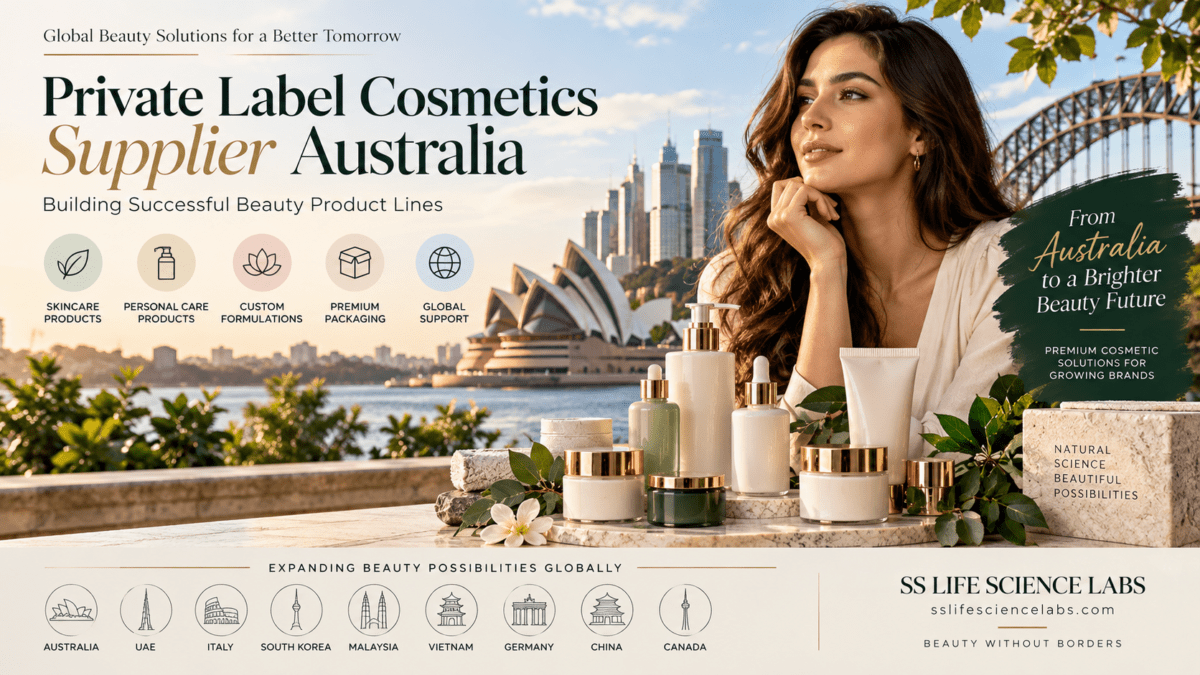
Private Label Cosmetics Supplier Australia: Building Successful Beauty Product Lines
Australia has a diverse beauty and personal care market, creating opportunities for businesses that want to build skincare, cosmetics, body care, hair care, wellness, and other beauty product lines. For a new brand, retailer, distributor, or established beauty business, developing the right products is only one part of the process. Finding a manufacturing partner that can support product development, private labeling, packaging, production, and future expansion is equally important.
Choosing a Private Label Cosmetics Supplier Australia can help a beauty business develop products under its own brand identity instead of relying entirely on products from established brands. Private label manufacturing can provide businesses with an opportunity to build a distinct product portfolio while focusing their resources on branding, marketing, distribution, and customer relationships.
However, supplier selection should involve more than comparing prices. Product quality, formulation options, samples, minimum order quantities, packaging, manufacturing capabilities, communication, production capacity, and future scalability should all be considered before making a decision.
For businesses operating internationally, the manufacturing partner does not necessarily have to be located in Australia. An India-based cosmetic manufacturer can also work with international brands when the products, documentation, labeling, shipping, import requirements, and other applicable market considerations are properly addressed.
SS Life Science Labs is an India-based cosmetic manufacturer offering private label and customized cosmetic product solutions across categories such as skincare, personal care, body care, and aromatherapy-related products. Brands looking to understand its broader capabilities can explore the SS Life Science Labs website.
What Is a Private Label Cosmetics Supplier Australia?
A Private Label Cosmetics Supplier Australia can help businesses develop or source cosmetic and personal care products that are sold under the business’s own brand identity.
The exact services offered by a supplier can vary. Some suppliers may provide ready formulations, while others may offer customization, packaging support, product development, sampling, and manufacturing services.
For a growing beauty brand, this model can make it possible to build a branded product range without investing in its own manufacturing facility.
A business can focus on deciding what type of products it wants to offer, who those products are designed for, and how the brand should be positioned.
The manufacturing partner can then become part of the product development and supply process.
This relationship can be particularly useful when a brand plans to start with a focused range and gradually introduce more products.
Why Private Label Can Help Growing Beauty Brands
Private label can give a business more control over its product identity.
Instead of selling products only under another company’s branding, the business can develop a portfolio that represents its own brand.
This can include skincare products, body care, personal care, hair care, wellness products, or other categories depending on the manufacturer’s capabilities.
A startup may begin with one hero product, while a larger company may develop an entire product collection.
The important point is that private label does not mean launching everything at once.
A brand can build its product range step by step.
For businesses researching private label manufacturing, the Private Label Cosmetics Supplier page provides more information about private label and customized cosmetic solutions.
Building a Successful Beauty Product Line
A successful product line begins with a clear understanding of the customer.
Before contacting a manufacturer, a brand should define its target audience, product category, positioning, preferred product formats, packaging direction, and expected launch scale.
For example, a skincare startup may want to create a simple daily routine rather than launch twenty products immediately.
It could begin with a cleanser, serum, and moisturizer.
Once the brand understands customer response, it can consider expanding into masks, creams, body care, hair care, or other complementary categories.
This approach can make inventory management easier and provide a clearer identity for the brand.
A manufacturer should therefore be selected based on both today’s requirements and the brand’s future product plans.
Understanding Your Target Customer
The same cosmetic product will not necessarily appeal to every customer.
A premium skincare brand may focus on a different audience from a mass-market personal care company.
Similarly, a wellness brand may have different packaging, product formats, and messaging from a cosmetics-focused business.
Before developing products, ask:
Who is the customer?
What problem or need is the product designed around?
What product category does the customer already understand?
What price positioning does the brand want?
What type of packaging fits the brand?
Which products should be launched first?
These questions help the manufacturer understand the business direction and can make product discussions more productive.
Choosing the Right Product Categories
Beauty brands have many categories to choose from.
Depending on the manufacturing partner, a business may explore skincare, personal care, body care, hair care, wellness, aromatherapy, men’s grooming, baby care, lip care, hand and foot care, or other beauty-related categories.
However, a broad catalogue is not automatically better.
A brand should select products that fit its customer and positioning.
For example, a skincare-focused company may develop a coordinated skincare range before moving into body care.
A wellness brand may combine skincare with aromatherapy products.
A retailer may choose several categories to create a broader private label collection.
The product strategy should be driven by the business rather than by the number of products a supplier happens to offer.
Skincare as a Core Product Category
Skincare is often a natural starting point for businesses building a beauty portfolio.
A brand can create products around everyday routines, targeted skincare needs, or specific product formats.
Depending on the manufacturer’s capabilities, a range may include cleansers, serums, moisturizers, creams, masks, oils, and other skincare products.
The most important factor is consistency.
If customers purchase a product repeatedly, they expect a similar experience from one purchase to the next.
Brands should therefore evaluate samples and understand the manufacturer’s approach to product development and quality control before committing to larger production.
Businesses interested in skincare products can explore the Skin Care Product Manufacturer category from SS Life Science Labs.
Product Quality and Consistency
Product quality is one of the most important considerations when selecting a manufacturing partner.
A product may look attractive in marketing material, but the brand ultimately depends on the customer’s actual experience.
Before choosing a supplier, businesses should understand the product development process and evaluate samples where appropriate.
A sample can help the business review texture, appearance, fragrance, application, packaging compatibility, and overall product experience.
This stage also gives the brand an opportunity to identify changes before larger production.
For a new company, careful sampling can help reduce unnecessary inventory risk.
MOQ and Production Planning
MOQ means Minimum Order Quantity.
It is an important factor because the required quantity can affect the initial investment, inventory, storage, and cash flow of a new beauty business.
A startup may prefer a manageable initial order while an established brand may require larger production volumes.
There is no single MOQ that is appropriate for every business.
The right quantity depends on expected demand, product category, budget, sales channels, storage capacity, and launch strategy.
Brands should clarify MOQ requirements before finalizing their product range.
What to Check Before Choosing a Supplier
A supplier should be evaluated as a long-term business partner rather than simply as a source of low-cost products.
Important factors include manufacturing experience, product range, customization, samples, packaging, MOQ, communication, production capacity, and scalability.
Private Label Supplier Evaluation Checklist
| 🔍 Area to Evaluate | 💎 What the Brand Should Check |
|---|---|
| Product Range | Whether the supplier supports the categories required for the brand |
| Quality | Product consistency and overall manufacturing standards |
| Customization | Available formulation, fragrance, product and packaging options |
| MOQ | Whether the minimum quantity suits the planned launch |
| Samples | Whether samples can be evaluated before larger production |
| Packaging | Packaging options that fit the brand identity |
| Production | Ability to manage current and future production requirements |
| Communication | Clear and responsive communication throughout development |
| Scalability | Ability to support additional products and larger future orders |
Packaging and Brand Identity
Packaging is an important part of a beauty brand’s identity.
Customers often see the package before they experience the product itself.
A strong packaging strategy should therefore support the brand’s positioning and make the product easy to recognize.
For a private label business, packaging can also help create consistency across the product portfolio.
For example, a brand with a skincare collection can use related colors, typography, bottle styles, and visual elements across different products.
At the same time, packaging should remain practical.
Businesses should consider product protection, labeling space, transportation, storage, usability, and the overall customer experience.
Australia as Part of an International Beauty Strategy
A business targeting Australia may eventually want to expand into other international markets.
This makes it useful to think about the product portfolio from an international perspective from the beginning.
A manufacturer that can support additional products can potentially make future expansion more manageable.
A brand may begin with Australia and later research markets such as the UAE, Italy, South Korea, Malaysia, Vietnam, Germany, China, Canada, or other regions.
Each market can have different business, labeling, regulatory, import, distribution, and customer considerations.
The product strategy should therefore remain flexible.
Private Label Cosmetics Supplier UAE
The UAE can be considered by beauty businesses planning broader international expansion from Australia or other markets.
A brand researching the UAE may evaluate private label manufacturing options, product categories, packaging, production capabilities, and supply-chain requirements.
Businesses should not assume that the exact same launch strategy will work in every country.
Customer segments, positioning, distribution channels, pricing, and applicable market requirements can vary.
For businesses researching this market, the Private Label Cosmetics Supplier UAE resource provides another reference point for international supplier research.
Private Label Cosmetics Supplier Italy
Italy is another market that businesses may research when planning international beauty expansion.
Brands interested in the Italian market should consider their customer segment and product positioning before developing a market-specific strategy.
A private label manufacturer can support the development of a branded product portfolio, while the business can focus on its chosen sales channels and customer communication.
For international expansion, it is useful to maintain a clear distinction between manufacturing requirements and the requirements of the market where products will ultimately be sold.
Private Label Cosmetics Supplier South Korea
South Korea is widely associated with skincare and beauty product innovation, making it a market that some international beauty businesses may research when planning a wider product strategy.
A company considering this market should first define whether it wants to compete through skincare, personal care, wellness, or another beauty category.
The same supplier-selection principles still apply: product quality, customization, samples, packaging, MOQ, production capacity, and scalability should all be considered.
Private Label Cosmetics Supplier Malaysia
Malaysia can also be included in an international beauty expansion plan.
For a business exploring Malaysia, understanding the target customer and preferred product category should come before selecting a manufacturing partner.
A focused product range can make it easier to manage inventory and build brand recognition while the business evaluates market response.
If the brand later expands into additional categories, its manufacturing partner should ideally be able to support that growth.
Private Label Cosmetics Supplier Vietnam
Vietnam is another market that can be researched by beauty companies developing an international strategy.
A brand planning to enter Vietnam should evaluate its product category, target customer, distribution model, packaging, and applicable market requirements.
From a manufacturing perspective, the same core supplier evaluation remains relevant.
The goal should be to select a partner that can support the business’s actual product requirements rather than simply selecting a supplier based on location.
Private Label Cosmetics Supplier Germany
Germany can also be relevant for businesses researching European beauty opportunities.
Brands considering Germany should build their product strategy around their intended customer and positioning.
A supplier should be assessed according to the products it can manufacture, customization options, quality processes, packaging support, MOQ, and production capabilities.
International brands should also ensure that their products and documentation are appropriate for the market in which they intend to sell.
Private Label Cosmetics Supplier China
China is another major market that businesses may research as part of a global beauty strategy.
A company looking at China should distinguish between market-entry considerations and manufacturing decisions.
The right supplier depends on the products required, production volumes, customization, quality expectations, packaging, and long-term business plans.
A brand should also consider how its product portfolio can remain consistent as it expands across multiple markets.
Private Label Cosmetics Supplier Canada
Canada can be another destination for businesses planning to expand an international beauty brand.
A company entering the Canadian market may consider skincare, personal care, body care, hair care, wellness, or other categories depending on its customer.
As with Australia and other international markets, the manufacturing partner should be selected according to the brand’s product requirements.
The business should also evaluate the applicable product, labeling, import, and distribution requirements for the Canadian market before launch.
Why an India-Based Manufacturer Can Support International Brands
An international beauty business does not always need its manufacturer to be located in the same country where its customers live.
India-based manufacturing can provide another sourcing option for businesses developing private label and customized cosmetic products.
For an international brand, the important considerations include product capabilities, quality, customization, communication, production capacity, packaging, and supply-chain requirements.
SS Life Science Labs operates from India and supports businesses looking for private label and customized cosmetic product solutions.
Its product categories include skincare, personal care, body care, and aromatherapy-related products.
The manufacturer location and target market can therefore be different, provided the business properly handles the requirements associated with its intended market.
Developing Products for Different Markets
International expansion does not necessarily mean creating completely different products for every country.
A brand may have a core product portfolio and adapt certain elements depending on the market.
For example, the core product identity can remain consistent while packaging, product information, positioning, distribution, or marketing strategy is adjusted where required.
This can help the business maintain a recognizable brand identity while remaining flexible across different markets.
The manufacturing partner should be informed about the brand’s international plans so that future product development can be considered from the beginning.
Building a Product Line Around a Hero Product
A hero product can give a new beauty brand a clear starting point.
Instead of launching a large catalogue, the business can focus its initial marketing around one product and then introduce complementary products.
For example:
Hero Serum → Cleanser → Moisturizer → Face Mask → Body Care
This progression can create a logical product journey.
It also allows the business to understand which products receive customer interest before expanding further.
The strategy will differ depending on the brand, but the principle remains useful: start with a clear purpose and expand based on the business’s requirements.
Expanding Into Wellness and Aromatherapy
Beauty and wellness can complement one another when they fit naturally with a brand’s identity.
A skincare company may eventually introduce aromatherapy or wellness-related products to create a broader self-care range.
A business interested in this category can explore the Aromatherapy Oils Supplier category from SS Life Science Labs.
Adding a new category should still be based on customer demand and brand positioning.
A product should have a clear reason for being part of the portfolio rather than being added simply to increase the number of products.
Private Label vs OEM vs ODM
Businesses researching cosmetic manufacturing will often encounter the terms private label, OEM, and ODM.
Although exact services can vary between manufacturers, these models generally represent different approaches to product development and customization.
Comparing Private Label, OEM and ODM
| 🏷️ Model | ⚙️ General Approach | 🎯 Suitable For |
|---|---|---|
| Private Label | Products are offered under the brand’s own identity with available customization options | Startups and growing beauty brands |
| OEM | Products are developed according to specific brand requirements | Businesses seeking greater customization |
| ODM | Supplier-supported development using established product concepts | Brands looking for development support |
The most suitable approach depends on the brand’s product requirements, budget, customization expectations, and desired level of involvement in product development.
Why Sampling Should Be Part of the Process
Sampling should be treated as an important product-development stage rather than a formality.
A sample allows a business to evaluate the product before committing to larger production.
The brand can review the physical product and determine whether changes are required.
For skincare and personal care products, this may include evaluating texture, fragrance, appearance, application, packaging, and overall user experience.
Once the product meets the brand’s expectations, the business can move toward production with greater clarity.
Planning for Repeat Orders
The first production order is only one stage of the relationship between a brand and its manufacturer.
If the product performs well, the business may need repeat production.
This means the supplier should be evaluated for its ability to maintain consistency over time.
A brand should understand how repeat orders are handled and whether the manufacturer can support increasing quantities as the business grows.
This becomes particularly important when the brand begins expanding from Australia into other international markets.
Common Mistakes Beauty Brands Should Avoid
Choosing Only on Price
Price is an important commercial consideration, but it should not be the only factor.
Product quality, MOQ, customization, packaging, communication, and scalability can also affect the total value of a supplier relationship.
Launching Too Many Products
A large product range can increase inventory requirements and make it difficult for a new brand to communicate its core identity.
Skipping Product Samples
Moving directly into large-scale production without properly evaluating samples can create unnecessary product risk.
Ignoring Packaging
Packaging should support both the practical requirements of the product and the brand’s visual identity.
Not Planning Future Products
A supplier may satisfy the requirements of one product but may not be able to support future categories.
Brands should consider their longer-term product roadmap.
Ignoring Market Requirements
A product intended for Australia, Germany, Canada, China, Malaysia, or another market may have specific requirements.
Businesses should investigate and address the relevant market requirements before commercial launch.
How to Build a Scalable Beauty Brand
A scalable beauty brand needs a product strategy that can grow gradually.
The business can begin with a focused range, evaluate customer response, improve the product offering, and then introduce complementary products.
A possible progression is:
Research → Product Selection → Sampling → Branding → Packaging → Production → Launch → Customer Feedback → Product Expansion
This process can help the brand remain focused while creating opportunities for future growth.
The manufacturer can become an important part of this process by supporting product development and repeat production.
How SS Life Science Labs Can Fit Into an International Product Strategy
SS Life Science Labs is an India-based cosmetic manufacturer offering private label and customized cosmetic product solutions.
Its product categories include skincare, personal care, body care, and aromatherapy-related products.
For an Australian beauty business, the manufacturer can be evaluated according to its specific product requirements rather than simply its geographic location.
The same principle applies to brands researching UAE, Italy, South Korea, Malaysia, Vietnam, Germany, China, Canada, or other international markets.
Businesses should evaluate the supplier’s capabilities, product requirements, samples, packaging, production needs, and applicable market considerations before making a commercial decision.
Frequently Asked Questions
What should I look for in a Private Label Cosmetics Supplier Australia?
Look at product quality, customization, MOQ, samples, packaging, manufacturing capabilities, communication, production capacity, and scalability. These factors can have a direct impact on product development and long-term supply planning.
Can an Australian beauty brand work with an India-based manufacturer?
Yes. An Australian business can work with an India-based manufacturer when the supplier can support its product requirements and the business properly addresses the applicable Australian product, labeling, import, shipping, and other market requirements.
What is a private label cosmetic manufacturer?
A private label cosmetic manufacturer produces or supplies cosmetic products that a business can sell under its own brand identity. Depending on the manufacturer, private label services may include product selection, customization, packaging, sampling, and production.
Is private label suitable for beauty startups?
Private label can be a practical model for startups because it allows them to develop branded products without establishing their own manufacturing facility. A focused product launch can also make inventory and marketing easier to manage.
What products can I develop with a private label supplier?
Depending on the manufacturer’s capabilities, businesses can explore skincare, personal care, body care, hair care, wellness, aromatherapy, lip care, men’s grooming, and other beauty-related products.
How many products should a new beauty brand launch?
There is no fixed number. Many businesses can benefit from starting with a focused collection that matches their target customer and brand positioning before expanding into additional categories.
Why are samples important before production?
Samples allow the business to evaluate the product before committing to larger quantities. Brands can review characteristics such as texture, fragrance, appearance, application, packaging, and overall product experience.
What does MOQ mean in cosmetic manufacturing?
MOQ means Minimum Order Quantity. It refers to the minimum quantity a supplier requires for a particular product or production order. The appropriate MOQ depends on the brand’s budget, demand, storage, and launch strategy.
Can I sell private label cosmetics in Australia if the manufacturer is in India?
The manufacturer can be located in India while the products are sold in Australia. However, the business should properly investigate and comply with the applicable Australian product, labeling, import, documentation, and other market requirements.
Can one manufacturer support multiple beauty categories?
Some manufacturers support several categories, while others specialize in particular product types. Brands should confirm the manufacturer’s actual capabilities before planning a multi-category product portfolio.
Can an Australian beauty brand expand into other countries?
Yes. A business can develop an international expansion strategy covering markets such as the UAE, Italy, South Korea, Malaysia, Vietnam, Germany, China, and Canada. Each market should be evaluated separately for its customer, commercial, regulatory, labeling, import, and distribution requirements.
What is the difference between private label, OEM and ODM?
Private label generally focuses on selling products under the brand’s identity, while OEM can involve products developed according to specific requirements and ODM can involve supplier-supported product development. The exact services vary between manufacturers.
How important is packaging for a private label brand?
Packaging is important because it protects the product and contributes to the brand’s visual identity. Consistent packaging can also help customers recognize products as part of the same product line.
Can SS Life Science Labs support international beauty brands?
SS Life Science Labs is an India-based cosmetic manufacturer offering private label and customized cosmetic solutions across categories including skincare, personal care, body care, and aromatherapy-related products. International businesses can evaluate its capabilities according to their specific product and target-market requirements.
Conclusion
Building a successful beauty product line requires more than selecting attractive products. A brand needs a clear customer strategy, suitable product categories, reliable samples, appropriate packaging, manageable production quantities, and a manufacturing partner capable of supporting future growth.
For businesses researching a Private Label Cosmetics Supplier Australia, the supplier-selection process should include product quality, customization, MOQ, packaging, manufacturing capabilities, communication, production capacity, and scalability.
An Australia-focused brand can also consider international manufacturing options. An India-based manufacturer may support businesses targeting Australia and other international markets when the required product and supply-chain requirements are properly addressed.
As the brand grows, its product strategy can expand beyond Australia into markets such as the UAE, Italy, South Korea, Malaysia, Vietnam, Germany, China, and Canada. Each market should be researched according to its individual requirements rather than assuming that one approach will work everywhere.
SS Life Science Labs provides private label and customized cosmetic product solutions across skincare, personal care, body care, and aromatherapy-related categories. For brands looking to build a focused product range and gradually expand their portfolio, evaluating the right manufacturing partner can be an important step in creating a sustainable beauty business.
Related Reading
For brands researching international private label opportunities, explore the Private Label Cosmetics Supplier USA guide for additional information on building a beauty product strategy for the US market.
Businesses planning UK expansion can also read the Private Label Cosmetics Supplier UK guide to understand additional considerations when developing an international beauty portfolio.
For European market research, the Private Label Cosmetics Supplier Europe guide provides another resource for businesses evaluating international supplier options.
Brands exploring Middle Eastern opportunities can read the Private Label Cosmetics Supplier Middle East guide before developing a wider regional strategy.
Businesses specifically researching Saudi Arabia can also explore the Beauty Products Supplier Saudi Arabia guide for additional information about beauty product sourcing and market planning.