
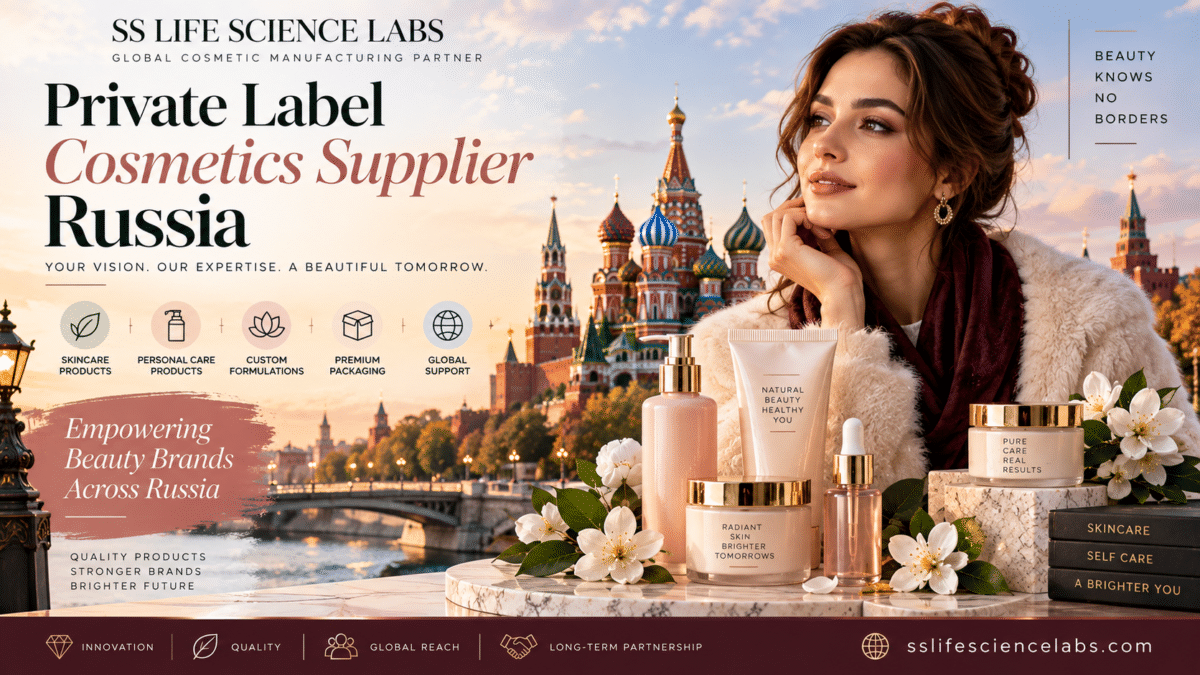
Private Label Cosmetics Supplier Russia: Product Sourcing Guide for Beauty Brands
Russia is a large and diverse market for businesses operating in beauty, skincare, cosmetics, personal care, body care, and wellness. For brands planning to enter or expand within the Russian beauty market, product sourcing is an important part of building a sustainable business. The right manufacturing partner can help a brand develop a consistent product portfolio while supporting customization, packaging, production planning, and future product expansion.
Choosing a Private Label Cosmetics Supplier in Russia can be useful for businesses that want to create products under their own brand identity. Instead of establishing a complete manufacturing facility, a beauty business can work with an experienced cosmetic manufacturer to develop or source products according to its requirements.
However, supplier selection should not be based only on product price. Beauty brands should consider product quality, formulation capabilities, customization, minimum order quantity, samples, packaging, manufacturing capacity, communication, and long-term scalability before making a sourcing decision.
For international beauty businesses, the manufacturing partner does not necessarily need to be located in Russia. An India-based cosmetic manufacturer can also work with international brands when the applicable product, labeling, documentation, shipping, import, and market requirements are properly addressed.
SS Life Science Labs is an India-based cosmetic manufacturer offering private label and customized cosmetic product solutions across categories such as skincare, personal care, body care, and aromatherapy-related products.
What Is a Private Label Cosmetics Supplier Russia?
A Private Label Cosmetics Supplier Russia can support businesses that want to sell cosmetic and beauty products under their own brand identity.
Depending on the manufacturer’s capabilities, private label services can include product selection, formulation support, customization, samples, packaging, manufacturing, and repeat production.
For startups, private label manufacturing can provide a way to develop a branded product range without building their own manufacturing facility.
For established businesses, it can provide an additional sourcing option when they want to expand their existing portfolio.
The exact level of customization and manufacturing support differs from one supplier to another, so brands should clearly communicate their requirements before choosing a manufacturing partner.
Why Private Label Can Work for Beauty Brands
Private label allows a business to create a product portfolio around its own brand.
A company may begin with a small number of products and gradually expand after understanding customer response.
For example, a skincare brand may start with a cleanser and serum before adding moisturizers, creams, masks, or body care products.
This approach can make product planning easier and help the brand establish a clear identity.
A private label model can also allow businesses to focus more of their resources on branding, marketing, distribution, customer service, and sales while working with a manufacturing partner for production.
Businesses researching private label manufacturing can explore the Private Label Cosmetics Supplier page for additional information about private label and customized cosmetic solutions.
Understanding the Russian Beauty Product Market
Before selecting a supplier, a business should define its target customer and product category.
Russia covers a large geographic area and includes different customer segments, price points, beauty preferences, and retail channels.
A premium skincare brand may have a different target customer from a mass-market personal care business.
Similarly, a wellness-focused company may require a different product portfolio from a cosmetics brand.
The first step should therefore be understanding the intended customer and deciding which products are most relevant.
Once the product direction is clear, the business can shortlist manufacturers according to its requirements.
Cosmetic Products Supplier Russia: What Should Brands Check?
Businesses searching for a Cosmetic Products Supplier Russia should evaluate more than the supplier’s catalogue.
The manufacturing partner should be assessed according to the products required, production expectations, customization needs, packaging requirements, and future plans.
Brands should also understand how samples are handled and whether the supplier can support repeat production.
A supplier that can meet the requirements of an initial order but cannot support future expansion may not be suitable for a growing product portfolio.
Cosmetic Supplier Evaluation Checklist
| 🔍 Evaluation Area | 💎 What Beauty Brands Should Check |
|---|---|
| Product Range | Skincare, personal care, body care, hair care, wellness and other required categories |
| Product Quality | Consistency and manufacturing standards |
| Customization | Formulation, fragrance, product and packaging options |
| MOQ | Minimum quantity required for production |
| Samples | Availability of samples before bulk production |
| Packaging | Options suitable for the brand’s identity and product |
| Production Capacity | Ability to handle current and future order volumes |
| Communication | Clear and responsive communication |
| Scalability | Ability to support new products and larger future orders |
Product Quality Should Be a Priority
Beauty products are directly connected to customer experience.
A brand can invest heavily in marketing, but if customers receive inconsistent products, it can affect their confidence in the brand.
For this reason, businesses should understand how a manufacturer approaches product development and quality consistency.
Samples can be particularly useful before placing a larger production order.
Depending on the product category, brands can evaluate texture, appearance, fragrance, application, packaging, and overall product experience.
If changes are required, they can be discussed before larger-scale production.
Importance of Product Samples
Product samples provide a practical way to evaluate a potential product before committing to larger quantities.
A brand can compare different samples and determine whether a product fits its positioning.
For skincare, businesses may review factors such as texture, absorption, fragrance, finish, and packaging.
For body care or personal care products, application and overall user experience may also be important.
Sampling can therefore become an important part of the product sourcing process.
Understanding MOQ
MOQ means Minimum Order Quantity.
It refers to the minimum quantity that a manufacturer requires for a specific product or production order.
MOQ can influence the initial investment required by a new beauty business.
A startup may want a manageable quantity while an established business may need larger volumes.
There is no single MOQ that is suitable for every business.
The appropriate quantity depends on expected demand, budget, storage capacity, sales channels, product category, and launch strategy.
Brands should understand MOQ requirements before finalizing their product portfolio.
Building a Russian Beauty Product Portfolio
A beauty business entering Russia does not necessarily need to launch dozens of products.
A focused product portfolio can make it easier to establish a clear brand identity.
For example, a skincare brand might begin with:
Cleanser → Serum → Moisturizer → Cream
After establishing its initial range, the brand can consider adding body care, hair care, wellness, or other complementary categories.
The product expansion should be based on customer needs and business performance.
A manufacturing partner should ideally be able to support this progression.
Skincare Product Opportunities
Skincare can be an important category for beauty brands looking to build a private label portfolio.
Depending on the manufacturer’s capabilities, brands can develop products such as cleansers, serums, moisturizers, creams, masks, oils, and other skincare products.
The most important consideration is whether the product range has a clear purpose for the intended customer.
A business should avoid selecting products simply because they are available from a supplier.
Instead, each product should have a role within the overall brand strategy.
Businesses researching skincare manufacturing can explore the Skin Care Product Manufacturer category from SS Life Science Labs.
Personal Care and Body Care Products
Beauty brands can also consider personal care and body care as complementary categories.
Depending on the brand’s positioning, these products can expand the customer’s relationship with the brand beyond facial skincare.
Possible categories may include body care, hand and foot care, hair care, wellness products, and other personal care solutions.
The manufacturer should be able to explain which categories it supports and what customization options are available.
A clear product roadmap can then help the brand decide which categories to introduce first.
Packaging and Product Presentation
Packaging plays an important role in the overall customer experience.
Customers often see a product’s packaging before they use the product itself.
For a private label brand, packaging can also help create a recognizable identity across multiple products.
A brand may use consistent colors, typography, bottle styles, labels, and design elements to connect products within the same collection.
However, packaging should also remain practical.
Businesses should consider product protection, storage, transportation, labeling space, usability, and the intended distribution model.
Private Label Cosmetics Supplier Middle East and Russia
Some beauty brands may research Russia as part of a broader international sourcing or expansion strategy.
A business that is already researching Middle Eastern markets may also consider other international opportunities.
For example, brands can compare product sourcing strategies across Russia, the Middle East, Europe, Asia, and other regions.
Businesses researching Middle Eastern private label opportunities can read the Private Label Cosmetics Supplier Middle East guide for additional information.
The important point is that every target market should be evaluated according to its own customer, commercial, product, and market requirements.
Expanding From Russia to Other International Markets
A beauty brand may eventually want to expand beyond one market.
Once the core product portfolio is established, the business can evaluate other destinations based on its long-term strategy.
Potential markets may include the UK, USA, Europe, Australia, UAE, Saudi Arabia, Canada, Germany, Italy, South Korea, Malaysia, Vietnam, and China.
Each market can have different customer expectations, labeling requirements, import considerations, distribution models, and commercial conditions.
A manufacturing partner that can support a growing product portfolio may therefore be useful for an international beauty business.
Private Label Cosmetics Supplier USA
The USA can be another destination for brands developing an international beauty strategy.
Businesses entering the US market may explore skincare, cosmetics, personal care, wellness, and other beauty categories depending on their target customer.
Supplier selection should continue to focus on product quality, customization, samples, MOQ, packaging, production capabilities, and scalability.
Brands researching this market can explore the Private Label Cosmetics Supplier USA guide for additional information.
Private Label Cosmetics Supplier UK
The UK can also be considered by beauty businesses developing an international product portfolio.
A brand planning UK expansion should understand its customer, product category, pricing position, packaging requirements, and distribution strategy.
The manufacturing partner should also be able to support the brand’s product requirements and future expansion plans.
Businesses researching UK private label opportunities can explore the Private Label Cosmetics Supplier UK guide.
Private Label Cosmetics Supplier Europe
European markets can provide additional opportunities for businesses developing international beauty brands.
However, Europe should not necessarily be treated as one identical market.
Customer preferences and applicable requirements can vary between countries.
Brands should therefore identify their specific target market before developing a detailed product strategy.
Businesses researching European opportunities can read the Private Label Cosmetics Supplier Europe guide for additional supplier research.
Private Label Cosmetics Supplier Australia
Australia can also be part of a broader international beauty expansion strategy.
A brand may begin with one market and gradually introduce its product range to additional countries.
Businesses should evaluate each target market individually while maintaining consistency in their core brand identity.
For Australia-focused supplier research, brands can explore the Private Label Cosmetics Supplier Australia guide.
Private Label Cosmetics Supplier Saudi Arabia
Saudi Arabia is another market that beauty brands may research when developing an international strategy.
Businesses interested in Saudi Arabia can evaluate skincare, personal care, body care, cosmetics, and wellness opportunities based on their intended customers.
The supplier-selection process remains similar: evaluate quality, samples, MOQ, customization, packaging, production capacity, and scalability.
Brands researching this market can read the Beauty Products Supplier Saudi Arabia guide for additional information.
Private Label Cosmetics Supplier UAE
The UAE can also be relevant for beauty businesses looking at Middle Eastern markets.
Brands can explore private label opportunities across skincare, personal care, body care, wellness, and other categories.
A clear product strategy is important because the same product portfolio may not necessarily be suitable for every target market.
Businesses researching UAE opportunities can explore the Private Label Cosmetics Supplier UAE guide.
International Product Sourcing From India
A brand targeting Russia or another international market does not necessarily need its manufacturing partner to be located in the same country.
India is another potential sourcing location for businesses looking for cosmetic manufacturing and private label solutions.
An India-based manufacturer can work with international brands when the required product, documentation, packaging, shipping, import, and other applicable market requirements are properly addressed.
For international businesses, the manufacturer’s capabilities should be evaluated based on the actual requirements of the product and target market.
How SS Life Science Labs Supports Beauty Product Development
SS Life Science Labs is an India-based cosmetic manufacturer offering private label and customized product solutions.
Its product categories include skincare, personal care, body care, and aromatherapy-related products.
For an international brand, the manufacturer can be evaluated according to its specific product requirements, customization needs, packaging expectations, production requirements, and future product roadmap.
A business planning to enter Russia can therefore consider its manufacturing options while also planning for potential expansion into additional international markets.
Private Label vs OEM vs ODM
Beauty businesses may come across different manufacturing models when researching suppliers.
Private label, OEM, and ODM can involve different levels of product development and customization depending on the manufacturer.
Private Label vs OEM vs ODM
| 🏷️ Model | ⚙️ General Approach | 🎯 Suitable For |
|---|---|---|
| Private Label | Products are offered under the brand’s identity with available customization options | Startups and growing beauty brands |
| OEM | Products are developed according to specific brand requirements | Brands seeking greater customization |
| ODM | Supplier-supported product development using established concepts | Businesses looking for development support |
The right model depends on the brand’s product requirements, budget, desired customization, and involvement in product development.
Developing a Strong Product Sourcing Strategy
A successful sourcing strategy begins before contacting suppliers.
The business should first define its target audience and product category.
Next, it should identify the products required for the initial launch.
After that, it can shortlist manufacturers and compare their capabilities.
Samples can then be reviewed before larger production.
Once the products are finalized, the business can work on packaging, branding, inventory, distribution, and marketing.
A structured process can help reduce unnecessary product decisions and make the launch more manageable.
Common Mistakes When Choosing a Cosmetic Supplier
Choosing Only Based on Price
The lowest price does not necessarily provide the best overall value.
Quality, MOQ, customization, packaging, communication, and production capacity should also be considered.
Launching Too Many Products
A large catalogue can create unnecessary inventory pressure and make it difficult to establish a clear brand identity.
Skipping Samples
Moving directly into bulk production without evaluating samples can create avoidable product risk.
Ignoring Packaging
Packaging should support the brand identity while also protecting the product and supporting transportation and storage.
Not Planning Future Expansion
A supplier should ideally be evaluated according to both current and future product requirements.
Ignoring Market-Specific Requirements
Businesses targeting Russia or other international markets should research and address the applicable requirements before commercial launch.
Building a Scalable Beauty Brand
A scalable beauty business can begin with a focused product range and gradually expand.
One possible approach is:
Market Research → Product Selection → Supplier Shortlisting → Sampling → Branding → Packaging → Production → Launch → Customer Feedback → Product Expansion
This process can help the business understand what works before investing heavily in a wider portfolio.
The manufacturing partner can become an important part of this process by supporting product development and repeat production.
Frequently Asked Questions
What should I look for in a Private Label Cosmetics Supplier Russia?
Look at product quality, customization, MOQ, samples, packaging, production capacity, communication, and scalability. The supplier should also be able to support the specific products required by your brand.
Can an international brand work with an India-based cosmetic manufacturer for Russia?
Yes. An international brand can consider an India-based manufacturer when the supplier can support the required products and the business properly addresses applicable Russian market, product, labeling, documentation, shipping, and import requirements.
What is a private label cosmetics supplier?
A private label cosmetics supplier helps businesses develop or source cosmetic products that are sold under the business’s own brand identity. Services can vary and may include product selection, customization, samples, packaging, and manufacturing.
Is private label suitable for a new beauty brand?
Private label can be a practical option for startups because it allows a business to build branded products without establishing its own manufacturing facility.
What products can I develop with a private label supplier?
Depending on the manufacturer’s capabilities, businesses can explore skincare, personal care, body care, hair care, wellness, aromatherapy, lip care, men’s grooming, and other beauty-related products.
Why should I request samples before placing a bulk order?
Samples allow the brand to evaluate the product before committing to larger production. Depending on the product, brands can review texture, appearance, fragrance, application, packaging, and overall product experience.
What does MOQ mean?
MOQ means Minimum Order Quantity. It is the minimum quantity a manufacturer requires for a particular product or production order.
How many products should a new beauty brand launch?
There is no fixed number. A focused range can be easier to manage for a new business, especially when the brand is still testing customer response.
Can one manufacturer provide skincare and personal care products?
Some manufacturers support multiple product categories, while others specialize in specific areas. Businesses should confirm the manufacturer’s capabilities before planning a multi-category portfolio.
Can a Russian beauty brand work with an overseas manufacturer?
An international manufacturing arrangement can be considered, but the business should properly evaluate the applicable product, labeling, documentation, import, shipping, and other market requirements.
Can I expand my beauty brand from Russia to other markets?
Yes. A brand can develop an international expansion strategy covering markets such as the USA, UK, Europe, Australia, UAE, Saudi Arabia, Canada, Germany, Italy, South Korea, Malaysia, Vietnam, and China. Each market should be researched separately.
What is the difference between private label, OEM and ODM?
Private label generally focuses on products sold under a brand’s own identity, while OEM can involve products developed according to specific requirements and ODM can involve supplier-supported product development. Exact services differ between manufacturers.
How important is packaging for a private label brand?
Packaging is important because it protects the product and contributes to the brand’s identity. Consistent packaging can also make multiple products feel like part of one collection.
Can SS Life Science Labs support international beauty brands?
SS Life Science Labs is an India-based cosmetic manufacturer offering private label and customized cosmetic solutions across categories including skincare, personal care, body care, and aromatherapy-related products. International businesses can evaluate its capabilities according to their specific product and target-market requirements.
Conclusion
Building a beauty brand for the Russian market requires more than finding a product supplier. Businesses should develop a clear product strategy, understand their target customer, evaluate product quality, review samples, consider MOQ, plan packaging, and choose a manufacturing partner that can support future growth.
For businesses researching a Private Label Cosmetics Supplier Russia, supplier selection should be based on the complete manufacturing relationship rather than price alone.
An India-based cosmetic manufacturer can also be considered by international beauty businesses when its product capabilities and supply process match the requirements of the intended market.
As the brand grows, it can evaluate additional markets such as the USA, UK, Europe, Australia, UAE, Saudi Arabia, Canada, Germany, Italy, South Korea, Malaysia, Vietnam, and China. Each market should be evaluated separately according to its customer expectations and applicable business requirements.
SS Life Science Labs provides private label and customized cosmetic product solutions across skincare, personal care, body care, and aromatherapy-related categories.
For beauty businesses planning to build a product line for Russia or expand internationally, selecting a manufacturing partner with suitable product capabilities, customization options, production support, and scalability can be an important part of long-term product sourcing.
Related Reading
For businesses researching the USA market, explore the Private Label Cosmetics Supplier USA guide for additional product sourcing information.
Brands researching UK opportunities can read the Private Label Cosmetics Supplier UK guide for further international supplier research.
For European beauty market planning, explore the Private Label Cosmetics Supplier Europe guide.
Businesses exploring Australia can read the Private Label Cosmetics Supplier Australia guide for additional information.
For Middle Eastern opportunities, explore the Private Label Cosmetics Supplier Middle East resource.
For Saudi Arabia-focused research, read the Beauty Products Supplier Saudi Arabia guide.
For UAE-focused supplier research, explore the Private Label Cosmetics Supplier UAE guide.