
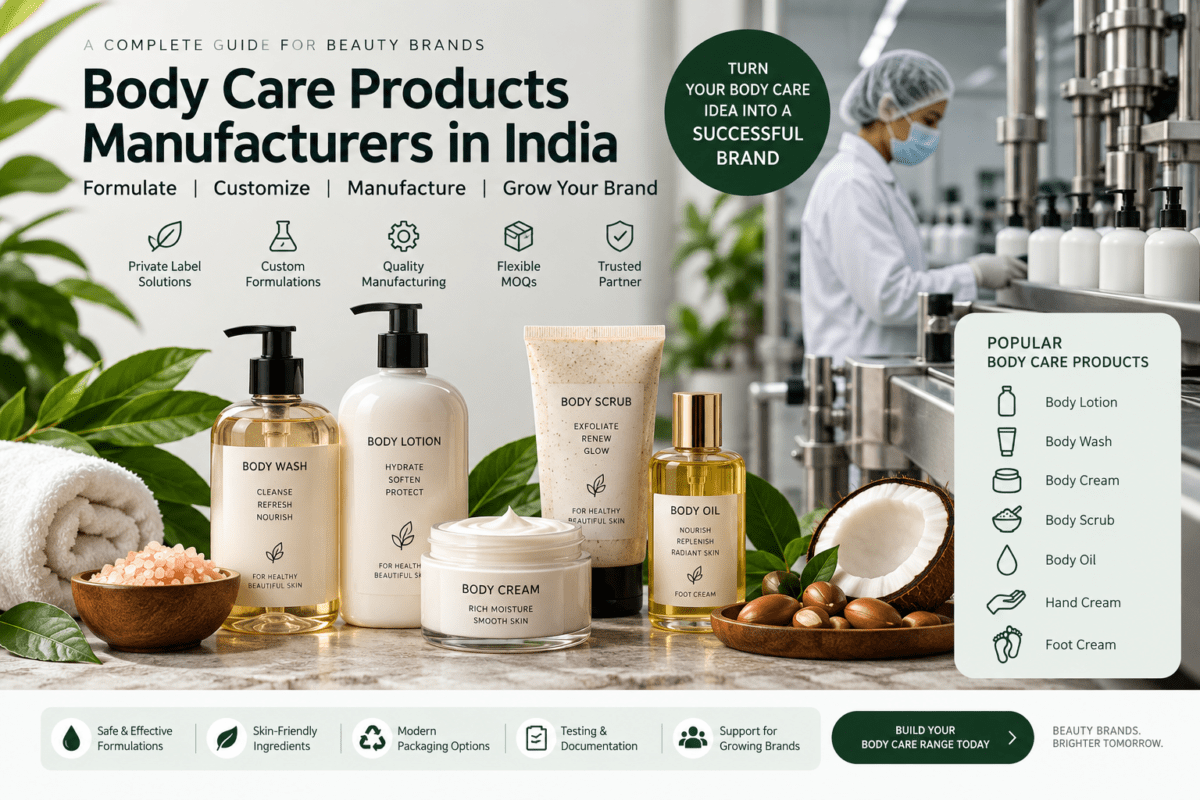
Body Care Products Manufacturers in India: Private Label Guide for Beauty Brands 2026
Body care products manufacturers in India help beauty brands develop private label lotions, body washes, scrubs, creams and other personal care products. From formulation and sampling to MOQ, packaging, quality checks and bulk production, choosing the right manufacturing approach can make launching a body care range more manageable. This guide explains the complete process, current product opportunities, important cost considerations and practical questions to ask before selecting a manufacturing partner.
Body care has evolved beyond basic cleansing and moisturization. Customers now pay closer attention to ingredients, texture, fragrance, skin comfort and the experience a product provides during everyday use. For beauty brands, this creates opportunities to develop focused collections that meet specific customer needs rather than offering a large assortment without a clear purpose.
However, launching a successful body care range requires more than selecting attractive packaging. Brands must understand their target audience, evaluate formulations, plan production quantities, review quality requirements and establish a realistic commercial strategy. Whether you are starting a new business or expanding an existing beauty portfolio, the following guide will help you make more informed manufacturing decisions.
What Do Body Care Products Manufacturers Do?
Body care products manufacturers develop and produce cosmetic products intended for use on the body, including lotions, creams, body washes, scrubs, oils and other personal care formulations. Depending on their facilities and expertise, manufacturers may provide formulation development, raw material sourcing, sampling, testing, filling, packaging and bulk production.
A manufacturing partner translates an approved product specification into a consistent finished product. The brand is responsible for defining its customer, product positioning, commercial objectives and marketing strategy. Both parties need clear communication so that the finished product meets the agreed requirements.
For example, a brand may want to launch a lightweight body lotion for customers who prefer non-greasy daily moisturization. The manufacturer can discuss suitable formulation options, ingredient considerations, packaging compatibility and production requirements. The brand then evaluates samples and approves the final product before commercial manufacturing.
Businesses that do not operate their own production facility can explore private label cosmetics supplier in India services to develop and manufacture products under their own brand name.
Private Label, OEM and Custom Formulation
Private label manufacturing commonly involves selecting an established formulation and selling it under your own brand. OEM manufacturing may involve producing products according to agreed specifications, while custom formulation focuses on developing a formula around a particular product brief.
These terms are not always used identically by every supplier. A brand should confirm exactly what is included, which elements can be customized and who is responsible for formulation ownership, testing and documentation.
A startup may prefer a suitable existing formulation to reduce development complexity. An established brand may invest in custom formulation to create a distinctive texture, fragrance profile or ingredient positioning. Neither approach is automatically better; the right choice depends on business goals.
Table 1: Private Label vs OEM vs Custom Formulation
| Factor | Private Label | OEM Manufacturing | Custom Formulation |
|---|---|---|---|
| Starting point | Existing or established formula | Agreed product specifications | New product brief |
| Customization | Usually limited to available options | Depends on agreement | Extensive, subject to feasibility |
| Development work | Generally lower | Varies by project | Generally higher |
| Sampling | Product and available variations | Specification-based samples | Multiple development stages may be needed |
| Time to launch | Often shorter | Depends on requirements | Often longer due to development |
| Best suited for | Brands seeking a simpler launch | Brands with defined requirements | Brands seeking distinctive formulations |
| Main consideration | Product differentiation | Clear technical specifications | Development cost and testing |
The actual timeline and customization level depend on the manufacturer and product. For a more detailed explanation of these models, read private label vs OEM vs ODM cosmetics.
Body Care Products You Can Develop for Your Brand
A successful body care collection should be built around customer needs and a clear brand identity. Launching too many products at once can increase inventory, packaging and marketing complexity. A focused range allows the brand to evaluate customer response before expanding.
Body Lotions and Moisturizing Creams
Body lotions are commonly designed for daily moisturization and a comfortable skin feel. They may be positioned around lightweight hydration, richer nourishment, fragrance preferences or particular skin-type needs.
During development, brands should evaluate absorption, spreadability, residue, fragrance and performance under different usage conditions. A lotion intended for warm climates may require a different sensory profile from a rich cream designed for customers who prefer heavier moisturization.
Body creams often have a richer texture, but the distinction should be based on the actual formulation rather than the product name alone. Packaging may include pumps, tubes or jars, depending on viscosity and intended use.
Body Washes and Shower Gels
Body washes combine cleansing performance with sensory experience. Customers may prefer gentle cleansing, a refreshing fragrance, creamy foam or fragrance-free options.
Important development considerations include cleansing performance, foam, rinsing, skin feel, fragrance stability and packaging compatibility. Products positioned for sensitive skin require appropriate formulation and claim substantiation.
A body wash can also be paired with a matching lotion to create a simple two-product routine. This may help brands develop a cohesive collection without launching too many SKUs.
Body Scrubs and Exfoliating Products
Body scrubs may use physical exfoliating particles, chemical exfoliating ingredients or a combination of approaches. The appropriate formulation depends on the intended use, target customer and desired product experience.
Brands should not assume that stronger exfoliation is always better. Particle characteristics, ingredient concentration, usage instructions and skin tolerance all matter. Claims about exfoliation or skin appearance should be supported by appropriate evidence.
A scrub can complement a moisturizing product, but the brand should provide clear directions and avoid encouraging excessive use.
Body Oils
Body oils may be positioned around massage, skin conditioning, fragrance or a particular sensory experience. Their appeal often depends on spreadability, absorption, oil blend and the overall feel after application.
Packaging requires careful consideration because oils may interact differently with pumps, droppers, closures and labels. Compatibility and stability should be evaluated before the final container is approved.
For brands exploring a separate wellness or fragrance-led product line, aromatherapy oils supplier solutions may be relevant. Essential oils should be used at appropriate levels with suitable safety assessment, and therapeutic claims should not be assumed.
Hand and Foot Care
Hand creams, foot creams and targeted moisturizing products can help brands expand beyond a basic body lotion. These products may focus on convenience, richer textures or specific usage occasions.
A hand cream may benefit from a compact tube and fast-absorbing formula, while a foot cream may be designed with a richer texture. The final positioning should reflect the product’s actual characteristics.
Table 2: Body Care Product Comparison
| Product Type | Main Purpose | Customer Positioning | Key Manufacturing Focus |
|---|---|---|---|
| Body Lotion | Daily moisturization | Everyday body care | Texture, absorption, fragrance |
| Body Cream | Rich moisturization | Nourishing body care | Richness, spreadability |
| Body Wash | Cleansing | Daily shower routine | Mildness, foam, rinsing |
| Body Scrub | Exfoliation | Periodic body care | Exfoliant selection, skin tolerance |
| Body Oil | Conditioning or massage | Sensory or premium range | Oil blend, absorption |
| Hand Cream | Targeted moisturization | Convenient portable care | Fast absorption, packaging |
| Foot Cream | Rich targeted care | Foot-care routine | Texture, application and claims |
A new brand does not need to launch every category. Two or three complementary products can provide a clearer starting point and allow the business to learn from customer feedback.
Brands that already operate in facial skincare can explore complementary body products through a skin care product manufacturer partnership, while ensuring that facial and body formulations are appropriate for their intended uses.
Body Care Trends and Product Opportunities for 2026
Body care product development in 2026 is influenced by ingredient awareness, skin comfort, sensory experience and the desire for practical daily routines. Trends can help identify opportunities, but they should not replace customer research, formulation expertise or testing.
Barrier-Support and Hydration-Focused Body Care
Ingredients such as ceramides, glycerin, niacinamide and urea are increasingly discussed in relation to body moisturization and skin-conditioning products. These ingredients may be considered for particular cosmetic benefits depending on the formula, concentration and applicable claims.
A brand should not add an ingredient simply because it is trending. The complete formulation, intended customer and desired performance matter more than a long ingredient list.
For example, a lightweight lotion may be appropriate for customers who dislike heavy textures, while a richer cream may appeal to those who prefer a more nourishing feel. Both can be useful products when developed for a clear audience.
Gentle Exfoliation and Texture-Focused Products
Exfoliating body products remain an area of interest, but brands should focus on appropriate use and skin tolerance. Gentle scrubs, exfoliating lotions and other formats can be explored when supported by suitable formulation expertise.
The product brief should define the intended customer, frequency of use and desired cosmetic result. Instructions should be clear, and brands should avoid unsupported promises about treating medical skin conditions.
Fragrance and Sensory Experience
Fragrance can influence how customers perceive a body care product. Fresh, floral, warm, gourmand and fragrance-free options may appeal to different audiences, but preferences vary by market and customer segment.
A useful approach is to test a small number of fragrance directions with the intended audience rather than assuming one scent will appeal to everyone. Fragrance compatibility, stability and applicable safety requirements should be considered during development.
Packaging and Sustainability Considerations
Customers may also consider packaging convenience, recyclability and waste reduction. Refill formats, larger packs and simplified packaging can be explored where commercially and technically practical.
Sustainability claims should be specific and supportable. A package should not be described as environmentally friendly without considering its materials, recyclability, supply chain and actual disposal conditions.
For broader product-development inspiration, the existing article on trending skincare and haircare products provides additional context for brands considering expansion across personal care categories.
How Private Label Body Care Manufacturing Works
Understanding the manufacturing process helps brands prepare realistic briefs, avoid unnecessary revisions and communicate more effectively with production partners.
1. Define the Product Brief
The process begins with a clear description of the product you want to create. The brief should identify the product category, target customer, desired texture, fragrance preference, packaging format, intended price positioning and any specific ingredient requirements.
For example, “a premium body lotion” is too broad to guide development effectively. A more useful brief might describe a lightweight daily lotion for warm climates, with a non-greasy finish, a particular fragrance direction and a pump-bottle format.
The brand should also explain whether it prefers an existing formulation or requires custom development.
2. Review Formulation Options and Samples
The manufacturer may present suitable existing formulations or discuss a custom development process. Samples allow the brand to evaluate texture, fragrance, appearance, application and overall product experience.
Feedback should be specific. Instead of saying “make it better,” explain whether the lotion feels too heavy, absorbs too slowly or has a fragrance that is too strong.
Multiple revisions may be necessary, especially for customized products. The scope, costs and timeline for additional samples should be agreed upon in advance.
3. Confirm Testing and Product Specifications
Before bulk production, the parties should agree on the final product specification and appropriate testing requirements. Depending on the product, this may include stability, microbiological, preservative efficacy, packaging compatibility or other relevant assessments.
Testing requirements depend on formulation, intended use, packaging and applicable regulations. A brand should ask what testing has been completed, what remains necessary and which documents will be provided.
This stage is particularly important when introducing new ingredients, changing packaging or making performance claims.
4. Approve Packaging and Artwork
Packaging should be selected for both appearance and functionality. A visually attractive bottle is not useful if the formula cannot be dispensed properly or the closure leaks during transport.
The manufacturer and brand should confirm container compatibility, fill volume, labeling space, artwork specifications and any applicable packaging requirements.
Artwork approval should include careful checking of ingredient information, usage directions, warnings, batch details and other required label information.
5. Plan Bulk Production
Once the formula, packaging and commercial terms are approved, the manufacturer can schedule production according to agreed requirements.
The brand should confirm the production quantity, raw material availability, packaging procurement, payment terms, quality checks and expected dispatch arrangements. Timelines should be documented rather than assumed.
Businesses that want a broader understanding of outsourced production can explore 3rd-party cosmetic manufacturing in India and its role in building a cosmetic brand without operating an in-house factory.
6. Review Finished Goods and Dispatch
Before dispatch, the brand should understand the agreed finished-goods inspection process, documentation and acceptance criteria.
The manufacturer should provide relevant batch or quality documentation as agreed, while the brand should verify quantities, packaging condition and delivery arrangements.
A clear process for handling damaged goods, quality concerns or discrepancies can prevent disputes after the order is delivered.
Choosing Ingredients and Formulations for Body Care
Ingredient selection should begin with the product’s intended purpose. A moisturizing lotion, cleansing wash and exfoliating scrub require different formulation approaches, even when they belong to the same brand.
Humectants and Moisturizing Ingredients
Humectants such as glycerin help attract and retain water in the skin. They are commonly used in moisturizing formulations, but their performance depends on the complete formula.
Emollients help improve skin feel and softness, while occlusive ingredients can help reduce moisture loss. A balanced moisturizer may combine different ingredient functions to achieve the desired texture and performance.
The brand should evaluate the finished product rather than judging quality solely by the number of ingredients listed on the label.
Ceramides, Niacinamide and Urea
Ceramides, niacinamide, and urea are examples of ingredients that may be considered in body care formulations. Their suitability depends on concentration, formulation compatibility, intended use and claim substantiation.
Urea, for instance, can serve different cosmetic functions depending on its concentration and formulation. Brands should discuss appropriate use with qualified formulation professionals rather than copying ingredient percentages from social media.
Similarly, niacinamide should not be included merely to make a product appear premium. The formulation should have a clear purpose and be evaluated for stability and performance.
Fragrance-Free and Sensitive-Skin Positioning
A fragrance-free product may appeal to customers who prefer to avoid added fragrance, but fragrance-free does not automatically mean suitable for every sensitive-skin user.
Claims such as hypoallergenic, dermatologist-tested or suitable for sensitive skin should be supported by appropriate evidence. Brands should understand the difference between a marketing preference and a substantiated product claim.
Formulation Compatibility Matters
Ingredients do not work independently. Preservatives, pH, emulsifiers, fragrances and packaging materials can all affect the final product.
A formulation that performs well in a laboratory sample may still require additional evaluation before commercial production. This is why testing and technical review are important parts of product development.
MOQ, Packaging and Cost Planning for a Body Care Range
Minimum order quantity, or MOQ, is the smallest production quantity a manufacturer is willing to accept under particular conditions. It can vary by product, formulation, packaging, and production arrangement.
There is no universal MOQ that applies to every body care manufacturer. Brands should request a quotation based on their actual requirements rather than relying on a general number found online.
What Affects Minimum Order Quantity?
MOQ may be influenced by batch size, equipment requirements, raw material purchasing quantities, packaging supplier minimums and the complexity of the formulation.
A standard formulation in commonly available packaging may have different commercial requirements from a customized product requiring special ingredients or a unique container.
Brands should ask whether MOQ applies per product, per fragrance, per packaging variation or to the total order. This distinction can significantly affect launch planning.
Understanding the Main Cost Components
The finished product cost may include formulation development, raw materials, manufacturing, testing, packaging, filling, labeling and logistics. Additional costs may apply depending on the agreed scope.
A low unit price does not necessarily mean a lower total project cost. For example, a custom bottle may require a larger packaging order, while a specialized formulation may involve additional development or testing expenses.
Requesting an itemized quotation makes it easier to compare options and understand what is included.
Table 3: Body Care Packaging Comparison
| Packaging Type | Suitable Products | Advantages | Things to Check |
|---|---|---|---|
| Pump Bottle | Lotion, body wash | Convenient dispensing | Pump compatibility, cost |
| Tube | Cream, lotion | Portable and convenient | Filling, sealing, leakage |
| Jar | Rich cream, selected scrubs | Easy product access | Hygiene, closure, compatibility |
| Flip-Top Bottle | Body wash, lotion | Easy daily use | Leakage resistance |
| Dropper Bottle | Selected body oils | Controlled dispensing | Viscosity, dropper suitability |
| Large Refill Pack | Selected washes or lotions | Refill and bulk positioning | Stability, handling, packaging compatibility |
The best packaging is not always the most expensive. It should protect the product, support convenient use and fit the brand’s commercial positioning.
Planning a Realistic Launch Budget
A launch budget should account for more than the first manufacturing invoice. Brands may need to consider sampling, artwork, packaging, testing, photography, marketing, logistics and inventory storage.
It is also sensible to reserve funds for unexpected revisions or delays. A smaller initial range can help reduce complexity while allowing the brand to test customer response.
For a broader supplier evaluation framework, read how to choose a private label cosmetics supplier before comparing quotations and manufacturing proposals.
Quality, Labeling and Documentation Checklist
Quality should be considered throughout product development rather than only after manufacturing is complete. Brands should understand the manufacturer’s quality processes and the documentation relevant to their products.
The exact requirements depend on the product, manufacturing location, intended market and applicable regulations. A manufacturer should be able to explain which documents and tests are relevant to the agreed product.
Product Specifications and Testing
A product specification may include appearance, fragrance, pH where relevant, viscosity, fill quantity and other appropriate acceptance criteria. Testing may address stability, microbiological quality, preservative effectiveness or packaging compatibility.
Not every test applies to every product in the same way. The appropriate testing plan should be determined by qualified professionals based on the formulation and intended use.
Labeling and Product Claims
Labels should be reviewed for applicable requirements relating to ingredients, manufacturer details, batch information, quantity, usage instructions, warnings and other mandatory declarations.
Brands should also ensure that marketing claims are accurate and supported. Statements such as “clinically proven,” “100% safe,” “chemical-free” or claims about treating skin diseases should not be used without appropriate substantiation and regulatory review.
Questions to Ask About Documentation
Before placing an order, ask what quality documents will be supplied, how batches are identified, how complaints are handled and what process applies if a product does not meet agreed specifications.
For export markets, additional requirements may apply. Brands should confirm destination-specific regulations and documentation before finalizing the product or packaging.
How to Choose the Right Body Care Manufacturing Partner
The right manufacturing partner should be evaluated on product-category capability, technical communication, quality processes and commercial transparency—not only on the lowest quotation.
Start by asking whether the manufacturer has experience with the type of body care product you intend to launch. A supplier that produces basic lotions may not necessarily have the same capabilities for specialized exfoliating products or complex custom formulations.
Request relevant samples and discuss how formulation changes are handled. Ask about testing, packaging support, production planning and the documentation available for your product.
Table 4: How to Compare Body Care Manufacturers
| Evaluation Factor | What to Check | Why It Matters |
|---|---|---|
| Product Experience | Similar body care products | Relevant category expertise |
| Samples | Texture, fragrance, finish | Helps evaluate product suitability |
| MOQ | Per SKU or total order | Affects initial investment |
| Formulation Support | Existing and custom options | Determines development flexibility |
| Testing | Relevant testing processes | Supports product quality |
| Packaging Support | Available formats and compatibility | Reduces development complications |
| Documentation | Batch and quality records | Supports traceability and compliance |
| Communication | Written timelines and terms | Reduces misunderstandings |
| Scalability | Repeat and larger orders | Supports future growth |
It is also important to understand how the manufacturer communicates during development. Clear responses, written specifications and realistic timelines can make the process easier to manage.
If your business operates in eastern India or is exploring regional manufacturing options, the existing guide to cosmetics company in Kolkata provides additional context on evaluating cosmetic manufacturing opportunities for beauty brands.
Evaluate the Complete Partnership
A manufacturer should be able to explain what is included in its service, which responsibilities remain with the brand and how changes to the approved product are managed.
Ask about production capacity, repeat-order planning and the process for addressing quality concerns. A reliable partnership depends on clear expectations and consistent execution.
For a broader overview of manufacturing capabilities and supplier considerations, explore the existing guide on cosmetic products manufacturer in India.
A Practical Launch Checklist for New Body Care Brands
A focused launch plan can help reduce unnecessary spending and make product development more organized.
- Define your target customer. Identify customer needs, preferred price range, buying habits and product expectations.
- Select your initial products. Choose two or three complementary products rather than launching a large, unfocused collection.
- Prepare a detailed product brief. Include texture, fragrance, packaging, positioning and formulation requirements.
- Discuss manufacturing options. Compare suitable private label and custom formulation approaches.
- Evaluate samples. Collect structured feedback and approve the final formulation before production.
- Confirm testing and documentation. Understand requirements relevant to your product and intended market.
- Finalize packaging and artwork. Check compatibility, labeling and commercial quantities.
- Review the quotation. Confirm MOQ, inclusions, payment terms, timelines and delivery arrangements.
- Plan marketing and distribution. Prepare product information, photography, sales channels and customer support.
- Monitor customer feedback. Use early sales and feedback to guide reorders and future product development.
A successful launch is not simply about getting products manufactured. It is about creating a range that customers understand, enjoy using and have a reason to purchase again.
Frequently Asked Questions
1. What is private label body care manufacturing?
Private label body care manufacturing allows a business to sell body care products under its own brand, using suitable existing or customized formulations produced by a manufacturing partner.
2. How can I start my own body care brand in India?
Start by identifying your target customers, selecting a focused product range, preparing a product brief, evaluating manufacturers, approving samples and planning packaging, compliance and distribution.
3. What is the MOQ for body care manufacturing?
MOQ varies by product, formulation, packaging and manufacturer. Request a quotation based on your specific requirements and confirm whether the minimum applies per SKU or to the total order.
4. Can I customize body lotion and body wash formulations?
Many manufacturers offer customization, but the available options depend on their capabilities. Discuss ingredients, texture, fragrance, packaging and testing requirements before approving development.
5. How long does private label body care manufacturing take?
Timelines depend on formulation development, sample approval, testing, packaging availability and production scheduling. Ask the manufacturer for a project-specific timeline rather than relying on a universal estimate.
6. What documents should I ask a body care manufacturer for?
Ask about relevant product specifications, testing records, batch documentation, manufacturing permissions and applicable quality or regulatory documents. Requirements vary by product and market.
7. Can I launch multiple body care products under one brand?
Yes. Many brands launch complementary products such as body wash and lotion. A focused initial range can simplify inventory, marketing and customer feedback.
8. What is the difference between private label and custom formulation?
Private label commonly uses an established formulation under your brand, while custom formulation involves developing a product around specific requirements. The exact scope should be confirmed with the manufacturer.
9. How do I choose packaging for body care products?
Consider formulation compatibility, dispensing, convenience, appearance, cost and labeling space. Packaging should be evaluated with the actual product before bulk production.
10. How do I choose reliable body care products manufacturers?
Evaluate relevant product experience, samples, quality processes, documentation, transparent quotations, communication and the ability to support your future production requirements.
Conclusion: Build a Body Care Range with a Clear Strategy
Choosing among body care products manufacturers requires more than comparing product catalogs or unit prices. A successful brand needs a clear customer focus, suitable formulations, reliable quality processes and a manufacturing arrangement that supports its commercial goals.
Start with a manageable product range, evaluate samples carefully and confirm the details of MOQ, packaging, testing and production before placing a bulk order. These steps can help reduce avoidable complications and create a stronger foundation for future growth.
SS Life Science Labs supports beauty brands exploring cosmetic manufacturing, private label and product-development solutions. To discuss your body care requirements, product ideas or manufacturing options, visit the cosmetic products manufacturer website and share your project brief with the team.
Related Reading
Explore these additional resources for broader manufacturing and beauty-industry insights:
- Private Label Cosmetics Supplier in India: Complete OEM & ODM Manufacturing Guide (2026) — Understand private label manufacturing services and the process of building a cosmetic brand.
- Skin Care Product Manufacturer: Complete Guide to Starting Your Skincare Range — Learn how to plan and develop a focused skincare collection.
- Top Trends Every Cosmetic Products Manufacturer in India Should Watch in 2026 — Explore broader product and manufacturing trends affecting beauty brands.
- Cosmetic Manufacturers in Hyderabad: Complete Guide for Beauty Brands 2026 — Review manufacturing considerations for brands exploring Hyderabad.
- Beauty Products Manufacturers in Mumbai: Complete Guide for Beauty Brands 2026 — Discover product-development and manufacturing considerations for Mumbai-based beauty businesses.
- Cosmetic Manufacturers in Vadodara: Complete Private Label & OEM Guide 2026 — Explore private label and OEM manufacturing considerations in Vadodara.